


b20 vtec vs 2.0L b18c


Honda-Tech Member
Joined: May 2005
Posts: 1,655
Likes: 0
From: Minneap
 Re: b20 vtec vs 2.0L b18c (realis9)
id say the sleeve b18C just because 1. its sleeved and 2. The R/S ratio, even though its small why not?Yea, when done properly and there are no associated problems, sleeved motors are more reliable 

Honda-Tech Member
Joined: Dec 2004
Posts: 786
Likes: 0
From: Canada
Re: b20 vtec vs 2.0L b18c (VTECommie)
<TABLE WIDTH="90%" CELLSPACING=0 CELLPADDING=0 ALIGN=CENTER><TR><TD>Quote, originally posted by VTECommie »</TD></TR><TR><TD CLASS="quote">id say the sleeve b18C just because 1. its sleeved and 2. The R/S ratio, even though its small why not?Yea, when done properly and there are no associated problems, sleeved motors are more reliable </TD></TR></TABLE>
See sig for answer to R/S ratio nonsense. Earl > You
I'd go with the sleeved motor, run an 85mm bore and an LS/B20 stroke crankshaft. Best of both worlds.
</TD></TR></TABLE>See sig for answer to R/S ratio nonsense. Earl > You
I'd go with the sleeved motor, run an 85mm bore and an LS/B20 stroke crankshaft. Best of both worlds.
Honda-Tech Member
Joined: May 2005
Posts: 1,655
Likes: 0
From: Minneap
Re: b20 vtec vs 2.0L b18c (tokes1320)
<TABLE WIDTH="90%" CELLSPACING=0 CELLPADDING=0 ALIGN=CENTER><TR><TD>Quote, originally posted by tokes1320 »</TD></TR><TR><TD CLASS="quote">
See sig for answer to R/S ratio nonsense. Earl > You
I'd go with the sleeved motor, run an 85mm bore and an LS/B20 stroke crankshaft. Best of both worlds.</TD></TR></TABLE> Even though id agree that in this situation the small difference would make a difference( ). Honda did change the R/s ratio in the B18c's for a reason right? What about the B16b, was that just a mistake? is it a coincidence that Bike engines and F1 engines all have R/S ratios above 2? i think not.
See sig for answer to R/S ratio nonsense. Earl > You
I'd go with the sleeved motor, run an 85mm bore and an LS/B20 stroke crankshaft. Best of both worlds.</TD></TR></TABLE> Even though id agree that in this situation the small difference would make a difference(
). Honda did change the R/s ratio in the B18c's for a reason right? What about the B16b, was that just a mistake? is it a coincidence that Bike engines and F1 engines all have R/S ratios above 2? i think not.
Honda-Tech Member
Joined: Dec 2004
Posts: 786
Likes: 0
From: Canada
Re: b20 vtec vs 2.0L b18c (VTECommie)
<TABLE WIDTH="90%" CELLSPACING=0 CELLPADDING=0 ALIGN=CENTER><TR><TD>Quote, originally posted by VTECommie »</TD></TR><TR><TD CLASS="quote"> Even though id agree that in this situation the small difference would make a difference( ). Honda did change the R/s ratio in the B18c's for a reason right? What about the B16b, was that just a mistake? is it a coincidence that Bike engines and F1 engines all have R/S ratios above 2? i think not.</TD></TR></TABLE>
The fact that bike engines have very high rod/stroke ratios has more to do with the physics of making the lightest possible rotating assembly rather than rod/stroke ratios. A 'Busa has a 63mm stroke and a 119mm rod for a 1.9:1 rod/stroke ratio. They could have built that bike with a 105mm rod no problems and it would rev as high as it does without any reliability issues. The problem? Then you need the piston compression height to be jacked up an additional half an inch to compensate, which makes for a heavier rotating assembly, and a less stable piston in the bore. That has nothing to do with aiming for a great rod/stroke ratio.
I can't say what was going through the minds of Hondas engineers when they built the B16B, but they are notorious for absolutely over-engineering things. The difference in rod lengths between a B16A and a B16B makes such a rediculously miniscule difference in side loading and how the motor acts as a whole that I really have no idea whey they spent extra time and money changing the block setup.
In any case, I'd rather have the few extra foot pounds of torque, something that you could actually notice and can see on paper, rather than some mythical superior rod/stroke ratio that isn't going to amount to anything in the seat of my pants when I mash the throttle.
). Honda did change the R/s ratio in the B18c's for a reason right? What about the B16b, was that just a mistake? is it a coincidence that Bike engines and F1 engines all have R/S ratios above 2? i think not.</TD></TR></TABLE>The fact that bike engines have very high rod/stroke ratios has more to do with the physics of making the lightest possible rotating assembly rather than rod/stroke ratios. A 'Busa has a 63mm stroke and a 119mm rod for a 1.9:1 rod/stroke ratio. They could have built that bike with a 105mm rod no problems and it would rev as high as it does without any reliability issues. The problem? Then you need the piston compression height to be jacked up an additional half an inch to compensate, which makes for a heavier rotating assembly, and a less stable piston in the bore. That has nothing to do with aiming for a great rod/stroke ratio.
I can't say what was going through the minds of Hondas engineers when they built the B16B, but they are notorious for absolutely over-engineering things. The difference in rod lengths between a B16A and a B16B makes such a rediculously miniscule difference in side loading and how the motor acts as a whole that I really have no idea whey they spent extra time and money changing the block setup.
In any case, I'd rather have the few extra foot pounds of torque, something that you could actually notice and can see on paper, rather than some mythical superior rod/stroke ratio that isn't going to amount to anything in the seat of my pants when I mash the throttle.
Trending Topics

Honda-Tech Member
Joined: May 2004
Posts: 4,517
Likes: 0
From: DR. 90210, CA, Breast Man
Re: b20 vtec vs 2.0L b18c (bon3z1201)
<TABLE WIDTH="90%" CELLSPACING=0 CELLPADDING=0 ALIGN=CENTER><TR><TD>Quote, originally posted by bon3z1201 »</TD></TR><TR><TD CLASS="quote">which is better a b20 vtec or a sleeved up b18c1... what is a safe compression ratio w everything else pretty much stock for a daily driver on 91 octane...</TD></TR></TABLE>
Sleeved B18c1.... Better crank, Better sized Rod bearings, No Oil line kit, Stronger Sleeves, Oil jets , block says b18c soo... people dont know your really 2.0L
Sleeved B18c1.... Better crank, Better sized Rod bearings, No Oil line kit, Stronger Sleeves, Oil jets , block says b18c soo... people dont know your really 2.0L
Honda-Tech Member
Joined: May 2005
Posts: 1,655
Likes: 0
From: Minneap
Re: b20 vtec vs 2.0L b18c (tokes1320)
<TABLE WIDTH="90%" CELLSPACING=0 CELLPADDING=0 ALIGN=CENTER><TR><TD>Quote, originally posted by tokes1320 »</TD></TR><TR><TD CLASS="quote">
The fact that bike engines have very high rod/stroke ratios has more to do with the physics of making the lightest possible rotating assembly rather than rod/stroke ratios. A 'Busa has a 63mm stroke and a 119mm rod for a 1.9:1 rod/stroke ratio. They could have built that bike with a 105mm rod no problems and it would rev as high as it does without any reliability issues. The problem? Then you need the piston compression height to be jacked up an additional half an inch to compensate, which makes for a heavier rotating assembly, and a less stable piston in the bore. That has nothing to do with aiming for a great rod/stroke ratio.
I can't say what was going through the minds of Hondas engineers when they built the B16B, but they are notorious for absolutely over-engineering things. The difference in rod lengths between a B16A and a B16B makes such a rediculously miniscule difference in side loading and how the motor acts as a whole that I really have no idea whey they spent extra time and money changing the block setup.
In any case, I'd rather have the few extra foot pounds of torque, something that you could actually notice and can see on paper, rather than some mythical superior rod/stroke ratio that isn't going to amount to anything in the seat of my pants when I mash the throttle.</TD></TR></TABLE>
Bikes have high r/s ratios for two reasons, the first, like u said is to lose weight, which however could be done in many different ways, for example lessening the deck height. The second is to give them the capabilities of revving to oblivion. Honda thought about it the same way. The difference in redline between the b16a and b16b is a mere 600rpm(8200 to 8800). However in this difference Honda decided that they needed a better R/s ratio to SAFELY achieve that. An Ls/Vtec can Rev there, no doubt its been done many times. However a b18c can do it and be reliable forever. Now, if you look at any of Honda's high revving machines, or high performance engines for that matter, they all have high rod stroke ratios. The b18b was not designed to handle the strains of 8,000+ rpm. It wasnt designed to be a high performance engine. So if honda puts tons of money into R&D and decides that the Higher R/s ratio the higher an engine can rev and make more power. Who am i gonna believe? no one on this site spends the kinda money Honda does on R&D. Im not saying Ls/Vtecs are bad, im just saying Poor Man's Type R's are better.
The fact that bike engines have very high rod/stroke ratios has more to do with the physics of making the lightest possible rotating assembly rather than rod/stroke ratios. A 'Busa has a 63mm stroke and a 119mm rod for a 1.9:1 rod/stroke ratio. They could have built that bike with a 105mm rod no problems and it would rev as high as it does without any reliability issues. The problem? Then you need the piston compression height to be jacked up an additional half an inch to compensate, which makes for a heavier rotating assembly, and a less stable piston in the bore. That has nothing to do with aiming for a great rod/stroke ratio.
I can't say what was going through the minds of Hondas engineers when they built the B16B, but they are notorious for absolutely over-engineering things. The difference in rod lengths between a B16A and a B16B makes such a rediculously miniscule difference in side loading and how the motor acts as a whole that I really have no idea whey they spent extra time and money changing the block setup.
In any case, I'd rather have the few extra foot pounds of torque, something that you could actually notice and can see on paper, rather than some mythical superior rod/stroke ratio that isn't going to amount to anything in the seat of my pants when I mash the throttle.</TD></TR></TABLE>
Bikes have high r/s ratios for two reasons, the first, like u said is to lose weight, which however could be done in many different ways, for example lessening the deck height. The second is to give them the capabilities of revving to oblivion. Honda thought about it the same way. The difference in redline between the b16a and b16b is a mere 600rpm(8200 to 8800). However in this difference Honda decided that they needed a better R/s ratio to SAFELY achieve that. An Ls/Vtec can Rev there, no doubt its been done many times. However a b18c can do it and be reliable forever. Now, if you look at any of Honda's high revving machines, or high performance engines for that matter, they all have high rod stroke ratios. The b18b was not designed to handle the strains of 8,000+ rpm. It wasnt designed to be a high performance engine. So if honda puts tons of money into R&D and decides that the Higher R/s ratio the higher an engine can rev and make more power. Who am i gonna believe? no one on this site spends the kinda money Honda does on R&D. Im not saying Ls/Vtecs are bad, im just saying Poor Man's Type R's are better.
Honda-Tech Member
Joined: Dec 2004
Posts: 786
Likes: 0
From: Canada
Re: b20 vtec vs 2.0L b18c (VTECommie)
<TABLE WIDTH="90%" CELLSPACING=0 CELLPADDING=0 ALIGN=CENTER><TR><TD>Quote, originally posted by VTECommie »</TD></TR><TR><TD CLASS="quote">
Bikes have high r/s ratios for two reasons, the first, like u said is to lose weight, which however could be done in many different ways, for example lessening the deck height. The second is to give them the capabilities of revving to oblivion. Honda thought about it the same way. The difference in redline between the b16a and b16b is a mere 600rpm(8200 to 8800). However in this difference Honda decided that they needed a better R/s ratio to SAFELY achieve that. An Ls/Vtec can Rev there, no doubt its been done many times. However a b18c can do it and be reliable forever. Now, if you look at any of Honda's high revving machines, or high performance engines for that matter, they all have high rod stroke ratios. The b18b was not designed to handle the strains of 8,000+ rpm. It wasnt designed to be a high performance engine. So if honda puts tons of money into R&D and decides that the Higher R/s ratio the higher an engine can rev and make more power. Who am i gonna believe? no one on this site spends the kinda money Honda does on R&D. Im not saying Ls/Vtecs are bad, im just saying Poor Man's Type R's are better.</TD></TR></TABLE>
Piston speed of a GSR/ITR motor at 9000 RPM's is 5150 FPS. Piston speed of an LS-dimensioned block at 9000 RPM's is an utterly cataclysmic 5256 FPS. 2% slower at 9000 RPM's. That is absolutely peanuts from an engineering standpoint when you're talking about stress placed on parts due to speed. This whole argument is absolutely rediculous, because the stroke we're talking about here again is again an absolutely tiny amount, worth only a couple ft-lbs of torque here and there, it's not like you're comparing a B16 to a 95mm stroker setup or an H22. LS crank makes a tiny amount more torque and I will take that any day, go find me one person on here running an LS/VTEC that has seen any kind of increased ring wear due to the rod/stroke ratio, it's a bogus argument when there are no realistic and measureable upsides to running the ITR/GSR crank.
Bikes have high r/s ratios for two reasons, the first, like u said is to lose weight, which however could be done in many different ways, for example lessening the deck height. The second is to give them the capabilities of revving to oblivion. Honda thought about it the same way. The difference in redline between the b16a and b16b is a mere 600rpm(8200 to 8800). However in this difference Honda decided that they needed a better R/s ratio to SAFELY achieve that. An Ls/Vtec can Rev there, no doubt its been done many times. However a b18c can do it and be reliable forever. Now, if you look at any of Honda's high revving machines, or high performance engines for that matter, they all have high rod stroke ratios. The b18b was not designed to handle the strains of 8,000+ rpm. It wasnt designed to be a high performance engine. So if honda puts tons of money into R&D and decides that the Higher R/s ratio the higher an engine can rev and make more power. Who am i gonna believe? no one on this site spends the kinda money Honda does on R&D. Im not saying Ls/Vtecs are bad, im just saying Poor Man's Type R's are better.</TD></TR></TABLE>
Piston speed of a GSR/ITR motor at 9000 RPM's is 5150 FPS. Piston speed of an LS-dimensioned block at 9000 RPM's is an utterly cataclysmic 5256 FPS. 2% slower at 9000 RPM's. That is absolutely peanuts from an engineering standpoint when you're talking about stress placed on parts due to speed. This whole argument is absolutely rediculous, because the stroke we're talking about here again is again an absolutely tiny amount, worth only a couple ft-lbs of torque here and there, it's not like you're comparing a B16 to a 95mm stroker setup or an H22. LS crank makes a tiny amount more torque and I will take that any day, go find me one person on here running an LS/VTEC that has seen any kind of increased ring wear due to the rod/stroke ratio, it's a bogus argument when there are no realistic and measureable upsides to running the ITR/GSR crank.



Senior Member
Joined: Jul 2005
Posts: 3,728
Likes: 0
From: Armonk, NY, USA
Re: b20 vtec vs 2.0L b18c (:Andrew)
The amount of power difference due to r/s ratio is negligible especially a 1.54 compared to a 1.58 BUT it wasn't an accident that Honda shrunk the LS bore down to 87mm--after all the LS motor was out 4 years before the gsr. I know lots of people have 89 stroke Ls-vtecs that have been running reliably for years and lots of miles. Honda thought the piston speed and side loading was enough to be problematic over 150,000 miles 8000 rpm and 89 stroke. I don't think their decision had anything to do with power. I would say for most people who are going to expect a high-performance ls-vtec motor to last 50,000-75,000 miles before a rebuild its fine. But for a production car like the GSR which was going to be purchased by alot of people who know nothing about cars--having a brand new production car last 75,000 miles was unacceptable. If I myself were doing a build like that I would go with an 87mm stroke--just for extra peace of mind. But it has been proven time and again that 89mm can reliably rev high for long periods of time--just maybe not as long as 87mm. As far as the sport bikes and F1 cars--at that point its necessity--F1 cars (at least the v10) rev to 18,000-19,000 rpm--I think they have r/s ratios of 2.2+--having an r/s ratio of 1.5 or 1.6 would simply not work for more than a couple of miles at rpm like that. Same with a sport bike--it wouldn't last very long--and the piston speeds would get so high that it probably would impact performance just from airflow to say nothing of the enormous friction.
Senior Member
Joined: Jul 2005
Posts: 3,728
Likes: 0
From: Armonk, NY, USA
Re: b20 vtec vs 2.0L b18c (d16dcoe45)
Your argument about the Busa is hilarious. You say a Busa has a 63mm stroke and a 119mm rod for a r/s ratio of about 1.89. Then you say they could have went with a 105mm rod and rev just as high and have no reliability issues. That would be a r/s ratio of 1.67. I am not too sure but I think the Busa in stock form maybe revs to 10,500 or 11,000? I don't know if it would work or last. What I do know is that you then say the reason they didn't put a 105mm rod is because then they have to jack up the compression height of the piston which will make it heavier. Agreed. But then you say the increased compression height will make it less stable in the bore--that is the exact opposite of the truth--it will be MORE stable with the taller compression height. The funniest part though, is if they decided to use a 105mm rod they wouldn't have to use increased compression height on the piston. Why? They would simply make the deck shorter--which would make the block lighter, and more compact. After all, they figure all this out when they are designing the motor--so why would they make a taller deck height to match the "shortened" rod? You are looking at it sort of "after the fact" As if the block was permanent and all of a sudden they realised they wanted a shorter rod--when in reality everything would have been designed together and when it was satisfactory--would go into production. The fact is--they made the rod longer because this is a production bike that is expected to last--and they probably figured they would get better reliabilty and a longer lasting motor with the longer rod.
Honda-Tech Member
Joined: May 2005
Posts: 1,655
Likes: 0
From: Minneap
Re: b20 vtec vs 2.0L b18c (d16dcoe45)
<TABLE WIDTH="90%" CELLSPACING=0 CELLPADDING=0 ALIGN=CENTER><TR><TD>Quote, originally posted by d16dcoe45 »</TD></TR><TR><TD CLASS="quote">The amount of power difference due to r/s ratio is negligible especially a 1.54 compared to a 1.58 BUT it wasn't an accident that Honda shrunk the LS bore down to 87mm--after all the LS motor was out 4 years before the gsr. I know lots of people have 89 stroke Ls-vtecs that have been running reliably for years and lots of miles. Honda thought the piston speed and side loading was enough to be problematic over 150,000 miles 8000 rpm and 89 stroke. I don't think their decision had anything to do with power. I would say for most people who are going to expect a high-performance ls-vtec motor to last 50,000-75,000 miles before a rebuild its fine. But for a production car like the GSR which was going to be purchased by alot of people who know nothing about cars--having a brand new production car last 75,000 miles was unacceptable. If I myself were doing a build like that I would go with an 87mm stroke--just for extra peace of mind. But it has been proven time and again that 89mm can reliably rev high for long periods of time--just maybe not as long as 87mm. As far as the sport bikes and F1 cars--at that point its necessity--F1 cars (at least the v10) rev to 18,000-19,000 rpm--I think they have r/s ratios of 2.2+--having an r/s ratio of 1.5 or 1.6 would simply not work for more than a couple of miles at rpm like that. Same with a sport bike--it wouldn't last very long--and the piston speeds would get so high that it probably would impact performance just from airflow to say nothing of the enormous friction.</TD></TR></TABLE> exactly, i never said that LS/VTEC's are bad or that they cannot rev to 8000+. All, Im saying is that R/S ratio does matter and is important to engine life/revability.

Honda-Tech Member
Joined: Jan 2002
Posts: 1,349
Likes: 0
From: On., Can.
Re: b20 vtec vs 2.0L b18c
to get the b18c to 2.0l you would need a wider than 84mm bore right? so wouldn't that create thinner walls between the cylinders. Honda went to some length with the b20 to make it reliable. how does sleeving handle the thin walls and cooling issues reliably?
d
d

Junior Member
Joined: Feb 2004
Posts: 323
Likes: 0
From: AZ, USA
Re: b20 vtec vs 2.0L b18c (daver)
this r/s argument is interesting. Of course they're gonna over engineer a motor b/c it has to have a warranty and it has to be extremely reliable, or else Honda wouldn't put their name on it.
Anywho, sleeved GSR FTW.
Anywho, sleeved GSR FTW.

Joined: Apr 2006
Posts: 176
Likes: 0
WTF does it matter how high it revs? I would recommend you finding another way to make power instead of increasing the RPM "safely". Fact is, there is no guarantee about safety when speaking of high RPM motors. If the B20 is in good condition, I'd go with that especially since your talking about a street car (I assume), otherwise reliability wouldn't be a factor. OEM is far more reliable than aftermarket sleeves, UNLESS those sleeves are top notch AND the B20 condition may be questionable. You can easily make 230+whp on stock sleeves and IF driven carefully and taken care of constantly, you can drive it daily for years. Use a good sizeable stroke in the car and use good mid-range/top-end cams to complement the motor. So where would you get the power? Surely not in compression or high revs. How about a medium compression of 11.5/1 and CFM. Port the head to 320+CFM, use .020 over Wiseco pistons, and eagle rods. OEM bearings and stock crank will do. Invest the money into your head, intake & exhaust manifold. Those are the key other than a damn good tuning. The idea is to keep as much stock as possible. I recommend aftermarket pistons such as Wiseco just because they will make more power given the same CR and CFM. Period. Eagle rods because they are cheap and durable. OEM bearings because the clearances can be better and stock crank of some sort because knife-edging and **** like that hurts the integrity of the assembly. 8500RPM's is plenty to make excellent streetable power levels.

Honda-Tech Member
Joined: Oct 2002
Posts: 669
Likes: 0
From: Las Vegas, NV, USA
Re: (WickedHonda00)
<TABLE WIDTH="90%" CELLSPACING=0 CELLPADDING=0 ALIGN=CENTER><TR><TD>Quote, originally posted by WickedHonda00 »</TD></TR><TR><TD CLASS="quote">
You can easily make 230+whp on stock sleeves ... </TD></TR></TABLE>
wow; is ths the all-motor forum, or the F/I forum? Do you really know what it takes to build a 230+whp n/a motor? I'm not trying to bust your chops, but there just are not that many 230+whp n/a B series motors out there.
You can easily make 230+whp on stock sleeves ... </TD></TR></TABLE>
wow; is ths the all-motor forum, or the F/I forum? Do you really know what it takes to build a 230+whp n/a motor? I'm not trying to bust your chops, but there just are not that many 230+whp n/a B series motors out there.

Honda-Tech Member
Joined: Sep 2001
Posts: 6,067
Likes: 0
From: socal, ca, US
Re: (Tomcat)
<TABLE WIDTH="90%" CELLSPACING=0 CELLPADDING=0 ALIGN=CENTER><TR><TD>Quote, originally posted by Tomcat »</TD></TR><TR><TD CLASS="quote">
wow; is ths the all-motor forum, or the F/I forum? Do you really know what it takes to build a 230+whp n/a motor? I'm not trying to bust your chops, but there just are not that many 230+whp n/a B series motors out there.</TD></TR></TABLE>
look out now...but here's a 91 octane pump gas NA setup

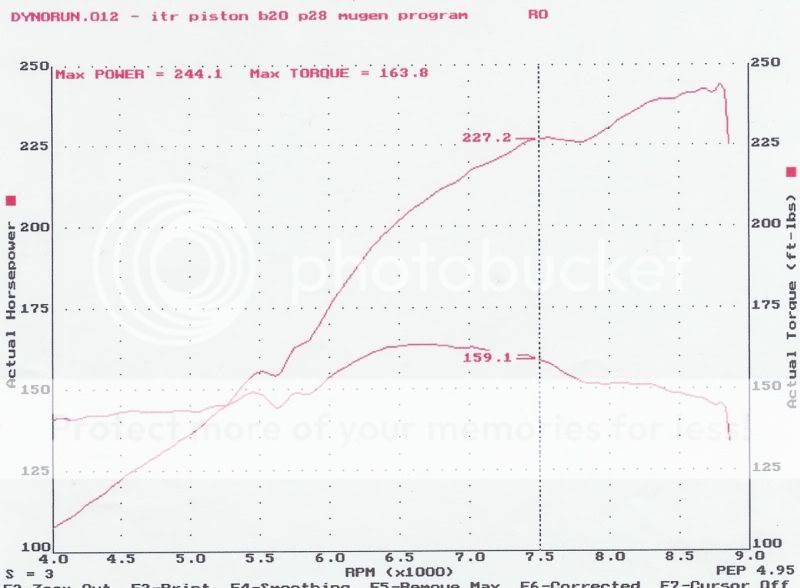
on stock B20B sleeves and RS ITR pistons. i think it made over 230 whp...sup now willis??
wow; is ths the all-motor forum, or the F/I forum? Do you really know what it takes to build a 230+whp n/a motor? I'm not trying to bust your chops, but there just are not that many 230+whp n/a B series motors out there.</TD></TR></TABLE>
look out now...but here's a 91 octane pump gas NA setup
on stock B20B sleeves and RS ITR pistons. i think it made over 230 whp...sup now willis??
Honda-Tech Member
Joined: May 2004
Posts: 4,517
Likes: 0
From: DR. 90210, CA, Breast Man
Re: (Tomcat)
<TABLE WIDTH="90%" CELLSPACING=0 CELLPADDING=0 ALIGN=CENTER><TR><TD>Quote, originally posted by Tomcat »</TD></TR><TR><TD CLASS="quote">wow; is ths the all-motor forum, or the F/I forum? Do you really know what it takes to build a 230+whp n/a motor? I'm not trying to bust your chops, but there just are not that many 230+whp n/a B series motors out there.</TD></TR></TABLE>
hmmmm check my sig.... stock b20 sleeves , 91 octane daily driver. 5 whp shy of 230 whp... And I am talking about dynojet numbers too.
IN our side of town there are plenty of 230+ whp b series on stock sleeves but they dont really post there numbers and setups online because they got better things too do
hmmmm check my sig.... stock b20 sleeves , 91 octane daily driver. 5 whp shy of 230 whp... And I am talking about dynojet numbers too.
IN our side of town there are plenty of 230+ whp b series on stock sleeves but they dont really post there numbers and setups online because they got better things too do
Honda-Tech Member
Joined: Oct 2002
Posts: 669
Likes: 0
From: Las Vegas, NV, USA
Re: (vivid 02)
<TABLE WIDTH="90%" CELLSPACING=0 CELLPADDING=0 ALIGN=CENTER><TR><TD>Quote, originally posted by vivid 02 »</TD></TR><TR><TD CLASS="quote">
hmmmm check my sig.... stock b20 sleeves , 91 octane daily driver. 5 whp shy of 230 whp... And I am talking about dynojet numbers too.
IN our side of town there are plenty of 230+ whp b series on stock sleeves but they dont really post there numbers and setups online because they got better things too do </TD></TR></TABLE>
Well you learn something new everyday. I guess I'll have to visit your side of town. It’s too bad they have better things to do, because I really enjoy seeing threads about these projects as they come together. That's one of the reasons I posted my ITR build; giving something back to Honda-Tech. 
<TABLE WIDTH="90%" CELLSPACING=0 CELLPADDING=0 ALIGN=CENTER><TR><TD>Quote, originally posted by acydphryck »</TD></TR><TR><TD CLASS="quote">look out now...but here's a 91 octane pump gas NA setup ... on stock B20B sleeves and RS ITR pistons. i think it made over 230 whp...sup now willis??</TD></TR></TABLE>
HaHa thanks for the education...
Modified by Tomcat at 10:36 PM 10/11/2006
hmmmm check my sig.... stock b20 sleeves , 91 octane daily driver. 5 whp shy of 230 whp... And I am talking about dynojet numbers too.
IN our side of town there are plenty of 230+ whp b series on stock sleeves but they dont really post there numbers and setups online because they got better things too do
</TD></TR></TABLE>Well you learn something new everyday. I guess I'll have to visit your side of town.
It’s too bad they have better things to do, because I really enjoy seeing threads about these projects as they come together. That's one of the reasons I posted my ITR build; giving something back to Honda-Tech. <TABLE WIDTH="90%" CELLSPACING=0 CELLPADDING=0 ALIGN=CENTER><TR><TD>Quote, originally posted by acydphryck »</TD></TR><TR><TD CLASS="quote">look out now...but here's a 91 octane pump gas NA setup
... on stock B20B sleeves and RS ITR pistons. i think it made over 230 whp...sup now willis??</TD></TR></TABLE>HaHa thanks for the education...
Modified by Tomcat at 10:36 PM 10/11/2006


Honda-Tech Member
Joined: Feb 2008
Posts: 736
Likes: 0
From: My Garage
Re: (vivid 02)
wow sounds nice...what kind of head did you run on that...so all you did was the RS ITR pistons...im thinking about doing this too...so let meh know wassup...and how fast did you run at the tracks...thanks...