


Argggh, how do you keep the electrode clean??!!?


Thread Starter
Joined: Jan 2006
Posts: 123
Likes: 0
 Argggh, how do you keep the electrode clean??!!?
Hey,
I'm having a heck of a time keeping the electrode from getting contaminated on my Miller Syncrowave w/Tigmate torch. I'm welding aluminum sheeting, 1/8th".
Any tips for a beginner? I basically have to take it out and regrind after each weld it seems. I'm making every effort not to touch the electrode to the weld puddle or the filler to the electrode, not sure what's I'm doing wrong.
Once regrinded I can make a puddle nice and neat and my bead quality goes way up but is it normal to have to regrind so often?
thanks
Fred
I'm having a heck of a time keeping the electrode from getting contaminated on my Miller Syncrowave w/Tigmate torch. I'm welding aluminum sheeting, 1/8th".
Any tips for a beginner? I basically have to take it out and regrind after each weld it seems. I'm making every effort not to touch the electrode to the weld puddle or the filler to the electrode, not sure what's I'm doing wrong.
Once regrinded I can make a puddle nice and neat and my bead quality goes way up but is it normal to have to regrind so often?
thanks
Fred

Honda-Tech Member
Joined: Feb 2005
Posts: 272
Likes: 0
From: Milford, CT, USA
Re: Argggh, how do you keep the electrode clean??!!? (Fred Allen Burge)
Is it getting contaminated or a balled end? The balling up is normal and will cause an arc thats a bit harder to control over a pointed electrode. If thats what its doing youll have to get used to it. If not then im not sure what to tell ya. Maybe clean the base metal better?

Joined: May 2002
Posts: 3
Likes: 1
From: banned NC
Re: Argggh, how do you keep the electrode clean??!!? (k20 jon)
you do NOT grind your tungssten to a point for Al.
make sure youre using green electrodes as well. non-thoriated.
the balled end is what you need to start off with. you get this by a few seconds of DC reverse arcing your electrode. then go back to AC HF...
contamination is material being deposited onto the electrode. youre just getting too close and probably dipping it in the puddle.
make sure youre using green electrodes as well. non-thoriated.
the balled end is what you need to start off with. you get this by a few seconds of DC reverse arcing your electrode. then go back to AC HF...
contamination is material being deposited onto the electrode. youre just getting too close and probably dipping it in the puddle.

Junior Member
Joined: Oct 2005
Posts: 419
Likes: 0
From: Cleveland, OH, USA
Re: Argggh, how do you keep the electrode clean??!!? (Fred Allen Burge)
If it is visibly contaminated, check your gas flow and post flow. bad gas flow can result in yellow or black soot looking junk on your tungsten.
Thread Starter
Joined: Jan 2006
Posts: 123
Likes: 0
Re: Argggh, how do you keep the electrode clean??!!? (dfoxengr)
<TABLE WIDTH="90%" CELLSPACING=0 CELLPADDING=0 ALIGN=CENTER><TR><TD>Quote, originally posted by dfoxengr »</TD></TR><TR><TD CLASS="quote">you do NOT grind your tungssten to a point for Al.
make sure youre using green electrodes as well. non-thoriated.
the balled end is what you need to start off with. you get this by a few seconds of DC reverse arcing your electrode. then go back to AC HF...
contamination is material being deposited onto the electrode. youre just getting too close and probably dipping it in the puddle.</TD></TR></TABLE>
So, from a blunt ended tungsten you switch the machine to DC electrode negative, right? Then arc on a piece of AL for a few seconds to get the ball? I think I'm using red ended tungsten too, I'll check tomorrow.
Thanks for the help!
Fred
make sure youre using green electrodes as well. non-thoriated.
the balled end is what you need to start off with. you get this by a few seconds of DC reverse arcing your electrode. then go back to AC HF...
contamination is material being deposited onto the electrode. youre just getting too close and probably dipping it in the puddle.</TD></TR></TABLE>
So, from a blunt ended tungsten you switch the machine to DC electrode negative, right? Then arc on a piece of AL for a few seconds to get the ball? I think I'm using red ended tungsten too, I'll check tomorrow.
Thanks for the help!
Fred

Honda-Tech Member
Joined: Feb 2005
Posts: 289
Likes: 0
From: Ephrata, PA, USA
Re: Argggh, how do you keep the electrode clean??!!? (Fred Allen Burge)
Get scrap copper (like a penny or tubing from house water lines), set your machine to DCEP (electrode positive), hover above the copper and lightly work the pedal. The more amps you put into, the quicker the tungsten will ball up to an end that you'll want. Be sure to be using either the green (pure) or white tungsten. After it's balled, switch back to AC and start welding.
Trending Topics

Honda-Tech Member
Joined: Jun 2004
Posts: 416
Likes: 0
From: Tempe, AZ, U.S.A.
Re: Argggh, how do you keep the electrode clean??!!?
How do you grind your tungsten? Do you grind it on a bench grinder, with the same wheel that you grind other stuff? If so, chances are that's where tungsten is getting contaminated. Don't grind anything else with your tungsten wheel.
<TABLE WIDTH="90%" CELLSPACING=0 CELLPADDING=0 ALIGN=CENTER><TR><TD>Quote, originally posted by dfoxengr »</TD></TR><TR><TD CLASS="quote">you do NOT grind your tungssten to a point for Al.
make sure youre using green electrodes as well. non-thoriated.</TD></TR></TABLE>
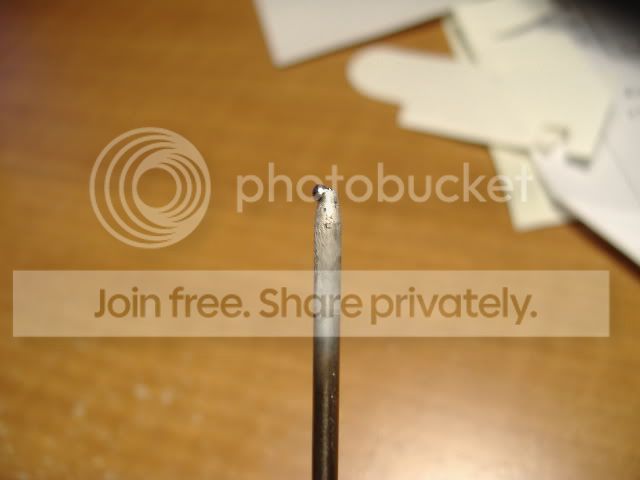
I never use green tungsten. I use 3/32" red tungsten for everything. I grind it to a sharp point and start on aluminum right away. I let it "ball up" on it's own. I don't bother with getting a super sharp point or the exact taper angle and what not, but I still sharpen it. Here's what the tungsten looks like after I'm done. If it looks like this, it's normal. Just use it until you're done welding and next time grind it to sharp point.
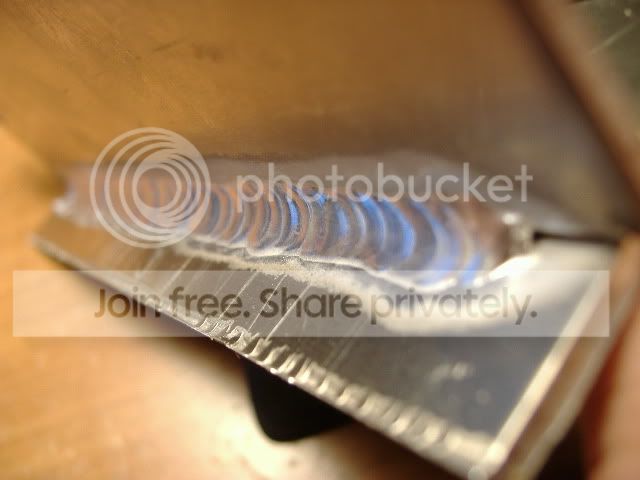
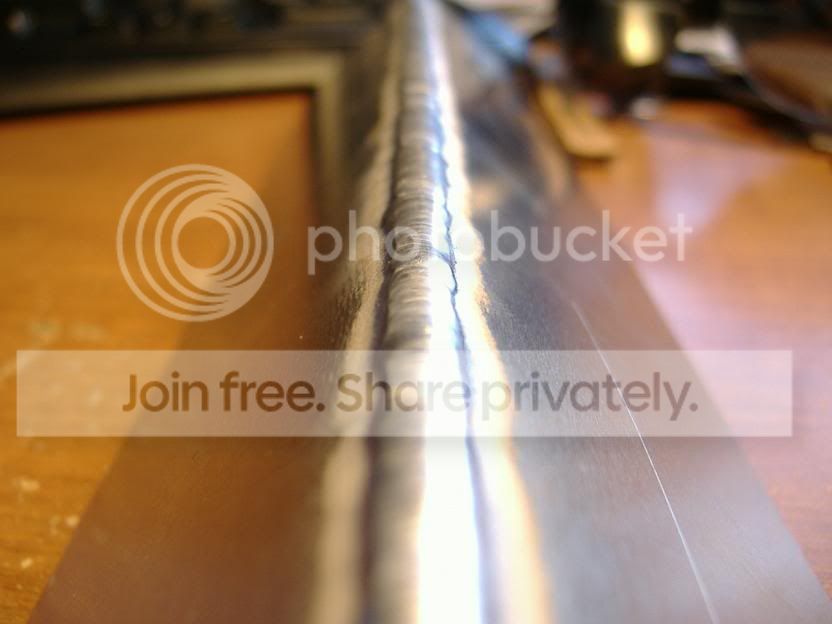
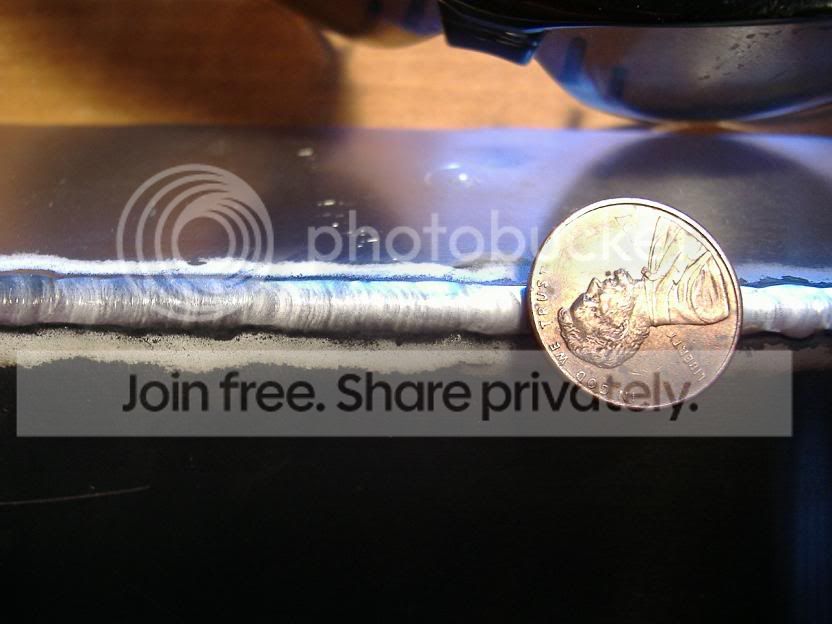
Some of my aluminum welds using the method I mentioned above:
<TABLE WIDTH="90%" CELLSPACING=0 CELLPADDING=0 ALIGN=CENTER><TR><TD>Quote, originally posted by dfoxengr »</TD></TR><TR><TD CLASS="quote">you do NOT grind your tungssten to a point for Al.
make sure youre using green electrodes as well. non-thoriated.</TD></TR></TABLE>
I never use green tungsten. I use 3/32" red tungsten for everything. I grind it to a sharp point and start on aluminum right away. I let it "ball up" on it's own. I don't bother with getting a super sharp point or the exact taper angle and what not, but I still sharpen it. Here's what the tungsten looks like after I'm done. If it looks like this, it's normal. Just use it until you're done welding and next time grind it to sharp point.
Some of my aluminum welds using the method I mentioned above:
Joined: May 2002
Posts: 3
Likes: 1
From: banned NC
Re: Argggh, how do you keep the electrode clean??!!? (Motorhead_AZ)
thats all good and well but youy should use green and ball it for Al. the ball is there so the arc can be the right shape for Al.
you should only run DC straight through thoriated.
Pure works best with ACHF current.
thoriated tungsten is radioactive
you should only run DC straight through thoriated.
Pure works best with ACHF current.
thoriated tungsten is radioactive
Honda-Tech Member
Joined: Jun 2004
Posts: 416
Likes: 0
From: Tempe, AZ, U.S.A.
Re: Argggh, how do you keep the electrode clean??!!? (dfoxengr)
<TABLE WIDTH="90%" CELLSPACING=0 CELLPADDING=0 ALIGN=CENTER><TR><TD>Quote, originally posted by dfoxengr »</TD></TR><TR><TD CLASS="quote">thoriated tungsten is radioactive </TD></TR></TABLE>
Hmmmm, that explains why I can see through walls..., LOL, j/k.
 Come one now, you get more exposed to radioactive radiation at the dentist's in an hour than you would your whole life with thoriated tungsten.
I know a lot of other people that use red tungsten for aluminum. It works out great. His contamination problem isn't related to the kind of tungsten he's using.
</TD></TR></TABLE>Hmmmm, that explains why I can see through walls..., LOL, j/k.
Come one now, you get more exposed to radioactive radiation at the dentist's in an hour than you would your whole life with thoriated tungsten. I know a lot of other people that use red tungsten for aluminum. It works out great. His contamination problem isn't related to the kind of tungsten he's using.

Honda-Tech Member
Joined: Nov 2005
Posts: 248
Likes: 0
From: CANADA, BC, Canada
Re: Argggh, how do you keep the electrode clean??!!? (dfoxengr)
Actually, 2% thorated (red band) tugsten is perfecly fine for AC HF, and it is one of the most versitile tungstens, hence why stores stock them the most and why so many ppl buy them. Even in them miller tig welding book 2% is perfectly suitable for AC HF.
I only own 2% cerated (orange) and 2% thorated (red) but then again I really only weld stainless.
I only own 2% cerated (orange) and 2% thorated (red) but then again I really only weld stainless.

OG Fabricator
Joined: Feb 2005
Posts: 1,864
Likes: 1
From: Burlington, Ont., Canada
i used to ball my pure tungsten electrodes for alum, but i stopped and started putting a sharp point on them and noticed it was much easier to weld thinner materials without making holes. it just forms a small ball on the end of the point on its own anyhow. i don't find it nescassary to ball the end unless i'm doing anything over 1/4" thick- that is when i ball the electrode.
to answer your original question, when you weld aluminum you have to add filler very quickly i find, it is when you are adding filler you probably are touching the torch to your puddle as the puddle "piles up". try lifting your torch ever so slightly when you add filler and then bringing it back down to flatten it out a bit.
to answer your original question, when you weld aluminum you have to add filler very quickly i find, it is when you are adding filler you probably are touching the torch to your puddle as the puddle "piles up". try lifting your torch ever so slightly when you add filler and then bringing it back down to flatten it out a bit.

Junior Member
Joined: Mar 2004
Posts: 111
Likes: 0
From: Minneapolis
AC welding is a combo of DCEP and DCEN. DCEP makes the tip ball up by itself (you NEVER need to ball it yourself, nor should you want to as it is more difficult to focus the arc) - there is nothing you can do aside from cranking the balance towards DCEN or getting an HF tig. You will find though that it's generally easier to weld with the balance biased to DCEP - solution: deal with it or fork over a couple grand for a top end machine. As for practicing, you don't need a clean electrode, just leave the crust on there - it's only aluminum oxide and can't contaminate anything. Just keep messing around, you'll get a much better understanding of Al welding by just playing with things and not worrying about being instantly perfect
Thread Starter
Joined: Jan 2006
Posts: 123
Likes: 0
Re: (Bjorn)
Wow, ok, so I can use either red OR green tungsten. I can ball it OR grind it sharp. If I choose to ball it for some reason I can do it on copper OR aluminum. Apparently any combination of the above can produce good results.
Now I'm all straightened out!
I'm gonna take Bjorn's advice and just play around until I get a technique that works best for ME.
Fred
Now I'm all straightened out!
I'm gonna take Bjorn's advice and just play around until I get a technique that works best for ME.
Fred
Joined: May 2002
Posts: 3
Likes: 1
From: banned NC
Re: (Fred Allen Burge)
due to the thermal properties of aluminum you really need to be moving fast. thats the best advice i can give.
and you dont need a top end machine to get DCSP or DCRP and ACHF. a miller 180sd does all those just fine.
just remember DC straight means the electrode is negative (-). for steel of course.
you dont want to evern weld on DC reverse because your tungsten will get eaten up.
and you dont need a top end machine to get DCSP or DCRP and ACHF. a miller 180sd does all those just fine.
just remember DC straight means the electrode is negative (-). for steel of course.
you dont want to evern weld on DC reverse because your tungsten will get eaten up.
Junior Member
Joined: Mar 2004
Posts: 111
Likes: 0
From: Minneapolis
Re: (Fred Allen Burge)
<TABLE WIDTH="90%" CELLSPACING=0 CELLPADDING=0 ALIGN=CENTER><TR><TD>Quote, originally posted by Fred Allen Burge »</TD></TR><TR><TD CLASS="quote">Wow, ok, so I can use either red OR green tungsten. I can ball it OR grind it sharp. If I choose to ball it for some reason I can do it on copper OR aluminum. Apparently any combination of the above can produce good results.
Now I'm all straightened out!
I'm gonna take Bjorn's advice and just play around until I get a technique that works best for ME.
Fred</TD></TR></TABLE>
green melts quicker (which is what the tip does when it ***** up), red handles the heat a little better so it'll keep a point better. A sharp tip is preferrable to focus the arc - it is rarely used because the tungsten ***** up within minutes of usage (unless using a $$$ HF tig). A higher balance of DCEP is good to learn on as it has less penetration, less prone to burn through (one less thing for you to worry about), however it will ball up your tungsten quicker, which can cause the arc to wander around.
the need to ball your tungsten and wire brush your aluminum are myths - don't waste your time doing either - trust me, try doing both, then try doing neither and see if your results change (as long as the aluminum is shiny it's good enough - besides, the oxide layer that everyone worries about builds back up within microseconds of being brushed off - it's that reactive).
start out doing lap joints without filler, just use the edge of the overlapping piece as filler. Get an idea of how Al flows when molten, how the oxide layer acts as a cocoon and how the Al flows out like solder when you up the amps. Dick around with that, then start using filler (a good rule of thumb is to have the tungsten, aluminum sheet and filler all around the same size - too thick of a filler creates a heat sink which freezes the puddle when you dip causing you to add more heat, which then burns through when you pull out the filler rod). When you get comfy with that, start doing T-joints - you'll realize then how a balled end rides up and causes an excessively wide bead, and that you'll need more DCEN and a thicker red tungsten to better hold up to the heat and keep from balling.
as always, practice, practice, practice - good luck!
Now I'm all straightened out!
I'm gonna take Bjorn's advice and just play around until I get a technique that works best for ME.
Fred</TD></TR></TABLE>
green melts quicker (which is what the tip does when it ***** up), red handles the heat a little better so it'll keep a point better. A sharp tip is preferrable to focus the arc - it is rarely used because the tungsten ***** up within minutes of usage (unless using a $$$ HF tig). A higher balance of DCEP is good to learn on as it has less penetration, less prone to burn through (one less thing for you to worry about), however it will ball up your tungsten quicker, which can cause the arc to wander around.
the need to ball your tungsten and wire brush your aluminum are myths - don't waste your time doing either - trust me, try doing both, then try doing neither and see if your results change (as long as the aluminum is shiny it's good enough - besides, the oxide layer that everyone worries about builds back up within microseconds of being brushed off - it's that reactive).
start out doing lap joints without filler, just use the edge of the overlapping piece as filler. Get an idea of how Al flows when molten, how the oxide layer acts as a cocoon and how the Al flows out like solder when you up the amps. Dick around with that, then start using filler (a good rule of thumb is to have the tungsten, aluminum sheet and filler all around the same size - too thick of a filler creates a heat sink which freezes the puddle when you dip causing you to add more heat, which then burns through when you pull out the filler rod). When you get comfy with that, start doing T-joints - you'll realize then how a balled end rides up and causes an excessively wide bead, and that you'll need more DCEN and a thicker red tungsten to better hold up to the heat and keep from balling.
as always, practice, practice, practice - good luck!

Joined: Mar 2006
Posts: 15
Likes: 0
Re: (Bjorn)
I found whenever I didn't ball up my tungsten before welding AL it would do while welding(which is obviously going to happen unless you can adjust it to be DCEP so much of the time where it doesnt have time to ball). This would cause the arc to go nuts while welding as it was starting to develope the ball. The arc's focus would wonder and move and such. In the end i would have to stop, either grind the tungsten clean again or just turn it on DCEP make the ball look the way I wanted and then continue welding again. I'm far from a professional, but i still always liked to ball the tungsten before I welded. Also my tungsten only looked like the one posted above if i dunked it in the puddle a few times. I always found it looked pretty close to the way it would when welding steel except for the fact it was balled at the end.

Thread
Thread Starter
Forum
Replies
Last Post