


lowered car = more suspension strain?


Thread Starter
* B A N N E D *
Joined: Mar 2004
Posts: 2,084
Likes: 0
From: Chicago, Il
 lowered car = more suspension strain?
Does lowering your car wether a nice drop or slaming have a significant impact on the relabilty or longevity of any of the suspension parts? I have heard conflicting views from my local peanut gallery including that the rear trailing arm bushings wear out much faster and a medium ot large front drop puts strain on your front axles? Are ideas?


Honda-Tech Member

Joined: Apr 2002
Posts: 18,961
Likes: 76
From: I am Tyson
Re: lowered car = more suspension strain? (cbmprelude)
yes, it has a huge affect on bushings. especially if you dont zero out your bushings completely by jacking the suspension before tightening the bolts. and especially the rear trailing arm bushings because those are locked at a certain angle. its a primary reason why most ppls rear trailing arms are to ****.
my 88 crx with 214k miles has perfectly nice rear trailing arm bushings. its never been lowered.
my 88 crx with 214k miles has perfectly nice rear trailing arm bushings. its never been lowered.

Honda-Tech Member
Joined: May 2005
Posts: 791
Likes: 0
From: Uranus
Re: lowered car = more suspension strain? (Tyson)
<TABLE WIDTH="90%" CELLSPACING=0 CELLPADDING=0 ALIGN=CENTER><TR><TD>Quote, originally posted by Tyson »</TD></TR><TR><TD CLASS="quote">yes, it has a huge affect on bushings. especially if you dont zero out your bushings completely by jacking the suspension before tightening the bolts. and especially the rear trailing arm bushings because those are locked at a certain angle. its a primary reason why most ppls rear trailing arms are to ****.
my 88 crx with 214k miles has perfectly nice rear trailing arm bushings. its never been lowered.</TD></TR></TABLE>
WTF are you talking about?
zero what bushing?
What part of the suspension needs to be PRELOADED? elaborate?
my 88 crx with 214k miles has perfectly nice rear trailing arm bushings. its never been lowered.</TD></TR></TABLE>
WTF are you talking about?
zero what bushing?
What part of the suspension needs to be PRELOADED? elaborate?

Honda-Tech Member
Joined: Jun 2003
Posts: 4,167
Likes: 0
From: Portland, OR
Re: lowered car = more suspension strain? (cbmprelude)
<TABLE WIDTH="90%" CELLSPACING=0 CELLPADDING=0 ALIGN=CENTER><TR><TD>Quote, originally posted by cbmprelude »</TD></TR><TR><TD CLASS="quote">zero out your bushings?</TD></TR></TABLE>
If you tightem bolts that go through the bushing while the car is up on jack stands the bushing will be twisted when you lower it onto the wheels. To "zero" the bushings, don't tighten the bolts all the way, then either put a jack under the suspension arm and jack it up until the weight of the car is on the suspension, then tighten the bolts, or lower the car to the ground and tighten the bolts (not easy if the car is really low, so you might need to use ramps.
If you tightem bolts that go through the bushing while the car is up on jack stands the bushing will be twisted when you lower it onto the wheels. To "zero" the bushings, don't tighten the bolts all the way, then either put a jack under the suspension arm and jack it up until the weight of the car is on the suspension, then tighten the bolts, or lower the car to the ground and tighten the bolts (not easy if the car is really low, so you might need to use ramps.
Honda-Tech Member
Joined: May 2005
Posts: 791
Likes: 0
From: Uranus
Re: lowered car = more suspension strain? (nonsense)
<TABLE WIDTH="90%" CELLSPACING=0 CELLPADDING=0 ALIGN=CENTER><TR><TD>Quote, originally posted by nonsense »</TD></TR><TR><TD CLASS="quote">
If you tightem bolts that go through the bushing while the car is up on jack stands the bushing will be twisted when you lower it onto the wheels. To "zero" the bushings, don't tighten the bolts all the way, then either put a jack under the suspension arm and jack it up until the weight of the car is on the suspension, then tighten the bolts, or lower the car to the ground and tighten the bolts (not easy if the car is really low, so you might need to use ramps. </TD></TR></TABLE>
WHAT BUSHINGS????? there are like 300 bushings on hondas
If you tightem bolts that go through the bushing while the car is up on jack stands the bushing will be twisted when you lower it onto the wheels. To "zero" the bushings, don't tighten the bolts all the way, then either put a jack under the suspension arm and jack it up until the weight of the car is on the suspension, then tighten the bolts, or lower the car to the ground and tighten the bolts (not easy if the car is really low, so you might need to use ramps. </TD></TR></TABLE>
WHAT BUSHINGS????? there are like 300 bushings on hondas
Trending Topics


 Re: lowered car = more suspension strain? (low430)
<TABLE WIDTH="90%" CELLSPACING=0 CELLPADDING=0 ALIGN=CENTER><TR><TD>Quote, originally posted by low430 »</TD></TR><TR><TD CLASS="quote">
WHAT BUSHINGS????? there are like 300 bushings on hondas</TD></TR></TABLE>
All of them!!!
This step is always overlooked when people lower their cars. It's not that difficult, it just takes some extra time & effort. The rear trailing arm bushings, and rear UCA inner bushings do require some professional assitance though.
Here is a write up on "zeroing out your bushings"...
<TABLE WIDTH="90%" CELLSPACING=0 CELLPADDING=0 ALIGN=CENTER><TR><TD>Quote, originally posted by 94eg! »</TD></TR><TR><TD CLASS="quote">The proper way to lower your car (and the reason why):
CLICK ME!</TD></TR></TABLE>
WHAT BUSHINGS????? there are like 300 bushings on hondas</TD></TR></TABLE>
All of them!!!
This step is always overlooked when people lower their cars. It's not that difficult, it just takes some extra time & effort. The rear trailing arm bushings, and rear UCA inner bushings do require some professional assitance though.
Here is a write up on "zeroing out your bushings"...
<TABLE WIDTH="90%" CELLSPACING=0 CELLPADDING=0 ALIGN=CENTER><TR><TD>Quote, originally posted by 94eg! »</TD></TR><TR><TD CLASS="quote">The proper way to lower your car (and the reason why):
CLICK ME!</TD></TR></TABLE>
Honda-Tech Member
Joined: May 2005
Posts: 791
Likes: 0
From: Uranus
Re: lowered car = more suspension strain? (94eg!)
Bah Bushings are designed to flex, Read the install article on team integra and on the shock and lowering kit installation directions, It doesnt say anything about this.
I think its a hoax
I think its a hoax
 Re: lowered car = more suspension strain? (Slow EJ8)
<TABLE WIDTH="90%" CELLSPACING=0 CELLPADDING=0 ALIGN=CENTER><TR><TD>Quote, originally posted by Slow EJ8 »</TD></TR><TR><TD CLASS="quote">in for the good info 
are we talking about any drop or only like below 2" or 1" etc? </TD></TR></TABLE>
If you lower your car (any amount), the bushings are forced into a twist all the time. From the factory all your bushings are set so there is ZERO twist when the vehicle is on the ground. Once lowered, your suspension is always in the bump postion. The "zeroing" process removes the twist for your new ride height. The only problem is that the two bushings i mentioned before are almost impossible to zero without taking them to a macine shop (the process is detailed in this article). I just skiped them. I figured once they wear out I'll replace them with Mugen versions, and have them pressed in at the proper degree of rotation...
If you do all your own suspension work, you may as well do it (since you will be taking in there anyways). Shops don't do this for you since it's not necissary to loosen any other suspension bolts to lower a car. Plus you would never know the difference (until your bushings go to ****)...
<TABLE WIDTH="90%" CELLSPACING=0 CELLPADDING=0 ALIGN=CENTER><TR><TD>Quote, originally posted by low430 »</TD></TR><TR><TD CLASS="quote">Bah Bushings are designed to flex, Read the install article on team integra and on the shock and lowering kit installation directions, It doesnt say anything about this.
I think its a hoax </TD></TR></TABLE>
Usually the people that say this are the ones that re-assemble their suspensions with the everything dangling while the car sits on jackstands (directly against the procedure detailed in the factory Helms manuals)...
<TABLE WIDTH="90%" CELLSPACING=0 CELLPADDING=0 ALIGN=CENTER><TR><TD>Quote, originally posted by PIC Performance »</TD></TR><TR><TD CLASS="quote">lol conspiracy! 94eg! will stalk you while you waste time with this process, and steel your wheels while you are busy!</TD></TR></TABLE>
LOL! It's all part of my master plan. I make $10 every time someone does this. That check should be getting here any day now...
are we talking about any drop or only like below 2" or 1" etc?
</TD></TR></TABLE>If you lower your car (any amount), the bushings are forced into a twist all the time. From the factory all your bushings are set so there is ZERO twist when the vehicle is on the ground. Once lowered, your suspension is always in the bump postion. The "zeroing" process removes the twist for your new ride height. The only problem is that the two bushings i mentioned before are almost impossible to zero without taking them to a macine shop (the process is detailed in this article). I just skiped them. I figured once they wear out I'll replace them with Mugen versions, and have them pressed in at the proper degree of rotation...
If you do all your own suspension work, you may as well do it (since you will be taking in there anyways). Shops don't do this for you since it's not necissary to loosen any other suspension bolts to lower a car. Plus you would never know the difference (until your bushings go to ****)...
<TABLE WIDTH="90%" CELLSPACING=0 CELLPADDING=0 ALIGN=CENTER><TR><TD>Quote, originally posted by low430 »</TD></TR><TR><TD CLASS="quote">Bah Bushings are designed to flex, Read the install article on team integra and on the shock and lowering kit installation directions, It doesnt say anything about this.
I think its a hoax </TD></TR></TABLE>
Usually the people that say this are the ones that re-assemble their suspensions with the everything dangling while the car sits on jackstands (directly against the procedure detailed in the factory Helms manuals)...
<TABLE WIDTH="90%" CELLSPACING=0 CELLPADDING=0 ALIGN=CENTER><TR><TD>Quote, originally posted by PIC Performance »</TD></TR><TR><TD CLASS="quote">lol conspiracy! 94eg! will stalk you while you waste time with this process, and steel your wheels while you are busy!</TD></TR></TABLE>
LOL! It's all part of my master plan. I make $10 every time someone does this. That check should be getting here any day now...

Honda-Tech Member
Joined: Jul 2005
Posts: 2,041
Likes: 1
Re: lowered car = more suspension strain? (94eg!)
<TABLE WIDTH="90%" CELLSPACING=0 CELLPADDING=0 ALIGN=CENTER><TR><TD>Quote, originally posted by 94eg! »</TD></TR><TR><TD CLASS="quote">If you lower your car (any amount), the bushings are forced into a twist all the time. From the factory all your bushings are set so there is ZERO twist when the vehicle is on the ground. Once lowered, your suspension is always in the bump postion. The "zeroing" process removes the twist for your new ride height. The only problem is that the two bushings i mentioned before are almost impossible to zero without taking them to a macine shop (the process is detailed in this article). I just skiped them. I figured once they wear out I'll replace them with Mugen versions, and have them pressed in at the proper degree of rotation...
If you do all your own suspension work, you may as well do it (since you will be taking in there anyways). Shops don't do this for you since it's not necissary to loosen any other suspension bolts to lower a car. Plus you would never know the difference (until your bushings go to ****)...</TD></TR></TABLE>
much thanks for that info... i will be sure to keep this in mind if/when I lower my car
If you do all your own suspension work, you may as well do it (since you will be taking in there anyways). Shops don't do this for you since it's not necissary to loosen any other suspension bolts to lower a car. Plus you would never know the difference (until your bushings go to ****)...</TD></TR></TABLE>
much thanks for that info... i will be sure to keep this in mind if/when I lower my car
Re: lowered car = more suspension strain? (Slow EJ8)
Just watch out for those rear LCA bolts. If they become rusted to the inside of the bushings, the heads will snap right off when you try to remove them. This is a known problem with all EF-EG-EK-DA-DC chassis... Once you break a bolt off, it's dangerous to drive on, but it's also super difficult to remove... 
There is a million posts on this problem, so there is much help out there if something goes wrong...
There is a million posts on this problem, so there is much help out there if something goes wrong...
Honda-Tech Member
Joined: Jul 2005
Posts: 2,041
Likes: 1
Re: lowered car = more suspension strain? (94eg!)
<TABLE WIDTH="90%" CELLSPACING=0 CELLPADDING=0 ALIGN=CENTER><TR><TD>Quote, originally posted by 94eg! »</TD></TR><TR><TD CLASS="quote">Just watch out for those rear LCA bolts. If they become rusted to the inside of the bushings, the heads will snap right off when you try to remove them. This is a known problem with all EF-EG-EK-DA-DC chassis... Once you break a bolt off, it's dangerous to drive on, but it's also super difficult to remove...
There is a million posts on this problem, so there is much help out there if something goes wrong...</TD></TR></TABLE>
cool, well.... not the problem but the info, I will be sure to watch out for all of this...
::copies all of 94eg's posts to a notepad::
There is a million posts on this problem, so there is much help out there if something goes wrong...</TD></TR></TABLE>
cool, well.... not the problem but the info, I will be sure to watch out for all of this...
::copies all of 94eg's posts to a notepad::

Member
Joined: May 2005
Posts: 1,829
Likes: 1
From: Norcal
For the rear lower shock bolts, i suppose you could take the tack welds off the fork so the nut is free rotating. Makes it a bit more difficult to assemble, but easier to remove should the bolt shaft get rusted or frozen to the inside metal sleeve on the LCA's shock bushing. If the bolt head snapped, you could just hammer-punch it out, and if the nut snapped, you could just hammer it out the other way.
Antiseeze or teflon tape would work well to wrap the ribbed part of the shaft to prevent rust or frozeness, would it not?
I've never had difficulty removing these bolts, yet.
Antiseeze or teflon tape would work well to wrap the ribbed part of the shaft to prevent rust or frozeness, would it not?
I've never had difficulty removing these bolts, yet.
Re: (chrisw85)
I broke one. Hammering the broken studs out doesn't work at all because the rubber bushing absorbs all of your hammers energy. Most people say to use heat & PB blaster when you initially try to remove the bolt (before you've broken anything). You must pay close attention to not set the bushing on fire, but I have never personally tried it.
I used my broken LCA bolt as an excuse for my wife to buy some Koni sports, and a ImportAutoSalvage integra sway bar kit (my shock was stuck onto my LCA )...
One of my friends had the exact same problem, and he used a cutting disc to through either side of the bushing to free the shock from the LCA. Then he just replaced the LCA with a salvage yard piece...
I used my broken LCA bolt as an excuse for my wife to buy some Koni sports, and a ImportAutoSalvage integra sway bar kit (my shock was stuck onto my LCA
)...One of my friends had the exact same problem, and he used a cutting disc to through either side of the bushing to free the shock from the LCA. Then he just replaced the LCA with a salvage yard piece...
Honda-Tech Member
Joined: Apr 2002
Posts: 18,961
Likes: 76
From: I am Tyson
Re: lowered car = more suspension strain? (low430)
<TABLE WIDTH="90%" CELLSPACING=0 CELLPADDING=0 ALIGN=CENTER><TR><TD>Quote, originally posted by low430 »</TD></TR><TR><TD CLASS="quote">I think its a hoax </TD></TR></TABLE>
thats hilarious. thanks for the laugh.
first of all, HONDA calls out this procedure in the factory service manual. i didnt make it up. the note under step #3 is pretty explicit, they also drew in the jackstand under the suspension.
http://www.honda.co.uk/owner/C...9.pdf
the reason why you have to do this is because of the design of the oem bushings. basically, you have an inner sleeve and an outer sleeve and rubber that bonds them. rubber is elastic, it has a spring rate to it. it allows the inner sleeve to rotate relative to the outer sleeve as the rubber stretches, but will spring back into the regular orientation. but like a rubber band, if you exceed the amount you stretch rubber, it will snap and not go back to the same orientation and youve forever lost the elastic connection.
the suspension has a certain amount of range of motion and the rubber bushings accomodate that. its best to set the unstressed position of the bushings to the middle of that range, basically when the car is at rest. thats simulated by "loading" the suspension when you tighten the bushings. if you dont "zero out" your bushings, and tighten them with the wheel off, or in a drooped fashion or whatever off the loaded position, then you will increase the range of movement the bushings must accomodate once in the loaded position, and in general will keep the bushing in a stressed (stretched) position more than it would otherwise. so ineveitably they will fail and crack and your bushings are destroyed forever.
it happens naturally as time goes on. rubber is organic, suffers from temperature and age. but you certainly will accelerate failure by exceeding the amount its designed to move.
there are two specific bushings that really cant be zeroed unless you removed them. and i said thats the trailing arm bushing and also the rear upper control arm's inner bushing. because of the dogbone style of bushing, the zero orientation is set relatively to the arm.
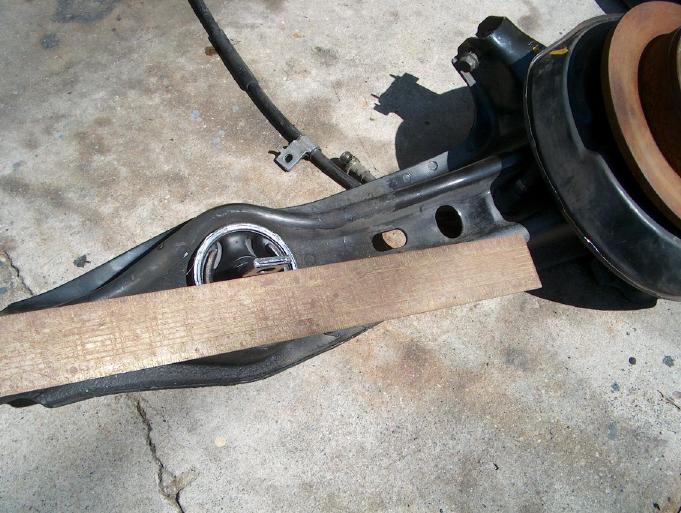
wes vann makes a great case for resetting the trailing arm bushing in his write up. http://www.performanceforum.co....html
basically as the car sits lower, the orientation of the trailing arm is cocked at an angle. but that makes the bushing locked in a non accomodating orientation.
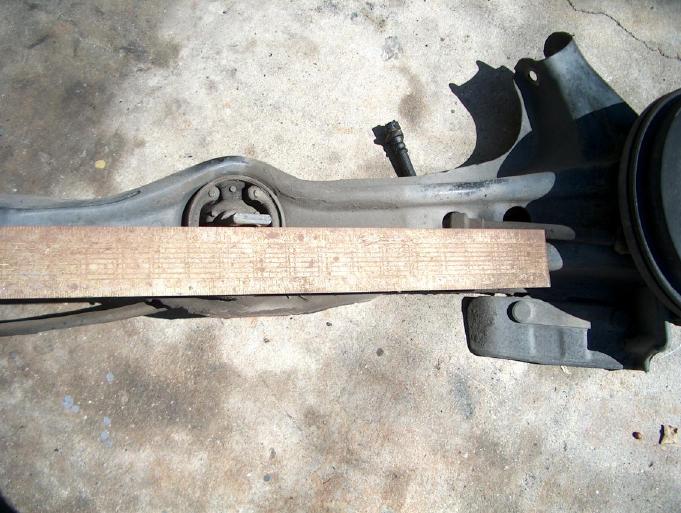
he wisely corrected for that orientation.
perhaps the issue is a little more obvious with the upper rear control arm.
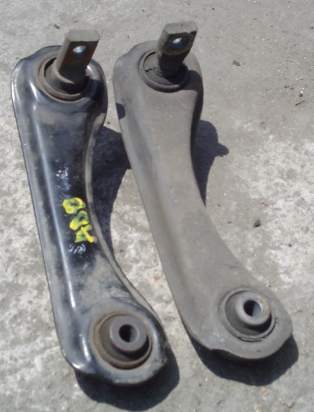
you can see that the inner bushing is a dogbone type bushing and its normal orientation is locked relative to the control arm. its designed to swing up and down. if you lowered the car, the arm is more swung up, but the bushing is more stressed in that position and will be pushed even further up. so like i said, unfortunately you cant just rezero this bushing without pressing it out and repositioning it.
</TD></TR></TABLE>thats hilarious. thanks for the laugh.
first of all, HONDA calls out this procedure in the factory service manual. i didnt make it up. the note under step #3 is pretty explicit, they also drew in the jackstand under the suspension.
http://www.honda.co.uk/owner/C...9.pdf
the reason why you have to do this is because of the design of the oem bushings. basically, you have an inner sleeve and an outer sleeve and rubber that bonds them. rubber is elastic, it has a spring rate to it. it allows the inner sleeve to rotate relative to the outer sleeve as the rubber stretches, but will spring back into the regular orientation. but like a rubber band, if you exceed the amount you stretch rubber, it will snap and not go back to the same orientation and youve forever lost the elastic connection.
the suspension has a certain amount of range of motion and the rubber bushings accomodate that. its best to set the unstressed position of the bushings to the middle of that range, basically when the car is at rest. thats simulated by "loading" the suspension when you tighten the bushings. if you dont "zero out" your bushings, and tighten them with the wheel off, or in a drooped fashion or whatever off the loaded position, then you will increase the range of movement the bushings must accomodate once in the loaded position, and in general will keep the bushing in a stressed (stretched) position more than it would otherwise. so ineveitably they will fail and crack and your bushings are destroyed forever.
it happens naturally as time goes on. rubber is organic, suffers from temperature and age. but you certainly will accelerate failure by exceeding the amount its designed to move.
there are two specific bushings that really cant be zeroed unless you removed them. and i said thats the trailing arm bushing and also the rear upper control arm's inner bushing. because of the dogbone style of bushing, the zero orientation is set relatively to the arm.
wes vann makes a great case for resetting the trailing arm bushing in his write up. http://www.performanceforum.co....html
basically as the car sits lower, the orientation of the trailing arm is cocked at an angle. but that makes the bushing locked in a non accomodating orientation.
he wisely corrected for that orientation.
perhaps the issue is a little more obvious with the upper rear control arm.
you can see that the inner bushing is a dogbone type bushing and its normal orientation is locked relative to the control arm. its designed to swing up and down. if you lowered the car, the arm is more swung up, but the bushing is more stressed in that position and will be pushed even further up. so like i said, unfortunately you cant just rezero this bushing without pressing it out and repositioning it.
Re: lowered car = more suspension strain? (Tyson)
It's amazing how many threads & IMs I've had to explain this in. Perhaps we should try to get the mods to "sticky" this thread at the top of the suspension forum once & for all...

Honda-Tech Member
Joined: Jul 2005
Posts: 2,041
Likes: 1
Re: lowered car = more suspension strain? (94eg!)
<TABLE WIDTH="90%" CELLSPACING=0 CELLPADDING=0 ALIGN=CENTER><TR><TD>Quote, originally posted by 94eg! »</TD></TR><TR><TD CLASS="quote">It's amazing how many threads & IMs I've had to explain this in. Perhaps we should try to get the mods to "sticky" this thread at the top of the suspension forum once & for all...</TD></TR></TABLE>
I agree... its been very helpful to me!
sticky this
I agree... its been very helpful to me!
sticky this
Honda-Tech Member
Joined: May 2005
Posts: 791
Likes: 0
From: Uranus
Re: lowered car = more suspension strain? (Slow EJ8)
Good info, Now I understand, but still its very minor unless your car is SLAMMED i wouldnt bother. Im not gonna mess with the ones you have to press out its just too much headache.

Honda-Tech Member
Joined: Jun 2004
Posts: 7,539
Likes: 5
From: Sherman Oaks, CA, United States
Re: lowered car = more suspension strain? (cbmprelude)
Hum, all this talk of "zeroing" the bushings is making me wonder if my car would ride better if I did this. When I lowered the car, I skipped that step, as it was rather late and I had already tied up too much of my friend's time using his tools, garrage, and help. I suppose I should go back and try and do this to all the bushing that won't require being pressed out and back in.
To add some technical discussion tothe topic, since the rubber does effect some twisting force on the suspension pieces, would not doing this add in the effect of additional spring rate? I mean, since the rubber is already trying to lift the car back up to stock height, how much would it actually effect the suspension? That would be an interesting sacrafice for a stock class car, knowlingly decrease the bushing life for a pseudo spring rate incrase by tightening down the bushings at full droop...
To add some technical discussion tothe topic, since the rubber does effect some twisting force on the suspension pieces, would not doing this add in the effect of additional spring rate? I mean, since the rubber is already trying to lift the car back up to stock height, how much would it actually effect the suspension? That would be an interesting sacrafice for a stock class car, knowlingly decrease the bushing life for a pseudo spring rate incrase by tightening down the bushings at full droop...
Re: lowered car = more suspension strain? (TunerN00b)
You are deffinently right that the bushings exert a force on the suspnesion when they are twisted. somehow I doubt it's really that much though, but you never know.
In answer to your first question: Honeslty I'm not sure if you will really "feel" the before & after difference in the ride quality (I didn't really). You will certlainly feel it later on when your bushings are still in good shape vs completely deteriorated...
In answer to your first question: Honeslty I'm not sure if you will really "feel" the before & after difference in the ride quality (I didn't really). You will certlainly feel it later on when your bushings are still in good shape vs completely deteriorated...