


Optimal way transition from 2.5"-3"


Thread Starter
Member
Joined: Nov 2004
Posts: 1,519
Likes: 0
From: NorCar!?
 Optimal way to transition from 2.5"-3"
I have an RMF h22 Prelude header that has a 2.5" exit pipe and I want to run a custom 3" exhaust after the header with a resonator and a muffler.
This is on a street car so the exhaust will go all the way back.
Is it best to go straight from 2.5 to 3 inch by somehow mating the flanges for the 2.5 and the 3 inch?
Is it better to make a pipe that expands from 2.5 to 3 in. over a certain interval of length? If so is there an optimal length so as not to create a violent rasp sound or a power loss?
Thanks for your input
Modified by jd3jdm at 5:31 PM 9/26/2005
This is on a street car so the exhaust will go all the way back.
Is it best to go straight from 2.5 to 3 inch by somehow mating the flanges for the 2.5 and the 3 inch?
Is it better to make a pipe that expands from 2.5 to 3 in. over a certain interval of length? If so is there an optimal length so as not to create a violent rasp sound or a power loss?
Thanks for your input
Modified by jd3jdm at 5:31 PM 9/26/2005

Thread Starter
Member
Joined: Nov 2004
Posts: 1,519
Likes: 0
From: NorCar!?
Re: (2kjettaguy)
<TABLE WIDTH="90%" CELLSPACING=0 CELLPADDING=0 ALIGN=CENTER><TR><TD>Quote, originally posted by I4sillypwr »</TD></TR><TR><TD CLASS="quote">You could use a reducer......but why?</TD></TR></TABLE>
When the motor is finished in a few weeks, should be making about 240-250 to the wheels and I was talking to my engine builder and he said I would want to go with a 3 inch exhaust to get the most power out of it. It would make more sense if my header had a 3 inch exit but it doesn't so I am basically making it have one and then taking the same size exhaust all the way back. I'm not just trying to have a big *** exhuast to make my car louder or anything gay like that.
When the motor is finished in a few weeks, should be making about 240-250 to the wheels and I was talking to my engine builder and he said I would want to go with a 3 inch exhaust to get the most power out of it. It would make more sense if my header had a 3 inch exit but it doesn't so I am basically making it have one and then taking the same size exhaust all the way back. I'm not just trying to have a big *** exhuast to make my car louder or anything gay like that.
Thread Starter
Member
Joined: Nov 2004
Posts: 1,519
Likes: 0
From: NorCar!?
Re: (2kjettaguy)
<TABLE WIDTH="90%" CELLSPACING=0 CELLPADDING=0 ALIGN=CENTER><TR><TD>Quote, originally posted by 2kjettaguy »</TD></TR><TR><TD CLASS="quote">You can make a reducer by just rolling some apropriate sheet metal into a cone shape. Might be easier if you have the equipment than buying one.
Evan </TD></TR></TABLE>
I see... Is there an optimal length over which to transition from the 2.5 to 3" via the cone?
Evan </TD></TR></TABLE>
I see... Is there an optimal length over which to transition from the 2.5 to 3" via the cone?

Honda-Tech Member
Joined: Oct 2004
Posts: 1,972
Likes: 0
From: sheridan, wyoming, usa
Re: (jd3jdm)
While I disagree with you on that point at least you are doing a 3 in for the right reasons. You can buy a transition from http://www.burnsstainless.com they have one that goes from 2.5 to 3.25 It's a coneshaped transition so you could trim it back to make the big side 3in.
Thread Starter
Member
Joined: Nov 2004
Posts: 1,519
Likes: 0
From: NorCar!?
Re: (I4sillypwr)
On the site, it says quote
"In the table here, the Small Dia. is the outside diameter of the tubing the transition is made from, and the Max Big End is the largest diameter to which it can be swaged."
This leads me to believe that the inside diameter of the 2.5 section of the cone would not actually be 2.5 inches and that I would be better off getting the 2 5/8" to 3 3/8" to compensate for the thickness of the material.
I am also curious as to why you disagree with this. I am not trying to say you are wrong but how could this hurt power? I can understand low end torque but I only see it helping in the higher rpm ranges.
"In the table here, the Small Dia. is the outside diameter of the tubing the transition is made from, and the Max Big End is the largest diameter to which it can be swaged."
This leads me to believe that the inside diameter of the 2.5 section of the cone would not actually be 2.5 inches and that I would be better off getting the 2 5/8" to 3 3/8" to compensate for the thickness of the material.
I am also curious as to why you disagree with this. I am not trying to say you are wrong but how could this hurt power? I can understand low end torque but I only see it helping in the higher rpm ranges.
Trending Topics
Honda-Tech Member
Joined: Oct 2004
Posts: 1,972
Likes: 0
From: sheridan, wyoming, usa
Honestly your best bet is ask RMF what he thinks since he designed the header....But I'll go out on a limb and guess at a loss of exhaust gas velocity etc and etc... seriously ask RMF.
Thread Starter
Member
Joined: Nov 2004
Posts: 1,519
Likes: 0
From: NorCar!?
Re: (I4sillypwr)
I sent him (Randy) a pm about an hour ago. Just waiting for him to get online. Thought I would get some input here as well. I wouldn't believe some random person that said Yeah get a 3" exhaust, bigger is always better! The person that told me to go with 3" definitely knows his ****.
Just a little mixed up here, trying to sort through which way to go with my exhaust. Right now I have an apex'i n1 (60mm=2.36") and with a 2.5" collector I see it to be restricting.
The only way my mind can see this is as a large tube you are trying to pour water through and get it to come out fast. Now, if you attach a smaller tube to the bottom of it, the water will pour out slower (like my current setup). If you attach the same size tube to the bottom of it, it should exit the pipe at the same speed at all areas of the pipe, but... If you allow the pipe to open up more through a gradual expansion, you should be able to not only maintain the same speed througout the pipes, but increase the volume of water exiting the pipe at each time interval. This is obviously not the same as exhuast gas but it is the way I see it. Let me know if this is the wrong way to be looking at the situation. I am a noob in this area!
Just a little mixed up here, trying to sort through which way to go with my exhaust. Right now I have an apex'i n1 (60mm=2.36") and with a 2.5" collector I see it to be restricting.
The only way my mind can see this is as a large tube you are trying to pour water through and get it to come out fast. Now, if you attach a smaller tube to the bottom of it, the water will pour out slower (like my current setup). If you attach the same size tube to the bottom of it, it should exit the pipe at the same speed at all areas of the pipe, but... If you allow the pipe to open up more through a gradual expansion, you should be able to not only maintain the same speed througout the pipes, but increase the volume of water exiting the pipe at each time interval. This is obviously not the same as exhuast gas but it is the way I see it. Let me know if this is the wrong way to be looking at the situation. I am a noob in this area!
Thread Starter
Member
Joined: Nov 2004
Posts: 1,519
Likes: 0
From: NorCar!?
Re: (jd3jdm)
Well, I talked to Randy and he said it would be fine to swedge a 2.5" pipe out to 3" and that it wouldn't negatively affect exhaust gas velocity.
I am also looking for a good resonator though, and I was looking at the stainless racing mufflers from burns stainless for this. I have also heard of the dynomax resonators that kteller sells. Which one would be better or is there is a better choice?
I am also looking for a good resonator though, and I was looking at the stainless racing mufflers from burns stainless for this. I have also heard of the dynomax resonators that kteller sells. Which one would be better or is there is a better choice?

Joined: Jan 2004
Posts: 270
Likes: 0
From: Lac des Loups, Qc, Canada
Re: (jd3jdm)
I'm not saying it would hurt you a big deal but I don't see how you would gain anything from going bigger than your collector diameter. Think of an hour glass ; the time it takes for all the sand to pass through the other side is determined by the size of the hole in the middle, not the size of the "containers" or whatever they're called. You can make the containers as big as you like, heck you could even break off the bottom one, sand is still going to get through at the same speed. Here the size of the hole is your header's collector and the container is your exhaust and the atmosphere.
Honda-Tech Member
Joined: Oct 2004
Posts: 1,972
Likes: 0
From: sheridan, wyoming, usa
It's probably not that big of a deal but in all honesty I don't really see the need. Let me know how it works out as I do have an h22 sitting in my garage just waiting for me to mate it with the crx shell sitting next to it. I'd be interested in a good comparision between a 2.5in and 3 in exh on one of randys headers.
Thread Starter
Member
Joined: Nov 2004
Posts: 1,519
Likes: 0
From: NorCar!?
Re: (Jamez)
I see the comparison here but... Why does RMF and every other header manufacturer make a collector that is lets say 2" but then, over the length of the exit pipe, it increases to a 2.5". And also, why do cars that run open header do this with their exit pipe?
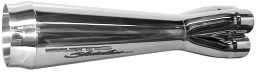
If what you are saying is correct then it shouldn't matter if the exhaust stayed at the collector size, in this case a 2" exhaust.
Just curious... I am just being kind of skeptical cuz I just want to get the most power out of my motor that I can.
If what you are saying is correct then it shouldn't matter if the exhaust stayed at the collector size, in this case a 2" exhaust.
Just curious... I am just being kind of skeptical cuz I just want to get the most power out of my motor that I can.
Thread Starter
Member
Joined: Nov 2004
Posts: 1,519
Likes: 0
From: NorCar!?
Re: (I4sillypwr)
<TABLE WIDTH="90%" CELLSPACING=0 CELLPADDING=0 ALIGN=CENTER><TR><TD>Quote, originally posted by I4sillypwr »</TD></TR><TR><TD CLASS="quote">It's probably not that big of a deal but in all honesty I don't really see the need. Let me know how it works out as I do have an h22 sitting in my garage just waiting for me to mate it with the crx shell sitting next to it. I'd be interested in a good comparision between a 2.5in and 3 in exh on one of randys headers. </TD></TR></TABLE>
Will do
I will only be able to compare open header to the 3in exhaust unless it loses an assload of power somewhere. If it does then I'll try my n1 on there but I probably won't put the 3in on and then the n1 if the 3" works out well. I know a few k-series guys running a 3" exhaust with about 250 to the wheels NA so we'll soon see how it works on my motor (89mm h22 + RLZ)
Will do
I will only be able to compare open header to the 3in exhaust unless it loses an assload of power somewhere. If it does then I'll try my n1 on there but I probably won't put the 3in on and then the n1 if the 3" works out well. I know a few k-series guys running a 3" exhaust with about 250 to the wheels NA so we'll soon see how it works on my motor (89mm h22 + RLZ)

Honda-Tech Double Platinum Member

Joined: May 2002
Posts: 3,293
Likes: 0
From: high point, nc, usa
Re: (I4sillypwr)
<TABLE WIDTH="90%" CELLSPACING=0 CELLPADDING=0 ALIGN=CENTER><TR><TD>Quote, originally posted by I4sillypwr »</TD></TR><TR><TD CLASS="quote">Honestly your best bet is ask RMF what he thinks since he designed the header....But I'll go out on a limb and guess at a loss of exhaust gas velocity etc and etc... seriously ask RMF.</TD></TR></TABLE>
Exhaust velocity isnt as big of a deal on an NA car as it is in a boosted one(believe it or not). With an NA car its more about the volume of exhaust that youre trying to get out. Im not saying that you should bolt a 3" exhaust on a stock civic or anything...but on a high hp car itll definately help.
You seem like youre the type of person that likes to understand why things make power and why they dont. If this is the case i would suggest getting a book on fluid dynamics. Or do what i did and search for articles on it(best ones are on college websites). This will help you understand things alot better. Good luck man
Exhaust velocity isnt as big of a deal on an NA car as it is in a boosted one(believe it or not). With an NA car its more about the volume of exhaust that youre trying to get out. Im not saying that you should bolt a 3" exhaust on a stock civic or anything...but on a high hp car itll definately help.
You seem like youre the type of person that likes to understand why things make power and why they dont. If this is the case i would suggest getting a book on fluid dynamics. Or do what i did and search for articles on it(best ones are on college websites). This will help you understand things alot better. Good luck man
Thread Starter
Member
Joined: Nov 2004
Posts: 1,519
Likes: 0
From: NorCar!?
Re: (sCeRaXn)
<TABLE WIDTH="90%" CELLSPACING=0 CELLPADDING=0 ALIGN=CENTER><TR><TD>Quote, originally posted by sCeRaXn »</TD></TR><TR><TD CLASS="quote">
Exhaust velocity isnt as big of a deal on an NA car as it is in a boosted one(believe it or not). With an NA car its more about the volume of exhaust that youre trying to get out. Im not saying that you should bolt a 3" exhaust on a stock civic or anything...but on a high hp car itll definately help.
You seem like youre the type of person that likes to understand why things make power and why they dont. If this is the case i would suggest getting a book on fluid dynamics. Or do what i did and search for articles on it(best ones are on college websites). This will help you understand things alot better. Good luck man</TD></TR></TABLE>
Thanks for the info. I'll look into that.
<TABLE WIDTH="90%" CELLSPACING=0 CELLPADDING=0 ALIGN=CENTER><TR><TD>Quote, originally posted by I4sillypwr »</TD></TR><TR><TD CLASS="quote">I have done that lol. I'm one semester and an internship from my ME degree. Lets not turn this into a debate. Sorry I jacked your thread man. </TD></TR></TABLE>
A debate would actually help me out a little bit here. I'm just trying to get both sides of the story with facts to back them up. No worries, you didn't really jack my thread, you're helping me learn some **** I didn't know before. Never a bad thing
Exhaust velocity isnt as big of a deal on an NA car as it is in a boosted one(believe it or not). With an NA car its more about the volume of exhaust that youre trying to get out. Im not saying that you should bolt a 3" exhaust on a stock civic or anything...but on a high hp car itll definately help.
You seem like youre the type of person that likes to understand why things make power and why they dont. If this is the case i would suggest getting a book on fluid dynamics. Or do what i did and search for articles on it(best ones are on college websites). This will help you understand things alot better. Good luck man</TD></TR></TABLE>
Thanks for the info. I'll look into that.
<TABLE WIDTH="90%" CELLSPACING=0 CELLPADDING=0 ALIGN=CENTER><TR><TD>Quote, originally posted by I4sillypwr »</TD></TR><TR><TD CLASS="quote">I have done that lol. I'm one semester and an internship from my ME degree. Lets not turn this into a debate. Sorry I jacked your thread man. </TD></TR></TABLE>
A debate would actually help me out a little bit here. I'm just trying to get both sides of the story with facts to back them up. No worries, you didn't really jack my thread, you're helping me learn some **** I didn't know before. Never a bad thing

Honda-Tech Member
Joined: Jan 2003
Posts: 3,788
Likes: 0
From: Charlotte, NC
Re: (jd3jdm)
<TABLE WIDTH="90%" CELLSPACING=0 CELLPADDING=0 ALIGN=CENTER><TR><TD>Quote, originally posted by jd3jdm »</TD></TR><TR><TD CLASS="quote">On the site, it says quote
"In the table here, the Small Dia. is the outside diameter of the tubing the transition is made from, and the Max Big End is the largest diameter to which it can be swaged."
This leads me to believe that the inside diameter of the 2.5 section of the cone would not actually be 2.5 inches and that I would be better off getting the 2 5/8" to 3 3/8" to compensate for the thickness of the material.
I am also curious as to why you disagree with this. I am not trying to say you are wrong but how could this hurt power? I can understand low end torque but I only see it helping in the higher rpm ranges.</TD></TR></TABLE>
Why would you need that? Tubing is tubing and randy uses tubing to make his header therefore it is also measure in OD. Assuming this is correct you would want part # RD-200-250-16-304-L variance can be long or short or vary the material thickness.
You do not have to trim our reducers we will make them whatever size you need
"In the table here, the Small Dia. is the outside diameter of the tubing the transition is made from, and the Max Big End is the largest diameter to which it can be swaged."
This leads me to believe that the inside diameter of the 2.5 section of the cone would not actually be 2.5 inches and that I would be better off getting the 2 5/8" to 3 3/8" to compensate for the thickness of the material.
I am also curious as to why you disagree with this. I am not trying to say you are wrong but how could this hurt power? I can understand low end torque but I only see it helping in the higher rpm ranges.</TD></TR></TABLE>
Why would you need that? Tubing is tubing and randy uses tubing to make his header therefore it is also measure in OD. Assuming this is correct you would want part # RD-200-250-16-304-L variance can be long or short or vary the material thickness.
You do not have to trim our reducers we will make them whatever size you need
Honda-Tech Member
Joined: Oct 2004
Posts: 1,972
Likes: 0
From: sheridan, wyoming, usa
In reality....it doesn't matter what we debate because it won't really matter. Why? because every engine/tune/setup is different. What matters is the correct setup for your engine. It may very well be that it is closer to 3in than it is to 2.5 it's just that I've never really seen the need to go that big (unless you are revving to like 9k) maybe you are.
I choose not to believe that volume is more important in a NA engine than it is in a boosted one. There is a **** load more going on than that. Enough going on that it makes my head hurt just reading books about it. Read the book that is suggested reading on Burns site. I got it and it may be from like the 60s but it's simple...ish examples will show how complex all this is.I'm by no means an expert on any of this (and I have been out of school for 2 yrs) so If anyone else wants to contribute go for it.
I choose not to believe that volume is more important in a NA engine than it is in a boosted one. There is a **** load more going on than that. Enough going on that it makes my head hurt just reading books about it. Read the book that is suggested reading on Burns site. I got it and it may be from like the 60s but it's simple...ish examples will show how complex all this is.I'm by no means an expert on any of this (and I have been out of school for 2 yrs) so If anyone else wants to contribute go for it.
Honda-Tech Member
Joined: Jan 2003
Posts: 3,788
Likes: 0
From: Charlotte, NC
Re: (sCeRaXn)
<TABLE WIDTH="90%" CELLSPACING=0 CELLPADDING=0 ALIGN=CENTER><TR><TD>Quote, originally posted by sCeRaXn »</TD></TR><TR><TD CLASS="quote">
Exhaust velocity isnt as big of a deal on an NA car as it is in a boosted one(believe it or not). With an NA car its more about the volume of exhaust that youre trying to get out. Im not saying that you should bolt a 3" exhaust on a stock civic or anything...but on a high hp car itll definately help.
You seem like youre the type of person that likes to understand why things make power and why they dont. If this is the case i would suggest getting a book on fluid dynamics. Or do what i did and search for articles on it(best ones are on college websites). This will help you understand things alot better. Good luck man</TD></TR></TABLE>
I don't know if it's necessarilly about volume either as we have ran some pretty small primary's on some high volume output engines. I think it's more about scavenging, and inducing effective scavengine by tuning all aspects of the header system this will provide the most broad and useable powerband
Exhaust velocity isnt as big of a deal on an NA car as it is in a boosted one(believe it or not). With an NA car its more about the volume of exhaust that youre trying to get out. Im not saying that you should bolt a 3" exhaust on a stock civic or anything...but on a high hp car itll definately help.
You seem like youre the type of person that likes to understand why things make power and why they dont. If this is the case i would suggest getting a book on fluid dynamics. Or do what i did and search for articles on it(best ones are on college websites). This will help you understand things alot better. Good luck man</TD></TR></TABLE>
I don't know if it's necessarilly about volume either as we have ran some pretty small primary's on some high volume output engines. I think it's more about scavenging, and inducing effective scavengine by tuning all aspects of the header system this will provide the most broad and useable powerband
Thread Starter
Member
Joined: Nov 2004
Posts: 1,519
Likes: 0
From: NorCar!?
Re: (Casey@Burns)
<TABLE WIDTH="90%" CELLSPACING=0 CELLPADDING=0 ALIGN=CENTER><TR><TD>Quote, originally posted by Casey@Burns »</TD></TR><TR><TD CLASS="quote">
Why would you need that? Tubing is tubing and randy uses tubing to make his header therefore it is also measure in OD. Assuming this is correct you would want part # RD-200-250-16-304-L variance can be long or short or vary the material thickness.
You do not have to trim our reducers we will make them whatever size you need </TD></TR></TABLE>
Since I'm going from a 2.5" to a 3" wouldn't I want a part # RD-250-300-16-304-L?? Also, could you all make a 30 degree bend or is 45 and 15 the closest you have? I would need about a 30 degree bend for my exhaust, that being the only real bend in it, I was going to buy all the straight tubing, the bend, and the transition from your company today, if you can make a 30 degree.
Thanks for your help
<TABLE WIDTH="90%" CELLSPACING=0 CELLPADDING=0 ALIGN=CENTER><TR><TD>Quote, originally posted by I4sillypwr »</TD></TR><TR><TD CLASS="quote">It may very well be that it is closer to 3in than it is to 2.5 it's just that I've never really seen the need to go that big (unless you are revving to like 9k) maybe you are. </TD></TR></TABLE>
I will be revving pretty high and I can guess that there is a lot more going on as far as exhuast gas velocity goes that I do not understand, which is exactly why I posted this thread in this forum instead of the prelude forum or the appearance cosmetic forum. haha. I just kinda wanted to pick your brains since I am actually still in school and have a lot more to learn on the subject.
Thanks
Modified by jd3jdm at 4:54 PM 9/28/2005
Why would you need that? Tubing is tubing and randy uses tubing to make his header therefore it is also measure in OD. Assuming this is correct you would want part # RD-200-250-16-304-L variance can be long or short or vary the material thickness.
You do not have to trim our reducers we will make them whatever size you need
</TD></TR></TABLE>Since I'm going from a 2.5" to a 3" wouldn't I want a part # RD-250-300-16-304-L?? Also, could you all make a 30 degree bend or is 45 and 15 the closest you have? I would need about a 30 degree bend for my exhaust, that being the only real bend in it, I was going to buy all the straight tubing, the bend, and the transition from your company today, if you can make a 30 degree.
Thanks for your help
<TABLE WIDTH="90%" CELLSPACING=0 CELLPADDING=0 ALIGN=CENTER><TR><TD>Quote, originally posted by I4sillypwr »</TD></TR><TR><TD CLASS="quote">It may very well be that it is closer to 3in than it is to 2.5 it's just that I've never really seen the need to go that big (unless you are revving to like 9k) maybe you are. </TD></TR></TABLE>
I will be revving pretty high and I can guess that there is a lot more going on as far as exhuast gas velocity goes that I do not understand, which is exactly why I posted this thread in this forum instead of the prelude forum or the appearance cosmetic forum. haha. I just kinda wanted to pick your brains since I am actually still in school and have a lot more to learn on the subject.
Thanks
Modified by jd3jdm at 4:54 PM 9/28/2005
Honda-Tech Member
Joined: Oct 2004
Posts: 1,972
Likes: 0
From: sheridan, wyoming, usa
Well please share you entire setup when you get it done I want to see how it performs. I'm going to let burns design my stuff cuz they are sweet (that's the business I meant Casey)
I want to see how it performs. I'm going to let burns design my stuff cuz they are sweet (that's the business I meant Casey)
Honda-Tech Member
Joined: Jan 2003
Posts: 3,788
Likes: 0
From: Charlotte, NC
Re: (jd3jdm)
yes you are correct my stupid typo RD-250-300-16-304-L
As far as the 30 degree just cut it from a 45 or a full u bend, answer no we dont have 30's sorry
let me know what you need to order or you can call and ask for jeff i have a horriblly busy week this week
As far as the 30 degree just cut it from a 45 or a full u bend, answer no we dont have 30's sorry
let me know what you need to order or you can call and ask for jeff i have a horriblly busy week this week

Honda-Tech Member
Joined: Jul 2004
Posts: 500
Likes: 0
The comparison of air flowing thru a transition to that of sand flowing in an hour glass does not seem like an accurate comparison. Air is compressible, sand is not. That one fact alone makes a huge difference as to how it will act/react in steady state and non-steady state flow situations.
Yes, there is a point where a given pipe diameter will reach a choke flow limit, and I suppose you could make the comparison of a non-compressible to air at that point. However, 95% of the time, the motor is operating no where close to the choke flow limits of the piping diameter and there is a lot more going on then just the shear steady state flow that a particular size pipe can handle.
To avoid having the air separate from the side of the tube and tumbling down the perimeter, increasing the thickness and turbulence in the boundary layer, I believe it is recommended to have the air change no greater the 9 degrees. A 9 degree taper (18 degree total) would make the transition from 2.5" to 3" take ~1.6". I think the Burns long tapers are 14 degree total, or 7 degree per side and just a hair over 2" in length.
Yes, there is a point where a given pipe diameter will reach a choke flow limit, and I suppose you could make the comparison of a non-compressible to air at that point. However, 95% of the time, the motor is operating no where close to the choke flow limits of the piping diameter and there is a lot more going on then just the shear steady state flow that a particular size pipe can handle.
To avoid having the air separate from the side of the tube and tumbling down the perimeter, increasing the thickness and turbulence in the boundary layer, I believe it is recommended to have the air change no greater the 9 degrees. A 9 degree taper (18 degree total) would make the transition from 2.5" to 3" take ~1.6". I think the Burns long tapers are 14 degree total, or 7 degree per side and just a hair over 2" in length.

