


K-series (or any series for that matter): 105mm throttle body


Thread Starter
Joined: Mar 2003
Posts: 488
Likes: 0
 K-series (or any series for that matter): 105mm throttle body


This will not bolt onto any existing intake manifolds for the K-series, but we'll make it work anyway. Many crave the performance seen with ITB's, however the significant pricetag and certain race organization (road racing and drag street class) rules prohibit their usage. So, that got us to thinking. LHP has built us fine ITB's, why stop there?
<TABLE WIDTH="90%" CELLSPACING=0 CELLPADDING=0 ALIGN=CENTER><TR><TD>Quote, originally posted by LHP »</TD></TR><TR><TD CLASS="quote">The main advantage of this system (drag 54mm ITB setup with plenum) is the throttle crossectional area, with the 54m/m throttles, this system equals one large throttle of 108m/m
LHP</TD></TR></TABLE>
After mulling that over a bit, we figured it's about time to build an intake manifold. We couldn't get a 108mm TB, so 105's gotta be live... I think that may even be a magic number and will go well with the 105mm stroker crank when we're not allowed to run ITB's...
-Ron

Thread Starter
Joined: Mar 2003
Posts: 488
Likes: 0
Re: (CHEETAH)
sweet.... next time I'm looking for 80mm I'll know which one to hunt for. This one isn't for a Nissan though. I'll have to find out what it's for at some point, but we hope it'll do fine for what we need from it.
-Ron
-Ron


Trending Topics
Thread Starter
Joined: Mar 2003
Posts: 488
Likes: 0
Re: K-series (DavidR)
<TABLE WIDTH="90%" CELLSPACING=0 CELLPADDING=0 ALIGN=CENTER><TR><TD>Quote, originally posted by DavidR »</TD></TR><TR><TD CLASS="quote">Overkill? I've seen 90mm TBs for 5.7L LS1s....if 5.7L can live off 90mm, why can't 2.x L live of less?</TD></TR></TABLE>
The motor we're trying to feed is 2672cc. With 4x52mm ITB's it made 304hp/235tq (dynojet) untuned on its 5th pass after partially cleaning up AFR. It could not make a full pass due to electrical and ignition problems and did not optimize cam angles for the new bottom end. Sufficeth to say, once we strapped on the intake manifold with a stock TB it lost 40hp. If you've noticed my methods, it's all or nothing. I'll start at either end of the spectrum and if needed, work my way back to the middle. This is a big intake for a big motor (relatively speaking, this is H-T). You can't generalize V8 trends against K-series and attempt to rationalize what we're experimenting with. If that were the case, why would Honda give us 300cfm heads straight from the factory? Surely that's too much for a little four banger. Further, why are we trying to extract even more flow from these wonderful engines? We want to make the most power with what we've got. I know from direct experience that if ITB's aren't to be implemented, then in my mind the starting point would attempt to provide similar numbers on the flowbench. Currently, the 52mm ITB's flow 351cfm. Once we finish the intake manifold, we'll be able to run some tests on the flowbench. I don't have the stock manifold/TB data handy, but it is significantly less.
Lighter modified K-series shouldn't need this level, so that's an issue we've taken into consideration for this induction setup. It will be modular and built to suit. Perhaps down the line, once we figure out what works for various displacements - the intake manifold/TB configuration will come in different flavors for their targeted engine combo. I think everyone is just focusing on the honkin 105mm TB and mistaking that it might be the magic bullet for everything. That's not the case, and again I reiterate - it's not a one-size-fit-all. We started with the largest single TB easily found since we know that the stock TB on an intake manifold lost us 40hp. There's no point in taking baby steps at this junction. Once we obtain some positive results with the 105mm TB on the 2672cc engine, we can build other setups for other motors and begin the arduous task of back to back testing, working downward in TB bore size and altering runner/plenum configurations. We need to start somewhere and this 105mm TB is it.
-Ron
The motor we're trying to feed is 2672cc. With 4x52mm ITB's it made 304hp/235tq (dynojet) untuned on its 5th pass after partially cleaning up AFR. It could not make a full pass due to electrical and ignition problems and did not optimize cam angles for the new bottom end. Sufficeth to say, once we strapped on the intake manifold with a stock TB it lost 40hp. If you've noticed my methods, it's all or nothing. I'll start at either end of the spectrum and if needed, work my way back to the middle. This is a big intake for a big motor (relatively speaking, this is H-T). You can't generalize V8 trends against K-series and attempt to rationalize what we're experimenting with. If that were the case, why would Honda give us 300cfm heads straight from the factory? Surely that's too much for a little four banger. Further, why are we trying to extract even more flow from these wonderful engines? We want to make the most power with what we've got. I know from direct experience that if ITB's aren't to be implemented, then in my mind the starting point would attempt to provide similar numbers on the flowbench. Currently, the 52mm ITB's flow 351cfm. Once we finish the intake manifold, we'll be able to run some tests on the flowbench. I don't have the stock manifold/TB data handy, but it is significantly less.
Lighter modified K-series shouldn't need this level, so that's an issue we've taken into consideration for this induction setup. It will be modular and built to suit. Perhaps down the line, once we figure out what works for various displacements - the intake manifold/TB configuration will come in different flavors for their targeted engine combo. I think everyone is just focusing on the honkin 105mm TB and mistaking that it might be the magic bullet for everything. That's not the case, and again I reiterate - it's not a one-size-fit-all. We started with the largest single TB easily found since we know that the stock TB on an intake manifold lost us 40hp. There's no point in taking baby steps at this junction. Once we obtain some positive results with the 105mm TB on the 2672cc engine, we can build other setups for other motors and begin the arduous task of back to back testing, working downward in TB bore size and altering runner/plenum configurations. We need to start somewhere and this 105mm TB is it.
-Ron


Honda-Tech Member
iTrader: (2)
Joined: Mar 2002
Posts: 5,828
Likes: 1
From: Woodbridge, NJ, Middlesex
Re: K-series (edo)
ron, I think you need to also play with manifold plenum with you're trying to out perform the 4x52mm itbs. I'm not sure anyone has a good manifold yet for the k. speak to a few to see if you can make something for trial. I dont think its in the t/b diameter size as much as it is in the plenum design. by plenum I mean things like having each cyl's runner staggered in such a way to match the sequential cyl firing order, etc.
Thread Starter
Joined: Mar 2003
Posts: 488
Likes: 0
Re: K-series (CHEETAH)
Definitely. As you already suspect, the runner dimensions and plenum volume need to be optimized for a specific setup and desired powerband. That's the problem with intake manifolds. It isn't easy to reconfigure like we can with ITB's. So most likely it will take many cycles to get the final combination down pat. Even then, it won't be one-size-fits-all.
-Ron
-Ron

Member
Joined: Sep 2003
Posts: 1,569
Likes: 0
From: Texas Damnit
Re: K-series (edo)
<TABLE WIDTH="90%" CELLSPACING=0 CELLPADDING=0 ALIGN=CENTER><TR><TD>Quote, originally posted by edo »</TD></TR><TR><TD CLASS="quote">
The motor we're trying to feed is 2672cc. With 4x52mm ITB's it made 304hp/235tq (dynojet) untuned on its 5th pass after partially cleaning up AFR. It could not make a full pass due to electrical and ignition problems and did not optimize cam angles for the new bottom end. Sufficeth to say, once we strapped on the intake manifold with a stock TB it lost 40hp. If you've noticed my methods, it's all or nothing. I'll start at either end of the spectrum and if needed, work my way back to the middle. This is a big intake for a big motor (relatively speaking, this is H-T). You can't generalize V8 trends against K-series and attempt to rationalize what we're experimenting with. If that were the case, why would Honda give us 300cfm heads straight from the factory? Surely that's too much for a little four banger. Further, why are we trying to extract even more flow from these wonderful engines? We want to make the most power with what we've got. I know from direct experience that if ITB's aren't to be implemented, then in my mind the starting point would attempt to provide similar numbers on the flowbench. Currently, the 52mm ITB's flow 351cfm. Once we finish the intake manifold, we'll be able to run some tests on the flowbench. I don't have the stock manifold/TB data handy, but it is significantly less.
Lighter modified K-series shouldn't need this level, so that's an issue we've taken into consideration for this induction setup. It will be modular and built to suit. Perhaps down the line, once we figure out what works for various displacements - the intake manifold/TB configuration will come in different flavors for their targeted engine combo. I think everyone is just focusing on the honkin 105mm TB and mistaking that it might be the magic bullet for everything. That's not the case, and again I reiterate - it's not a one-size-fit-all. We started with the largest single TB easily found since we know that the stock TB on an intake manifold lost us 40hp. There's no point in taking baby steps at this junction. Once we obtain some positive results with the 105mm TB on the 2672cc engine, we can build other setups for other motors and begin the arduous task of back to back testing, working downward in TB bore size and altering runner/plenum configurations. We need to start somewhere and this 105mm TB is it.
-Ron</TD></TR></TABLE>
Quality of flow isn't always about how much air you can flow. The same hodna engineers that gave us 300 cfm heads from the factory also fed them with a 64mm TB. I'm not saying that it isn't good to experiment however. Total air flow for a TB shouldn't be each cylinder x4, as only one cylinder is breathing at a time. Just some food for thought.
The motor we're trying to feed is 2672cc. With 4x52mm ITB's it made 304hp/235tq (dynojet) untuned on its 5th pass after partially cleaning up AFR. It could not make a full pass due to electrical and ignition problems and did not optimize cam angles for the new bottom end. Sufficeth to say, once we strapped on the intake manifold with a stock TB it lost 40hp. If you've noticed my methods, it's all or nothing. I'll start at either end of the spectrum and if needed, work my way back to the middle. This is a big intake for a big motor (relatively speaking, this is H-T). You can't generalize V8 trends against K-series and attempt to rationalize what we're experimenting with. If that were the case, why would Honda give us 300cfm heads straight from the factory? Surely that's too much for a little four banger. Further, why are we trying to extract even more flow from these wonderful engines? We want to make the most power with what we've got. I know from direct experience that if ITB's aren't to be implemented, then in my mind the starting point would attempt to provide similar numbers on the flowbench. Currently, the 52mm ITB's flow 351cfm. Once we finish the intake manifold, we'll be able to run some tests on the flowbench. I don't have the stock manifold/TB data handy, but it is significantly less.
Lighter modified K-series shouldn't need this level, so that's an issue we've taken into consideration for this induction setup. It will be modular and built to suit. Perhaps down the line, once we figure out what works for various displacements - the intake manifold/TB configuration will come in different flavors for their targeted engine combo. I think everyone is just focusing on the honkin 105mm TB and mistaking that it might be the magic bullet for everything. That's not the case, and again I reiterate - it's not a one-size-fit-all. We started with the largest single TB easily found since we know that the stock TB on an intake manifold lost us 40hp. There's no point in taking baby steps at this junction. Once we obtain some positive results with the 105mm TB on the 2672cc engine, we can build other setups for other motors and begin the arduous task of back to back testing, working downward in TB bore size and altering runner/plenum configurations. We need to start somewhere and this 105mm TB is it.
-Ron</TD></TR></TABLE>
Quality of flow isn't always about how much air you can flow. The same hodna engineers that gave us 300 cfm heads from the factory also fed them with a 64mm TB. I'm not saying that it isn't good to experiment however. Total air flow for a TB shouldn't be each cylinder x4, as only one cylinder is breathing at a time. Just some food for thought.
Thread Starter
Joined: Mar 2003
Posts: 488
Likes: 0
Re: K-series (DavidR)
Understood. I'm not a dynamicist, and I don't claim to be. Trial and error method isn't as elegant as CFD, but this is where we're starting - on the other end of the spectrum. We're not just going to slap on the 105mm TB by welding it to the stock intake manifold. Once it's done I'll post pics. Please try to remember and keep the discussion within context without generalizing - we tried the stock TB and it choked the 2672cc motor, losing 40hp. This is what we're trying to figure out at this point. How to supply the 2672cc motor with sufficient airflow, while abiding under a single TB/intake manifold rule restriction. The new manifold will have entirely different runner and plenum configuration from stock, since the OEM part made packaging concessions. We can put the 105mm TB anywhere and will be centered on the plenum, rather than fixed to one end. This will attempt to equalize the intake charge across the cylinders.
I've had that food, and it looks right on paper. In real life, from direct observation and empirical testing, TB sizing for the single cylinder thinking doesn't work on our 2672cc motor. They fire one at a time, yes. That's good at what idle? What about at 8, 9 - 10,000rpm? More of our findings on the exhaust side supports that a calculated collector diameter sufficient for the build, necessitated several increases to make more power, where we wanted to. The same "single cylinder" thinking was good to a point, but at higher rpms, the pulses are no longer distinct and individualized and needed a larger orifice to pass through without impeding flow.
-Ron
I've had that food, and it looks right on paper. In real life, from direct observation and empirical testing, TB sizing for the single cylinder thinking doesn't work on our 2672cc motor. They fire one at a time, yes. That's good at what idle? What about at 8, 9 - 10,000rpm? More of our findings on the exhaust side supports that a calculated collector diameter sufficient for the build, necessitated several increases to make more power, where we wanted to. The same "single cylinder" thinking was good to a point, but at higher rpms, the pulses are no longer distinct and individualized and needed a larger orifice to pass through without impeding flow.
-Ron
Member
Joined: Sep 2003
Posts: 1,569
Likes: 0
From: Texas Damnit
Re: K-series (edo)
I'm not a engineer qualified for that line of work, either, and we're all learning with the work you're doing. I like discussion boards where people like to discuss ideas and theories, rather than call each other names and downplay other's ideas because they don't have thousands of posts (not that you're doing that but it happens a lot here).
An engine is a big pump, so in theory the more air you can feed it the more it can pump, this I understand. However, the blending of the air with the fuel is as critical as how much air you've got in the chamber. Different stroke engines like different sized breathing ports (valves, ports, intake runners and TBs). Longer stroke motors are happier with a smaller port because it keeps the air pressure down on the front side of the valve, where short stroke motors don't have as much time to breathe, so they need a larger pipe. This should be consistant across RPMs, perhaps an engineer can tell me different (and explain it).
Nothing wrong with ad-hoc engineering, but trial and error is usually more expensive than sitting down and doing the math for what you need for what you want to obtain.
An engine is a big pump, so in theory the more air you can feed it the more it can pump, this I understand. However, the blending of the air with the fuel is as critical as how much air you've got in the chamber. Different stroke engines like different sized breathing ports (valves, ports, intake runners and TBs). Longer stroke motors are happier with a smaller port because it keeps the air pressure down on the front side of the valve, where short stroke motors don't have as much time to breathe, so they need a larger pipe. This should be consistant across RPMs, perhaps an engineer can tell me different (and explain it).
Nothing wrong with ad-hoc engineering, but trial and error is usually more expensive than sitting down and doing the math for what you need for what you want to obtain.
Thread Starter
Joined: Mar 2003
Posts: 488
Likes: 0
Re: K-series (DavidR)
Don't get me wrong, I understand the importance of engineering and the costs associated. The "ad-hoc" approach as you perceive, is nowhere near the costs it would take to engineer along the same lines as our camshaft profiles.
Again, I feel you are over simplifying the issue and making generalizations that are out of context and do not pertain to our specific needs. I welcome the discussion and perhaps you would like to contribute to the solution, by providing something tangible instead of reiterating rule-of-thumb and generally accepted practice. Focus on the subject at hand. Crunch some numbers and I'll verify if that's what we've got. Let's work together and compare notes, rather than speak in generalizations. I report what we've done and work-in-progress. Lastly, I do not think I can give you the answer you want to hear. I welcome you to join us in R&D and share with the community your findings.
-Ron
Again, I feel you are over simplifying the issue and making generalizations that are out of context and do not pertain to our specific needs. I welcome the discussion and perhaps you would like to contribute to the solution, by providing something tangible instead of reiterating rule-of-thumb and generally accepted practice. Focus on the subject at hand. Crunch some numbers and I'll verify if that's what we've got. Let's work together and compare notes, rather than speak in generalizations. I report what we've done and work-in-progress. Lastly, I do not think I can give you the answer you want to hear. I welcome you to join us in R&D and share with the community your findings.
-Ron


Joined: Jun 2003
Posts: 629
Likes: 0
From: Cincinnati, oh, usa
Re: K-series (edo)
Does anybody know how much cfm stock k20 intake manifold flows?
I have seen reworked B Series skunk2 manifolds matched with a 64mm TB flow 350cfm
My point being if you get a manifold that will flow that much or higher it seems 105mm will be overkill, killing velocity...
I understand what you said earlier about trial and error and that this is just R&D, and I really respect what you are doing here but im trying to offer some useful thoughts.
 to somebody benefiting the HT community
I have seen reworked B Series skunk2 manifolds matched with a 64mm TB flow 350cfm
My point being if you get a manifold that will flow that much or higher it seems 105mm will be overkill, killing velocity...
I understand what you said earlier about trial and error and that this is just R&D, and I really respect what you are doing here but im trying to offer some useful thoughts.
to somebody benefiting the HT community
Joined: Jun 2003
Posts: 629
Likes: 0
From: Cincinnati, oh, usa
Re: K-series (e9)
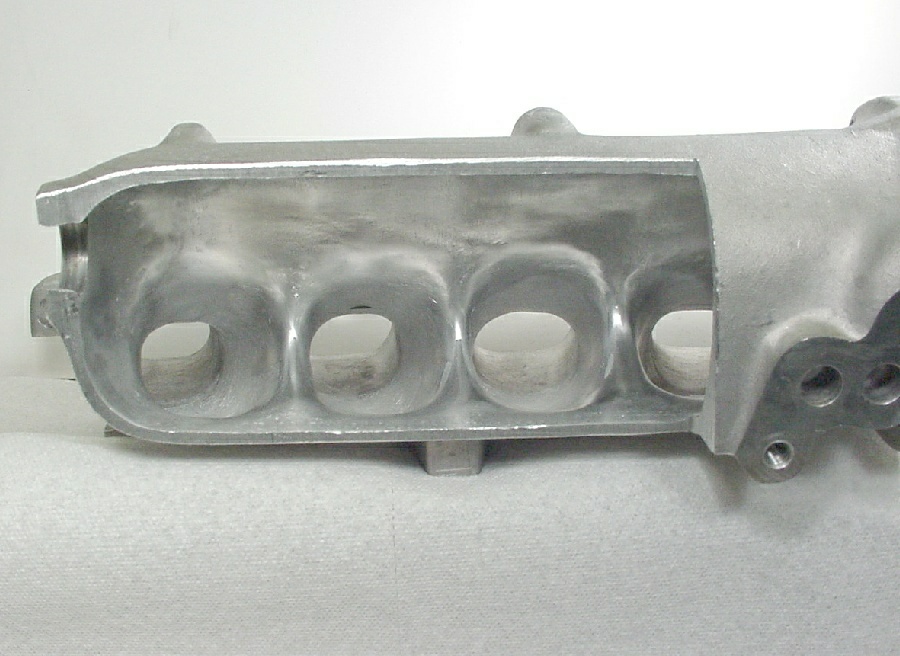
^^^ I believe that manifold was ported not extrude and honed correct? There’s to much removed material for that to be extrude and honed. but anyways something relatively simple like that for a kseries matched with the right size tb should be able to outperform ITB'S imo. shorter runners would most likely perform better as well
Thread Starter
Joined: Mar 2003
Posts: 488
Likes: 0
Re: K-series (realfasthonda)
<TABLE WIDTH="90%" CELLSPACING=0 CELLPADDING=0 ALIGN=CENTER><TR><TD>Quote, originally posted by realfasthonda »</TD></TR><TR><TD CLASS="quote">My point being if you get a manifold that will flow that much or higher it seems 105mm will be overkill, killing velocity...
I understand what you said earlier about trial and error and that this is just R&D, and I really respect what you are doing here but im trying to offer some useful thoughts.</TD></TR></TABLE>
I value your contribution. Let us finish the manifold and get some testing done to see if it works or not
-Ron
I understand what you said earlier about trial and error and that this is just R&D, and I really respect what you are doing here but im trying to offer some useful thoughts.</TD></TR></TABLE>
I value your contribution. Let us finish the manifold and get some testing done to see if it works or not
-Ron
Thread Starter
Joined: Mar 2003
Posts: 488
Likes: 0
Re: K-series (realfasthonda)
<TABLE WIDTH="90%" CELLSPACING=0 CELLPADDING=0 ALIGN=CENTER><TR><TD>Quote, originally posted by realfasthonda »</TD></TR><TR><TD CLASS="quote">but anyways something relatively simple like that for a kseries matched with the right size tb should be able to outperform ITB'S imo. shorter runners would most likely perform better as well
</TD></TR></TABLE>

The lower line represents a reworked manifold with shortened runners and sheet metal plenum through the stock TB. The higher graph swaps out the manifold for "street" 54mm ITB's.
-Ron
</TD></TR></TABLE>
The lower line represents a reworked manifold with shortened runners and sheet metal plenum through the stock TB. The higher graph swaps out the manifold for "street" 54mm ITB's.
-Ron
Member
Joined: Sep 2003
Posts: 1,569
Likes: 0
From: Texas Damnit
Re: K-series (edo)
<TABLE WIDTH="90%" CELLSPACING=0 CELLPADDING=0 ALIGN=CENTER><TR><TD>Quote, originally posted by edo »</TD></TR><TR><TD CLASS="quote">You know what they say about a picture.... Thanks Brad for posting that, didn't even need one word, nevermind a thousand.
-Ron</TD></TR></TABLE>
Then, according to the chart Brad posted, for an engine spinning 9000rpm, displacing .675L (41Cui) per cylinder, you only need 325cfm of manifold flow, and you'll be making about 340hp total (85hpX4 cylinders) at the crank. I did some quick math...
Calculating Average Air Speed through throttle body:
Calculate area of throttle body:
64mm throttle body with 10mm shaft
(64mm/2)^2 x 3.14 = 3215 square mm
Less shaft area = 64mm x 10mm = 640mm
Total throttle bore area = 2575 square mm or 25.75 sq cm
Calculate average air flow through body:
662cc/cylinder x 9000 RPMs x 2 /60 seconds/minute = 198750 cc/sec
198750 cc/sec / 25.75 sq cm = 7717 cm/sec or 77.17 meters/sec
From what I've read, you want to optimize for about 60 cm/sec on the TB, for for your size engine, you would need about a 72mm TB.
-Ron</TD></TR></TABLE>
Then, according to the chart Brad posted, for an engine spinning 9000rpm, displacing .675L (41Cui) per cylinder, you only need 325cfm of manifold flow, and you'll be making about 340hp total (85hpX4 cylinders) at the crank. I did some quick math...
Calculating Average Air Speed through throttle body:
Calculate area of throttle body:
64mm throttle body with 10mm shaft
(64mm/2)^2 x 3.14 = 3215 square mm
Less shaft area = 64mm x 10mm = 640mm
Total throttle bore area = 2575 square mm or 25.75 sq cm
Calculate average air flow through body:
662cc/cylinder x 9000 RPMs x 2 /60 seconds/minute = 198750 cc/sec
198750 cc/sec / 25.75 sq cm = 7717 cm/sec or 77.17 meters/sec
From what I've read, you want to optimize for about 60 cm/sec on the TB, for for your size engine, you would need about a 72mm TB.