


Flange warps when welded


Thread Starter
Joined: May 2005
Posts: 153
Likes: 0
From: Milwaukee, WI, USA
 Flange warps when welded
While welding on the turbo flange to a collector today, when I was about 1/2 way done, the thing looked like a frown. The middle was the high spot, while the outer edges where lower and pulled down. I had done all the welding in little sections about 3/4" long at a time. The flange was 3/8" mild steel.
What did I do wrong? I am using a angle grinder and cutoff wheel to cut the thing off and try again with a spare.
What did I do wrong? I am using a angle grinder and cutoff wheel to cut the thing off and try again with a spare.

Junior Member
Joined: Jul 2004
Posts: 520
Likes: 1
From: Sacramento, CA, USA
Re: Flange warps when welded (own6volvos)
3/8 thick?!?!?! And I am assuming you were welding something MUCH thinner to it? I have heard of warpage, but how many amps were you using???? MIG or TIG? Try bolting it to a flat surface...even a block of wood.
Kyle
Kyle


Joined: Jan 2004
Posts: 700
Likes: 0
From: Rubicon, WI, USA
Well first off, when welding to another surface, the mating surface SHOULD be flat... im assuming the collector surface was not all that flat or that gaps were being filled on it. Second, i honestly think 3/8" is to thin for any kind of flange, which is why i never make them that thin!
Thread Starter
Joined: May 2005
Posts: 153
Likes: 0
From: Milwaukee, WI, USA
The main setups I have seen with the swedish turbo headers was all 3/8" stuff, and they haven't had any problems with it. This was jsut my first time with it. 1/2" might help, but there is some other problem I need to fix instead of just going overkill to help stop the problem from coming up again.
Now what would be best to get the surface completely flat?
#5, ~65 on my MM210. Was going off the 3/8 settings.
EDIT: I didn't have it bolted to anything. Next time I will be hopefully using a 2" thick press plate drilled with the thing held in place with that.
Now what would be best to get the surface completely flat?
#5, ~65 on my MM210. Was going off the 3/8 settings.
EDIT: I didn't have it bolted to anything. Next time I will be hopefully using a 2" thick press plate drilled with the thing held in place with that.

Junior Member
Joined: Jan 2005
Posts: 138
Likes: 0
From: Albuquerque, NM, 87111
Re: (own6volvos)
I always weld as much as I can bolted down or tacked. Like exploited said, if both surfaces are perfectly flat, it will be minimal...BUT, I don't take the risk anymore because surface grinding takes too long. Whenever I weld a flange, I tack it all around in various spots to a 1" thick plate...weld the crap out of it, let it cool, and cut/break/clean up the tacks. Voila...
Trending Topics

Honda-Tech Member
Joined: Nov 2002
Posts: 17,227
Likes: 2
From: Illinois
Re: (own6volvos)
Bolt the piece down to a bigger piece of metal, plus use this next time.
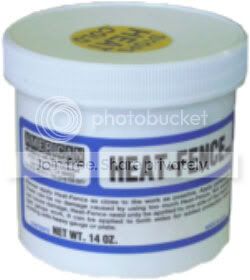
Heat Fence is the economical, safe and easy way to absorb heat harmlessly. Just apply the desired amount of HEAT FENCE from the jar and forget about it until the job is finished. The soft foam is immediately ready to absorb heat from the surrounding metal and provide an effective barrier that prevents heat from spreading to areas outside the work surface. Light gauge metals will not buckle, plastic, glass, rubber, wood, soft metals, paint and vinyl stay cool. With HEAT FENCE, clean up is never a problem. A few sweeps with a stick or paddle picks up the bulk of the foam; then rinse away the rest with cold water.
Heat Fence is the economical, safe and easy way to absorb heat harmlessly. Just apply the desired amount of HEAT FENCE from the jar and forget about it until the job is finished. The soft foam is immediately ready to absorb heat from the surrounding metal and provide an effective barrier that prevents heat from spreading to areas outside the work surface. Light gauge metals will not buckle, plastic, glass, rubber, wood, soft metals, paint and vinyl stay cool. With HEAT FENCE, clean up is never a problem. A few sweeps with a stick or paddle picks up the bulk of the foam; then rinse away the rest with cold water.
Honda-Tech Member
Joined: Nov 2002
Posts: 17,227
Likes: 2
From: Illinois
Re: (ChainbreakR)

Honda-Tech Member
Joined: Mar 2005
Posts: 148
Likes: 0
From: Indianapolis, In, U.S.A.
So lets say im making quite a few manifolds. Would it be a good idea to maybe make a special piece just for welding it together? Like maybe a 1inch thick piece or aluminum with the same bolt holes? and if i was really bored i could water cool the aluminum plate  is this a good idea or bad?
is this a good idea or bad?

Thread
Thread Starter
Forum
Replies
Last Post
