


BASIC QUESTION - How does an O2 sensor work?


Thread Starter
B*a*n*n*e*d
Joined: Mar 2002
Posts: 7,765
Likes: 1
 BASIC QUESTION - How does an O2 sensor work?
BASIC QUESTION - How does an O2 sensor work?
Here's a question for everybody.
If an O2 sensor measures O2 how does it measure air-fuel ratio below 14.7:1. At 14.7:1A/F a theortically 100% chemically effecient motor uses up all the 02 right. So for A/F less than 14.7 there should be no 02, correct?
If someone works at an O2 manufacture can come here and explain that would be awesome.
Also your O2 reading is dependant on placement of the O2 sensor. That's pretty retarded. If you went by 02 readings alone does your tune change when you change the location of the sensor.
Something for the gurus to think about
Most engine dyno cells don't use widebands. Instead air-fuel is measured directly by measuring the amount of air with a air mass sensor (hot wire deal) and fuel flow meter. That's the real way to measure air/fuel and how break specific horsepower is derived.
Here's a question for everybody.
If an O2 sensor measures O2 how does it measure air-fuel ratio below 14.7:1. At 14.7:1A/F a theortically 100% chemically effecient motor uses up all the 02 right. So for A/F less than 14.7 there should be no 02, correct?
If someone works at an O2 manufacture can come here and explain that would be awesome.
Also your O2 reading is dependant on placement of the O2 sensor. That's pretty retarded. If you went by 02 readings alone does your tune change when you change the location of the sensor.
Something for the gurus to think about
Most engine dyno cells don't use widebands. Instead air-fuel is measured directly by measuring the amount of air with a air mass sensor (hot wire deal) and fuel flow meter. That's the real way to measure air/fuel and how break specific horsepower is derived.

Honda-Tech Member
Joined: Jan 2004
Posts: 3,914
Likes: 1
From: Charlotte, NC
Re: BASIC QUESTION - How does an O2 sensor work? (Rocket)
Search, n00b!!! 
No, that's actually a good question. I would answer it right now but I have to meet someone for a while. I'll fill you in later this evening. Sorry for the teaser...
No, that's actually a good question. I would answer it right now but I have to meet someone for a while. I'll fill you in later this evening. Sorry for the teaser...

Joined: Sep 2002
Posts: 1,395
Likes: 0
From: Oxnard, CA, USA
Re: BASIC QUESTION - How does an O2 sensor work? (Rocket)
<TABLE WIDTH="90%" CELLSPACING=0 CELLPADDING=0 ALIGN=CENTER><TR><TD>Quote, originally posted by Rocket »</TD></TR><TR><TD CLASS="quote">BASIC QUESTION - How does an O2 sensor work?
</TD></TR></TABLE>
An normal O2 sensor is a chemical generator. It makes a comparison between the oxygen inside the exhaust manifold and/or cat and the air outside the engine. When the engine has more fuel than needed, all available oxygen is consumed in the cylinder and gasses leaving through the exhaust contain almost no oxygen. This sends out a voltage greater than 0.45 volts. If the engine is running lean, all fuel is burned, and the extra oxygen leaves the cylinder and flows into the exhaust. In this case, the sensor voltage goes lower than 0.45 volts. That is why normal O2 sensor is not accurate, it's bascially an on-off type of thing, and it allows the engine to switch back and forth and equalize. Either it detects oxygen, or it doesn't.
Now if you're talking about wideband O2 sensors, that's different. It operates by sending current to the O2 sensor, causing O2 ions to generate. By measuring how much current must be sent into the sensor in order to maintain a constant voltage across the O2 detecting cell, the A/F can be determined. It also detects proper operating temperature of the sensor is by measuring its electrical impedance, which is proportional to temperature of exhaust gas.
</TD></TR></TABLE>
An normal O2 sensor is a chemical generator. It makes a comparison between the oxygen inside the exhaust manifold and/or cat and the air outside the engine. When the engine has more fuel than needed, all available oxygen is consumed in the cylinder and gasses leaving through the exhaust contain almost no oxygen. This sends out a voltage greater than 0.45 volts. If the engine is running lean, all fuel is burned, and the extra oxygen leaves the cylinder and flows into the exhaust. In this case, the sensor voltage goes lower than 0.45 volts. That is why normal O2 sensor is not accurate, it's bascially an on-off type of thing, and it allows the engine to switch back and forth and equalize. Either it detects oxygen, or it doesn't.
Now if you're talking about wideband O2 sensors, that's different. It operates by sending current to the O2 sensor, causing O2 ions to generate. By measuring how much current must be sent into the sensor in order to maintain a constant voltage across the O2 detecting cell, the A/F can be determined. It also detects proper operating temperature of the sensor is by measuring its electrical impedance, which is proportional to temperature of exhaust gas.
Thread Starter
B*a*n*n*e*d
Joined: Mar 2002
Posts: 7,765
Likes: 1
Re: BASIC QUESTION - How does an O2 sensor work? (cpforyou)
<TABLE WIDTH="90%" CELLSPACING=0 CELLPADDING=0 ALIGN=CENTER><TR><TD>Quote, originally posted by cpforyou »</TD></TR><TR><TD CLASS="quote">wideband O2 sensors, that's different. It operates by sending current to the O2 sensor, causing O2 ions to generate. </TD></TR></TABLE>
So a wideband 02 sensor generates 02? I didnn't know that.
So a wideband 02 sensor generates 02? I didnn't know that.
Joined: Sep 2002
Posts: 1,395
Likes: 0
From: Oxnard, CA, USA
Re: BASIC QUESTION - How does an O2 sensor work? (Rocket)
<TABLE WIDTH="90%" CELLSPACING=0 CELLPADDING=0 ALIGN=CENTER><TR><TD>Quote, originally posted by Rocket »</TD></TR><TR><TD CLASS="quote">So a wideband 02 sensor generates 02? I didnn't know that.</TD></TR></TABLE>
A UEGO sensor is an Universal A/F Exhaust Gas Oxygen sensor. There are technically two sensors inside of them. One is exposed to the exhaust, and the other one is for passing current to generate O2 ions, not O2 itself. If it actually generated O2, a rich mixture could ignite, and that would be a no no. It then measures the potential difference by means of a complex method way above my head, and gives you an accurate A/F reading.
If anyone can explain the complex method, that would complete my education on wideband O2 sensors.
A UEGO sensor is an Universal A/F Exhaust Gas Oxygen sensor. There are technically two sensors inside of them. One is exposed to the exhaust, and the other one is for passing current to generate O2 ions, not O2 itself. If it actually generated O2, a rich mixture could ignite, and that would be a no no. It then measures the potential difference by means of a complex method way above my head, and gives you an accurate A/F reading.
If anyone can explain the complex method, that would complete my education on wideband O2 sensors.

Honda-Tech Member
Joined: May 2003
Posts: 432
Likes: 0
From: Dirty South, USA
Re: BASIC QUESTION - How does an O2 sensor work? (Rocket)
good post CPforyou, people rarely discuss how useless stock O2 sensors actually are...on or off. Which is why Volvo, with their long time turbo useage and necessary a/f control, cross references a MAP, MAF, and the 02's to get thier fuel delivery. I wouldn't want to just use one or the other. (i.e, the engine dyno vs chassis methods if I had my way). Of course 4 widebands would be the entirely too expensive ideal.....
Thread Starter
B*a*n*n*e*d
Joined: Mar 2002
Posts: 7,765
Likes: 1
Re: BASIC QUESTION - How does an O2 sensor work? (cpforyou)
<TABLE WIDTH="90%" CELLSPACING=0 CELLPADDING=0 ALIGN=CENTER><TR><TD>Quote, originally posted by cpforyou »</TD></TR><TR><TD CLASS="quote">and the other one is for passing current to generate O2 ions, not O2 itself. </TD></TR></TABLE>
What is an O2 ion and what is the consumable source of the 02 ion? since matter can neither be created nor destroyed.
What is an O2 ion and what is the consumable source of the 02 ion? since matter can neither be created nor destroyed.
Trending Topics
Thread Starter
B*a*n*n*e*d
Joined: Mar 2002
Posts: 7,765
Likes: 1
Re: BASIC QUESTION - How does an O2 sensor work? (Rocket)
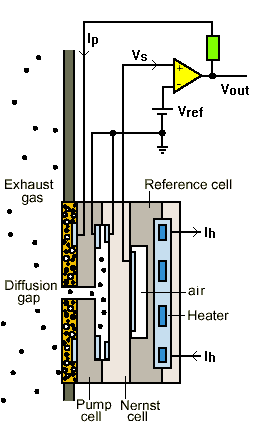
Here's what I've found.
Looks like the wideband detects both fuel and oxygen by consuming it.
Depending on the current required to keep the chamber stoichimetric is how the A/F is arrived at.
Modified by Rocket at 1:09 AM 6/1/2005
Looks like the wideband detects both fuel and oxygen by consuming it.
Depending on the current required to keep the chamber stoichimetric is how the A/F is arrived at.
Modified by Rocket at 1:09 AM 6/1/2005

Joined: Jan 2004
Posts: 270
Likes: 0
From: Lac des Loups, Qc, Canada
Re: BASIC QUESTION - How does an O2 sensor work? (Rocket)
Your readings will change with the location because your engine can't keep a steady stoichiometric mix going on, it must alternate from slightly rich to slightly lean but once the gases go through your catalytic converter everything gets equalised (when it goes lean it absorbs oxygen and then uses that oxygen to burn up the extra hydrocarbons in the rich condition. The oxygen sensor BEFORE the cat checks up on the rich/lean alternance, the oxygen sensor AFTER the cat checks to see if it did burn up the left over hydrocarbons from the rich condition. So your first O2 sensor is supposed to read a rich/lean alternance and your second one is supposed to read a stochiometric burn, if it doesn't it trows a CEL to indicate your cat is deffective.
Joined: Sep 2002
Posts: 1,395
Likes: 0
From: Oxnard, CA, USA
Re: BASIC QUESTION - How does an O2 sensor work? (Rocket)
<TABLE WIDTH="90%" CELLSPACING=0 CELLPADDING=0 ALIGN=CENTER><TR><TD>Quote, originally posted by Rocket »</TD></TR><TR><TD CLASS="quote">Here's what I've found.
Looks like the wideband detects both fuel and oxygen by consuming it.
Depending on the current required to keep the chamber stoichimetric is how the A/F is arrived at.
Modified by Rocket at 1:09 AM 6/1/2005</TD></TR></TABLE>
There's your two sensors! It's shown in the picture as one side exposed to exhaust gas, and the other side used for reference. I also see the current source as well.
I guess the answer is clear (well kinda) with this picure. Good job!
Looks like the wideband detects both fuel and oxygen by consuming it.
Depending on the current required to keep the chamber stoichimetric is how the A/F is arrived at.
Modified by Rocket at 1:09 AM 6/1/2005</TD></TR></TABLE>
There's your two sensors! It's shown in the picture as one side exposed to exhaust gas, and the other side used for reference. I also see the current source as well.
I guess the answer is clear (well kinda) with this picure. Good job!

Thread Starter
B*a*n*n*e*d
Joined: Mar 2002
Posts: 7,765
Likes: 1
Re: BASIC QUESTION - How does an O2 sensor work? (HondaIntegraR)
I am amazed this was a good question. I did some research and now I understand widebands alot better. They are basically a narrow band with gas sampling chamber that runs in "closed loop".
IMO: if you have a narrow band O2 sensor, you can tune a motor if you know what you are doing.
IMO: if you have a narrow band O2 sensor, you can tune a motor if you know what you are doing.


Junior Member
Joined: May 2004
Posts: 524
Likes: 0
From: Fresno, Ca, USA
Re: BASIC QUESTION - How does an O2 sensor work? (PURPLETERROR)
<TABLE WIDTH="90%" CELLSPACING=0 CELLPADDING=0 ALIGN=CENTER><TR><TD>Quote, originally posted by Rocket »</TD></TR><TR><TD CLASS="quote">I am amazed this was a good question. I did some research and now I understand widebands alot better. They are basically a narrow band with gas sampling chamber that runs in "closed loop".
IMO: if you have a narrow band O2 sensor, you can tune a motor if you know what you are doing.</TD></TR></TABLE>
tuning w/ narrowband? so its possible to determine air/fuel ratios outside of the stoich with narrowband??
IMO: if you have a narrow band O2 sensor, you can tune a motor if you know what you are doing.</TD></TR></TABLE>
tuning w/ narrowband? so its possible to determine air/fuel ratios outside of the stoich with narrowband??
Thread Starter
B*a*n*n*e*d
Joined: Mar 2002
Posts: 7,765
Likes: 1
Re: BASIC QUESTION - How does an O2 sensor work? (HondaIntegraR)
<TABLE WIDTH="90%" CELLSPACING=0 CELLPADDING=0 ALIGN=CENTER><TR><TD>Quote, originally posted by HondaIntegraR »</TD></TR><TR><TD CLASS="quote">
tuning w/ narrowband? so its possible to determine air/fuel ratios outside of the stoich with narrowband??</TD></TR></TABLE>
How did racers tune in the 60's and 70's? They went pretty fast right?
tuning w/ narrowband? so its possible to determine air/fuel ratios outside of the stoich with narrowband??</TD></TR></TABLE>
How did racers tune in the 60's and 70's? They went pretty fast right?
Joined: Sep 2002
Posts: 1,395
Likes: 0
From: Oxnard, CA, USA
Re: BASIC QUESTION - How does an O2 sensor work? (HondaIntegraR)
<TABLE WIDTH="90%" CELLSPACING=0 CELLPADDING=0 ALIGN=CENTER><TR><TD>Quote, originally posted by HondaIntegraR »</TD></TR><TR><TD CLASS="quote">tuning w/ narrowband? so its possible to determine air/fuel ratios outside of the stoich with narrowband??</TD></TR></TABLE>
It can be done, but very hard to do so.
Narrowband can only tell you if you are RICH or LEAN.
If you get a rich reading, you have to lean it out!.
If you get a lean reading, you have to richen the mixture.
For 14.7:1, the goal is to get it to alternate:
RICH, LEAN, RICH, LEAN, RICH, LEAN.
If you get RICH, RICH, RICH, LEAN, RICH, RICH, RICH, etc. etc... then you are running a little on the RICH side.
It can be done, but very hard to do so.
Narrowband can only tell you if you are RICH or LEAN.
If you get a rich reading, you have to lean it out!.
If you get a lean reading, you have to richen the mixture.
For 14.7:1, the goal is to get it to alternate:
RICH, LEAN, RICH, LEAN, RICH, LEAN.
If you get RICH, RICH, RICH, LEAN, RICH, RICH, RICH, etc. etc... then you are running a little on the RICH side.

Honda-Tech Member
Joined: Aug 2001
Posts: 1,247
Likes: 1
From: Cincinnati, OH, USA
Klaus who designed the Innovate LM1 was kind enough to provide a highly techical discussion of the principles of operation in his unit. If you'd like to read over it (really a great discussion!) you can read it here:
http://forum.pgmfi.org/viewtopic.php?t=3890
http://forum.pgmfi.org/viewtopic.php?t=3890
Honda-Tech Member
Joined: Jan 2004
Posts: 3,914
Likes: 1
From: Charlotte, NC
Re: (Rocket)
There are 2 kinds of wideband sensors that Honda uses, oxygen ion pumping and critical current sensors. I'm too lazy to write all about them, so I'll let Honda do the talking...
Pictures > Words
Narrowband Sensors


Critical Current Sensors


Oxygen Ion Pumping Sensors


Pictures > Words
Narrowband Sensors
Critical Current Sensors
Oxygen Ion Pumping Sensors

Joined: Apr 2004
Posts: 943
Likes: 1
From: Lincoln, NE, USA
Re: (drdisco69)
Oxygen sensors, also known as a lambda sensor - λ being the symbol used for relative air/fuel ratio, is an oxygen concentration cell with a solid electrolyte through which a current is carried by oxygen ions. The electrolye is yttria (Y²O³) stabalized zirconia (ZrO²) (excuse the chemical formula subscripts, I can't figure out how to do them in the forum) ceramic which seperates two gas chambers (the exhaust manifold and the atmosphere) which have different oxygen partial pressures. The cell can be represented as a series of interfaces as follows:
Exhaust [p'o²] Metal [Me] Ceramic [ZrO², Y²O³] Metal [Me] Air [p"o²]
p"o² is the partial pressure of the air, which is ~20kN/m^2 and p'o² is the equilibrium oxygen partial pressure in the exhaust gases. An electrochemical reaction takes place at the metal electrodes:
O² + 4Me <=> 2O²-
and the oxygen ions transport the current across the cell. The open-circuit output voltage of the vell Vo can be related to the oxygen partial pressures p'o² and p"o² through what is called the Nernst equation:
Vo = (RT/4F)Ln(p"o²/p'o²)
Where F is the Faraday constant. Equilibrium is established in the exhaust gases by the catalytic activity of the platinum metal electrodes. The oxygen partial pressure in the equilibriated exhaust gases decreases by many orders of magnitude as the equivalende ration changes from 0.99 to 1.01, thus the sensor output voltage increases rapidly in this transition from a lean to a rich mixture at the stoichiometric point. Since this transition is not temperature dependant, it is well suited as a sensor.
Reference
Internal Combustion Engine Fundamentals
John B Heywood
Exhaust [p'o²] Metal [Me] Ceramic [ZrO², Y²O³] Metal [Me] Air [p"o²]
p"o² is the partial pressure of the air, which is ~20kN/m^2 and p'o² is the equilibrium oxygen partial pressure in the exhaust gases. An electrochemical reaction takes place at the metal electrodes:
O² + 4Me <=> 2O²-
and the oxygen ions transport the current across the cell. The open-circuit output voltage of the vell Vo can be related to the oxygen partial pressures p'o² and p"o² through what is called the Nernst equation:
Vo = (RT/4F)Ln(p"o²/p'o²)
Where F is the Faraday constant. Equilibrium is established in the exhaust gases by the catalytic activity of the platinum metal electrodes. The oxygen partial pressure in the equilibriated exhaust gases decreases by many orders of magnitude as the equivalende ration changes from 0.99 to 1.01, thus the sensor output voltage increases rapidly in this transition from a lean to a rich mixture at the stoichiometric point. Since this transition is not temperature dependant, it is well suited as a sensor.
Reference
Internal Combustion Engine Fundamentals
John B Heywood

Thread
Thread Starter
Forum
Replies
Last Post
