


what type of motor oil should i use?


Honda-Tech Member
Joined: Jan 2002
Posts: 410
Likes: 0
From: Lyme, CT
 Re: what type of motor oil should i use? (wizzards581)
Weight will depend on what kind of car you have. If you have a civic then go with 5W-30, or 10W-30.
Brand depends on what you want and how you drive. If you drive real hard and want the best motor oil, go with redline. But you will have to pay 7-9 bucks a quart. If you drive semi-hard and want good oil, go with mobil 1 tri-synthentic. About 5-6 bucks a quart. If you drive easy, or just dont care about your car, get whatever is on sale at K-mart for 85 cents a quart.
Brand depends on what you want and how you drive. If you drive real hard and want the best motor oil, go with redline. But you will have to pay 7-9 bucks a quart. If you drive semi-hard and want good oil, go with mobil 1 tri-synthentic. About 5-6 bucks a quart. If you drive easy, or just dont care about your car, get whatever is on sale at K-mart for 85 cents a quart.

Joined: Nov 2001
Posts: 26
Likes: 0
From: Irvine, ca, Good ole USA
Re: what type of motor oil should i use? (wizzards581)
I think the manual that came with the car tells which oil you should use. From what I've heard, it doesn't really matter which motor oil brand you use, they are all the same. Have you ever heard the saying, you are paying for the name. Its kinda like buying name brand over the cheap store brand. All motor oil is the same, just remember to change the oil every 3000 miles, or so. And for the synthetic stuff...does anyone actually know what synthetic really means? It means that it not naturally made, or in other words made in a science lab. But its all up to you what you want to use.

New User
Joined: Apr 2001
Posts: 51
Likes: 0
Re: what type of motor oil should i use? (wizzards581)
if you can afford to do it, go with synthetic oils. petroleum based oils are less stable than synthetic ones. not all oils are the same. a good oil will reduce the friction between moving parts and in return will free up some power. some car magazine did testing motor oils and found Royal Purple to be one of the better ones. from the net, some dude dynoed his c5 corvette with petro-based and redline synthetic (motor, tranny, and diff. oils) and got more horsepower using redline. as for oil weights, it depends on your motor and the climate in which you drive your car.


Joined: Jan 2002
Posts: 186
Likes: 0
From: Everett, WA, US
Re: what type of motor oil should i use?
heh - all i know is that synthetic oils aren't good for a rotary engine, but i'm sure none of you have to worry about that. 
my question is, when you switch to synthetic, you still have some organic left in the crank case coating the parts inside...by the next oil change you should be pretty close to 100% synth, right? i'm gonna change over to synth next change.
my question is, when you switch to synthetic, you still have some organic left in the crank case coating the parts inside...by the next oil change you should be pretty close to 100% synth, right? i'm gonna change over to synth next change.

Joined: Dec 2001
Posts: 5,196
Likes: 1
From: tracy, ca, usa
Re: what type of motor oil should i use? (CrazyScott)
i change oil every 5k..and used to find that there was about a half qt. burnoff of oil at the time..but since changing to Mobil 1..the oil remains top d off during the change..for NA applications use 5/30..there was a test and show d that there was 2hp gain using it vs. the 10/30..for F/A ive been using the 10/30..
Trending Topics


Trial User
Joined: Sep 2000
Posts: 301
Likes: 0
From: Greensboro, NC, USA
Re: what type of motor oil should i use? (wizzards581)
If you have a real high mileage engine that doesn't stay topped off very well between changes I would recomend a conventional oil. My engine has all of 20k miles so I use synthetic, but I also have a Suzuki Engine with over 200k on it without ever having had the bottom end rebuilt, rings are little worn and it burn some oil, but I might lose 1/4 to 1/2 quart of conventional oil, wheras when I first bought it with 130k on the engine, and put synthetic in it, it blew through 2 quarts like it was gas.
But I don't think there is anything wrong with using conventional oil on a younger engine, just be consistent with it.
As far as brands, I always used Castrol conventional oil and Mobil synthetic. I don't believe its real important, just be consistent.
BTW, was watching a best motoring video and they were talking to Spoon CEO, he doesn't like the expensive synthetics, I wasn't sure from the translation if they use conventional or just regular synthetics as opposed to something like redline. But whatever, use whatever you like, won't hate you for it.
But I don't think there is anything wrong with using conventional oil on a younger engine, just be consistent with it.
As far as brands, I always used Castrol conventional oil and Mobil synthetic. I don't believe its real important, just be consistent.
BTW, was watching a best motoring video and they were talking to Spoon CEO, he doesn't like the expensive synthetics, I wasn't sure from the translation if they use conventional or just regular synthetics as opposed to something like redline. But whatever, use whatever you like, won't hate you for it.


HT White Ops

Joined: Oct 2001
Posts: 2,813
Likes: 2
From: Arizona Uplands
Re: MORE THAN YOU PROBABLY WANTED TO KNOW... (Reid)
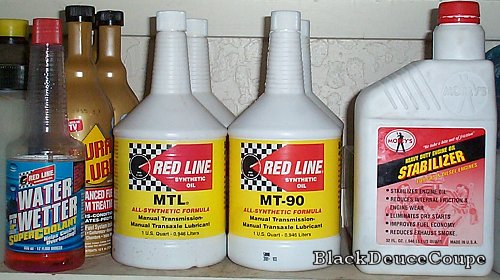
BlackDeuceCoupe - you really want to stick to using Honda MTF in the tranny.
RED LINE OIL
Manual Transmission / Manual Transaxle Lubricant
TECHNICAL INFORMATION
RED LINE MTL and MT-90 are designed to provide excellent protection and improved shiftability for manual transmissions and transaxles. MTL and MT-90 have cured the problem of hard shifting in numerous transmissions which have notoriously difficult shifting. The secret to their success is two-fold. First, they have the appropriate coefficient of friction for most manual transmission synchronizers. Many gear oils, engine oils, and ATFs are too slippery for proper synchro engagement. Secondly, the viscosity characteristics of MTL and MT-90 allow proper shifting over the entire temperature range which the transmission will experience. The synthetic base oils used have a very high viscosity index which provides relatively constant viscosity as temperature changes. MTL is a low 70W at very low temperatures and a high 80W, nearly an 85W, at elevated temperatures, providing adequate viscosity to prevent wear and deaden gear noise. MT-90 is a thicker 75W90 version of MTL. The shear stability and oxidation stability of these products are excellent, thus the physical characteristics of Red Line MTL and MT-90 will change little with use.
Red Line MTL is classified as a 70W80 gear lubricant satisfying the API Service requirements of GL-3 and GL-4. MTL also satisfies motor oil viscosities SAE 5W/10W/30, and the viscosity requirements for ATFs. MT-90 is a 75W90 GL-4 and also satisfies motor oil viscosities SAE 10W/15W/40. The additive chemistry used is non-corrosive, so even though they will provide GL-4 performance, they will not corrode synchros or bushings. Because of its low corrosivity, Red Line MTL and MT-90 could also be used in transmissions requiring GL-1 or GL-3 lubricants. Seal compatibility is designed to be similar to petroleum-based lubricants.
BENEFIT SUMMARY
- Eliminates notchy shifting
- Designed for manual transmissions and transaxles
- Perfect synchronizer coefficient of friction
- Enables high-speed downshifting
- Excellent shifting even when cold
- Eliminates gear whine and rattle at high temperatures
- High-performance gear protection
- Non-corrosive toward synchronizers
- Satisfies manual transmissions and transaxles requiring motor oils or GL-1, GL-3, or GL-4 gear oils.
IMPROVES SHIFTING
Red Line MTL and MT-90 are able to improve shifting in most manual transmissions and transaxles. They provide a relatively constant viscosity as temperature changes and provides the proper coefficient of friction to allow synchronizer engagement. Most gear oils are very viscous at lower temperatures. This higher viscosity requires increased shift effort to move the synchronizer gears with the shift fork and to squeeze the oil from between the synchronizer cone and the mating surface attached to the gear. Without contact of these two surfaces, the gear speeds will not be synchronized and locking of the synchromesh gears will not occur. Excessive viscosity results in a longer time required to synchronize before locking occurs.
Viscosity of common lubricants at 0°C (32°F) is compared with Red Line MTL in the chart below. Note that the viscosity of ATF and 10W30 motor oil seems to be adequate. These lubricants are not well suited for transmission use because of two factors - shear stability and improper coefficient of friction - which will be discussed in more detail later. At even lower temperatures such as -17.7°C (0°F), the differences between conventional lubricants and Red Line MTL are even more dramatic. At such a temperature many of these lubricants would prevent shifting into certain gears, depending on the design of the transmission.
All oils are slippery, and with most lubricated components, the slipperier the better, but this is not so with manual transmissions. The synchronization of shifting gears requires friction to transfer energy from the synchronizer, which is locked to the input shaft, to its mating surface attached to the gear to be locked in as the drive gear. Few modern transmissions use sliding gears to change gearing other than for reverse gearing. Synchromesh transmissions have the gear pairs constantly in mesh. The drive gear is selected by using the shift forks to slide a synchronizer ring, which rotates at the same speed as the input shaft, in contact with the selected drive gear. Once the drive gear is brought to the same speed as the input shaft, the locking ring on the synchro assembly is allowed to slide over and lock into the drive gear.
The time this process takes depends on how easily the synchro ring moves and the rate of frictional energy transfer between the two synchronizer surfaces. Higher viscosity lubricants slow the sliding of the synchro ring on the input shaft and require a longer time for the oil to be squeezed out from between the mating synchronizer surfaces. After the lubricant is squeezed out, the coefficient of friction of the lubricant determines the rate of frictional energy transfer between the two surfaces. Slippery lubricants such as hypoid gear oils and ATFs can take too long to synchronize the gears, which promotes synchronizer wear. Red Line MTL and MT-90 has a coefficient of friction which is greater than conventional oils, allowing a quicker transfer of frictional energy. The graph below shows the desirable friction curve demonstrated by Red Line MTL compared to conventional lubricants.
Clashing of the gears (actually clashing of the synchromesh gears, since the drive gears are always in contact) can occur if excessive shift effort is used in order to shift the locking ring into place before the surfaces have achieved equal speed. It may also occur at the end of a reasonably smooth shift if an instability exists in the coefficient of friction, causing stick-slip to occur. In this form of clashing, the ring slides on the mating synchro gear, but a sudden slippage causes a grinding of the gears. In order to prevent stick-slip from occuring and the gear clashing which results, the coefficient of friction should inflect downward as the relative speed drops to zero.
GEAR AND SYNCHRONIZER WEAR PROTECTION
Most manufacturers of manual transmissions and transaxles recommend an 80W or 90W GL-4 lubricant. GL-5 gears oils which are required in hypoid differentials are not used in most synchromesh transmissions because the chemicals used to provide the extreme pressure protection can be corrosive to synchronizers, which are commonly made of brass or bronze. Typically, the use of a GL-5 lubricant in a synchromesh transmission will shorten the synchronizer life by one half. The extreme pressure requirements of spur gears and helical gears found in transmissions are not nearly as great as found in rear-wheel drive differentials. A GL-4 lubricant provides adequate protection for most manual transmissions, unless a unique design consideration requires the extra protection of a GL-5.
The reason that many manufacturers have made recommendations of motor oils or ATFs is that petroleum 80W gear oils frequently do not shift well at low temperatures. Motor oils and ATFs are much more fluid at lower temperatures and they are not corrosive toward synchros, but they provide very poor gear protection. These lubricants provide almost no extreme-pressure protection. In addition, multigrade motor oils and ATFs have very poor shear stability. The shearing action by a manual transmission on thickeners is much worse than in an engine or automatic transmission. Within 5,000 miles the thickeners can be rendered ineffective and the transmission will be operating on a much reduced level of protection, as shown in the graph below. In hot weather these transmissions will whine and rattle because of poor vibration dampening and metal contact. Red Line MTL and MT-90 provide the excellent gear protection of a GL-4 gear oil in a synthetic lubricant which spans hot and cold temperatures and will not shear or oxidize with use.
DIRECTIONS FOR USE
Red Line MTL may be used in transmissions which recommend 70W, 75W, 80W, or 85W GL-4 gear oils, or SAE 30 or 5W/10W30 motor oils. If a 90W GL-4 or SAE 40, 10W40, or 15W40 is required, MT-90 may be used. If the transmission or transaxle requires an SAE 90 GL-5 gear oil, then Red Line 75W90NS or 75W140NS Gear Oil may be used. In transmissions which recommend Dexron or Mercon fluids we recommend our D4 ATF which is very similar to the MTL, being a GL-4 Gear Oil also. The D4 ATF will provide better low-temperature shiftability, and the MTL would provide better wear protection for racing use. MTL is not designed for use in rear-wheel drive differentials. Those generally require a GL-5 lubricant such as Red Line 75W90 Gear Oil. It is not necessary to flush the transmission before replacing with MTL. Remove the drain plug and drain while warm. Seal compatibility has been designed to be similar to petroleum lubricants, and leakage should be no greater than any other oil of comparable viscosity. Being formulated with extremely stable synthetic basestocks, MTL and MT-90 will last much longer than conventional petroleum lubricants. However, we do not recommend extended drain intervals, since without a filtration system, there is no way to remove metal shavings other than draining the lubricant. The regular maintenance intervals are also recommended to insure that the proper level of the fluid is maintained.
Manual Transmission / Manual Transaxle Lubricant
TECHNICAL INFORMATION
RED LINE MTL and MT-90 are designed to provide excellent protection and improved shiftability for manual transmissions and transaxles. MTL and MT-90 have cured the problem of hard shifting in numerous transmissions which have notoriously difficult shifting. The secret to their success is two-fold. First, they have the appropriate coefficient of friction for most manual transmission synchronizers. Many gear oils, engine oils, and ATFs are too slippery for proper synchro engagement. Secondly, the viscosity characteristics of MTL and MT-90 allow proper shifting over the entire temperature range which the transmission will experience. The synthetic base oils used have a very high viscosity index which provides relatively constant viscosity as temperature changes. MTL is a low 70W at very low temperatures and a high 80W, nearly an 85W, at elevated temperatures, providing adequate viscosity to prevent wear and deaden gear noise. MT-90 is a thicker 75W90 version of MTL. The shear stability and oxidation stability of these products are excellent, thus the physical characteristics of Red Line MTL and MT-90 will change little with use.
Red Line MTL is classified as a 70W80 gear lubricant satisfying the API Service requirements of GL-3 and GL-4. MTL also satisfies motor oil viscosities SAE 5W/10W/30, and the viscosity requirements for ATFs. MT-90 is a 75W90 GL-4 and also satisfies motor oil viscosities SAE 10W/15W/40. The additive chemistry used is non-corrosive, so even though they will provide GL-4 performance, they will not corrode synchros or bushings. Because of its low corrosivity, Red Line MTL and MT-90 could also be used in transmissions requiring GL-1 or GL-3 lubricants. Seal compatibility is designed to be similar to petroleum-based lubricants.
BENEFIT SUMMARY
- Eliminates notchy shifting
- Designed for manual transmissions and transaxles
- Perfect synchronizer coefficient of friction
- Enables high-speed downshifting
- Excellent shifting even when cold
- Eliminates gear whine and rattle at high temperatures
- High-performance gear protection
- Non-corrosive toward synchronizers
- Satisfies manual transmissions and transaxles requiring motor oils or GL-1, GL-3, or GL-4 gear oils.
IMPROVES SHIFTING
Red Line MTL and MT-90 are able to improve shifting in most manual transmissions and transaxles. They provide a relatively constant viscosity as temperature changes and provides the proper coefficient of friction to allow synchronizer engagement. Most gear oils are very viscous at lower temperatures. This higher viscosity requires increased shift effort to move the synchronizer gears with the shift fork and to squeeze the oil from between the synchronizer cone and the mating surface attached to the gear. Without contact of these two surfaces, the gear speeds will not be synchronized and locking of the synchromesh gears will not occur. Excessive viscosity results in a longer time required to synchronize before locking occurs.
Viscosity of common lubricants at 0°C (32°F) is compared with Red Line MTL in the chart below. Note that the viscosity of ATF and 10W30 motor oil seems to be adequate. These lubricants are not well suited for transmission use because of two factors - shear stability and improper coefficient of friction - which will be discussed in more detail later. At even lower temperatures such as -17.7°C (0°F), the differences between conventional lubricants and Red Line MTL are even more dramatic. At such a temperature many of these lubricants would prevent shifting into certain gears, depending on the design of the transmission.
All oils are slippery, and with most lubricated components, the slipperier the better, but this is not so with manual transmissions. The synchronization of shifting gears requires friction to transfer energy from the synchronizer, which is locked to the input shaft, to its mating surface attached to the gear to be locked in as the drive gear. Few modern transmissions use sliding gears to change gearing other than for reverse gearing. Synchromesh transmissions have the gear pairs constantly in mesh. The drive gear is selected by using the shift forks to slide a synchronizer ring, which rotates at the same speed as the input shaft, in contact with the selected drive gear. Once the drive gear is brought to the same speed as the input shaft, the locking ring on the synchro assembly is allowed to slide over and lock into the drive gear.
The time this process takes depends on how easily the synchro ring moves and the rate of frictional energy transfer between the two synchronizer surfaces. Higher viscosity lubricants slow the sliding of the synchro ring on the input shaft and require a longer time for the oil to be squeezed out from between the mating synchronizer surfaces. After the lubricant is squeezed out, the coefficient of friction of the lubricant determines the rate of frictional energy transfer between the two surfaces. Slippery lubricants such as hypoid gear oils and ATFs can take too long to synchronize the gears, which promotes synchronizer wear. Red Line MTL and MT-90 has a coefficient of friction which is greater than conventional oils, allowing a quicker transfer of frictional energy. The graph below shows the desirable friction curve demonstrated by Red Line MTL compared to conventional lubricants.
Clashing of the gears (actually clashing of the synchromesh gears, since the drive gears are always in contact) can occur if excessive shift effort is used in order to shift the locking ring into place before the surfaces have achieved equal speed. It may also occur at the end of a reasonably smooth shift if an instability exists in the coefficient of friction, causing stick-slip to occur. In this form of clashing, the ring slides on the mating synchro gear, but a sudden slippage causes a grinding of the gears. In order to prevent stick-slip from occuring and the gear clashing which results, the coefficient of friction should inflect downward as the relative speed drops to zero.
GEAR AND SYNCHRONIZER WEAR PROTECTION
Most manufacturers of manual transmissions and transaxles recommend an 80W or 90W GL-4 lubricant. GL-5 gears oils which are required in hypoid differentials are not used in most synchromesh transmissions because the chemicals used to provide the extreme pressure protection can be corrosive to synchronizers, which are commonly made of brass or bronze. Typically, the use of a GL-5 lubricant in a synchromesh transmission will shorten the synchronizer life by one half. The extreme pressure requirements of spur gears and helical gears found in transmissions are not nearly as great as found in rear-wheel drive differentials. A GL-4 lubricant provides adequate protection for most manual transmissions, unless a unique design consideration requires the extra protection of a GL-5.
The reason that many manufacturers have made recommendations of motor oils or ATFs is that petroleum 80W gear oils frequently do not shift well at low temperatures. Motor oils and ATFs are much more fluid at lower temperatures and they are not corrosive toward synchros, but they provide very poor gear protection. These lubricants provide almost no extreme-pressure protection. In addition, multigrade motor oils and ATFs have very poor shear stability. The shearing action by a manual transmission on thickeners is much worse than in an engine or automatic transmission. Within 5,000 miles the thickeners can be rendered ineffective and the transmission will be operating on a much reduced level of protection, as shown in the graph below. In hot weather these transmissions will whine and rattle because of poor vibration dampening and metal contact. Red Line MTL and MT-90 provide the excellent gear protection of a GL-4 gear oil in a synthetic lubricant which spans hot and cold temperatures and will not shear or oxidize with use.
DIRECTIONS FOR USE
Red Line MTL may be used in transmissions which recommend 70W, 75W, 80W, or 85W GL-4 gear oils, or SAE 30 or 5W/10W30 motor oils. If a 90W GL-4 or SAE 40, 10W40, or 15W40 is required, MT-90 may be used. If the transmission or transaxle requires an SAE 90 GL-5 gear oil, then Red Line 75W90NS or 75W140NS Gear Oil may be used. In transmissions which recommend Dexron or Mercon fluids we recommend our D4 ATF which is very similar to the MTL, being a GL-4 Gear Oil also. The D4 ATF will provide better low-temperature shiftability, and the MTL would provide better wear protection for racing use. MTL is not designed for use in rear-wheel drive differentials. Those generally require a GL-5 lubricant such as Red Line 75W90 Gear Oil. It is not necessary to flush the transmission before replacing with MTL. Remove the drain plug and drain while warm. Seal compatibility has been designed to be similar to petroleum lubricants, and leakage should be no greater than any other oil of comparable viscosity. Being formulated with extremely stable synthetic basestocks, MTL and MT-90 will last much longer than conventional petroleum lubricants. However, we do not recommend extended drain intervals, since without a filtration system, there is no way to remove metal shavings other than draining the lubricant. The regular maintenance intervals are also recommended to insure that the proper level of the fluid is maintained.


HT White Ops
Joined: Oct 2001
Posts: 2,813
Likes: 2
From: Arizona Uplands
Re: what type of motor oil should i use? (neof69)
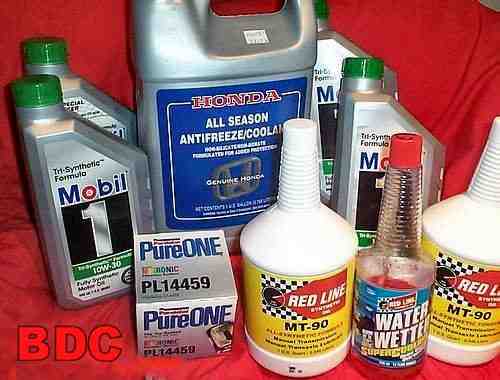
Use Mobil 1 which is what Honda uses and always use OEM Honda oil filters!!!!!
If you're interested, here's a sound clip of a F1 Honda RA001E engine being run on the dyno at Honda Racing Development in Bracknell at 17000+ RPM. Kinda puts it in perspective...
http://www.hondaf1.com/soundpop.htm
Secondly, Honda OEM oil filters suck! Japs keep the best for themselves. The best ones are 'Made in Japan" but you CANNOT buy them in the states. Take a close look at your OE filter. It'll either say 'Made in Canada" [if you're lucky] or "Made in USA" [the worst Honda oil filter made.]
The "Made in Japan" filters are made by Toyo Roki and Tennex, and they're excellent. Too bad YOU can't get them [unless you buy a new S2000].
The "Made in Canada" filters are [internally] identical in construction to FRAM's, and most likely made by them.
The "Made in USA" filters are made by FILTECH [a large US manufacturer of filters under various brand names]. They are MUCH MUCH WORSE than a FRAM, if you can imagine such a thing...
Anyway:
 for Mobil 1 motor oil.
 for Honda oil filters!
HT White Ops
Joined: Oct 2001
Posts: 2,813
Likes: 2
From: Arizona Uplands
Re: what type of motor oil should i use? (rotaryguy)
...my question is, when you switch to synthetic, you still have some organic left in the crank case coating the parts inside...by the next oil change you should be pretty close to 100% synth, right?...
The problem comes up when you change from one brand of synthetic oil to another. Since it is impossible to get every drop of oil out of a motor before switching from one brand of synthetic motor oil to another, what do you do???
If you decide to switch from Castrol Syntec
to Mobil 1 [smart move] for instance, you should switch back to dinosaur juice, first, for a couple of oil changes, THEN put the Mobil 1 in.Dinosaur juice is dinosaur juice, however, there are 7 or 8 different ways to make synthetic motor oils and the chemistry is completely different for each one. DO NOT MIX DIFFERENT BRANDS OF SYNTHETIC MOTOR OIL!!! Flush the system before switching to a different brand...

Global Moderator
Joined: Jan 2000
Posts: 11,470
Likes: 0
From: Yokohama, Japan
Re: what type of motor oil should i use? (BlackDeuceCoupe)
Japs keep the best for themselves.
I tried Redline for a while and my synchros didn't appreciate it too much. Honda MTF is the way to go, ask anyone in the know. My Kaaz is a happy camper with the Honda MTF. Real-world applications matter to me, not advertising.


Member
Joined: Oct 2001
Posts: 5,261
Likes: 0
From: Tacoma, WA
Re: what type of motor oil should i use? (Reid)
Japs keep the best for themselves.
Watch the racist comments.
Watch the racist comments.
Anyway, BlackDeuceCoupe nailed the filter thing. For more info on filters, try:
http://www.ntpog.org/reviews/filters/filters.shtml
HT White Ops
Joined: Oct 2001
Posts: 2,813
Likes: 2
From: Arizona Uplands
Re: what type of motor oil should i use? (Reid)
Japs keep the best for themselves.
Watch the racist comments.
Real-world applications matter to me, not advertising.
Watch the racist comments.
Real-world applications matter to me, not advertising.


Honda-Tech Member
Joined: Oct 2001
Posts: 1,319
Likes: 0
From: ATL
Re: what type of motor oil should i use? (JDM EG HATCH)
on the ITR best motoring video, the president of spoon said that expensive oil is unnessasary(sp?) and to use what the manufacturer suggests.
HT White Ops
Joined: Oct 2001
Posts: 2,813
Likes: 2
From: Arizona Uplands
MORE THAN YOU EVER WANTED TO KNOW ABOUT HONDA OIL FILTERS
whats the big deal on honda oil filters?? i use FRAM from kragen does it really matter?? just wondering.....
Originally posted by BlackDeuceCoupe
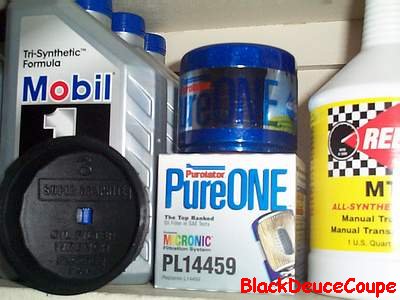
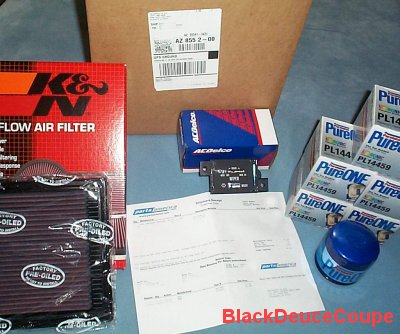
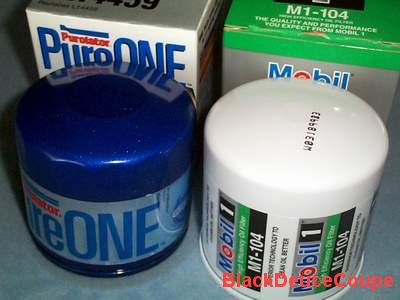
...Yeah, I 'studied' oil filters for months. I could 'go on' about this subject for pages. Bottom line is, I run the Purolator "PureONE" PL14459. They list for $13.50, but Pep Boys sells them for $5.99 in our area. They are simply THE best paper media oil filter you can buy --- period.
My second choice would be the ACDelco UltraGuard Gold UPF1127. Pep Boys sells them for $8.99. They have synthetic media. These are the best synthetic media filters you can buy.
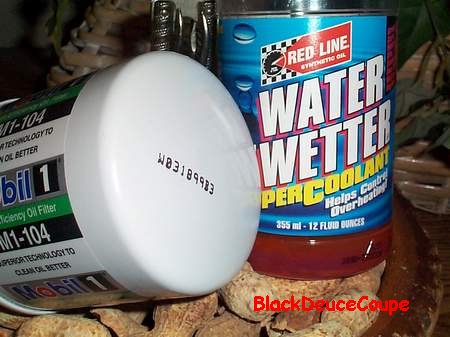
My third choice would be the Mobil 1 M1-104. They are about the same price as the ACDelco. These are generic Champion brand [not the spark plug ppl - different company] synthetic media filters, with a think-walled case and no facets. They're okay, but... The K&N oil filter is the same generic Champion filter with a 'nut' welded on the end of the case, so you can remove it with a regular wrench.
Lastly --- I would got the OE route. I think you can get Honda OE filters for about $3.99/mail order the last time I checked... If you're going to go this route, you might as well buy a 99-cent Pennzoil filter at K-mart and save your money, IMO.
Whatever you do, DO NOT USE FRAM FILTERS!!! FRAM SUCKS!!!
...Yeah, I 'studied' oil filters for months. I could 'go on' about this subject for pages. Bottom line is, I run the Purolator "PureONE" PL14459. They list for $13.50, but Pep Boys sells them for $5.99 in our area. They are simply THE best paper media oil filter you can buy --- period.
My second choice would be the ACDelco UltraGuard Gold UPF1127. Pep Boys sells them for $8.99. They have synthetic media. These are the best synthetic media filters you can buy.
My third choice would be the Mobil 1 M1-104. They are about the same price as the ACDelco. These are generic Champion brand [not the spark plug ppl - different company] synthetic media filters, with a think-walled case and no facets. They're okay, but... The K&N oil filter is the same generic Champion filter with a 'nut' welded on the end of the case, so you can remove it with a regular wrench.
Lastly --- I would got the OE route. I think you can get Honda OE filters for about $3.99/mail order the last time I checked... If you're going to go this route, you might as well buy a 99-cent Pennzoil filter at K-mart and save your money, IMO.
Whatever you do, DO NOT USE FRAM FILTERS!!! FRAM SUCKS!!!
Originally posted by BlackDeuceCoupe
Come on... don't make me do this...
First of all, Fram makes poo poo filters. This has been true since Allied Signal took them over. They have a nice radioactive-orange paint job, but all you have to do is look inside one to see what a piece of junk they are; you don't even have to cut them open; just look in 'the hole.' Having said that, they are the #1 seller. Go figure. Ppl are stupid! Frams 'catch your eye', and they're easy on your pocketbook. You can buy them at Wal-Mart for 2/$5, 365 days a year...
My primary concern with Fram filters are their cardboard end caps. The cardboard will deteriorate over time and come loose. I would be particularly concerned about this in a racing environment where higher pressures are common.
I don't normally shop at Pep Boys, but they have the best selection of oil filters of any auto store I've ever been in. Go to a Pep Boys and get the filters I've talked about. Take them to the parts counter and open the boxes up, place them side-by-side and look inside the filters. That will probably be enough to make you swear off of Fram filters for life.
Here's some hype on the PureONE:

"Why purchase a PureONE filter over other leading brands?"
PureONE offers several advantages over leading filter brands:
Filtration Efficiency. PureONE is clearly superior to all other leading brands. With its exclusive Micronic ® filtration system, PureONE captures 96% of all contaminants as measured by the Society of Automotive Engineers' (SAE) #J806 Multiple Pass Test.
More pleats. Provide more filter surface area to prevent oil restriction and allow an added measure of engine protection.
Silicone anti-drainback valve. Retains oil in the filter providing quick lubrication to vital engine parts at start-up. (On models as required by the manufacturer.)
PTFE coated sealing gasket. Reduces friction to assist in removal of the filter.
"How is PureONE's media different from that of other filters?"
PureONE's Micronic ® media is the result of years of research and testing, and it represents the very best in filtering performance available today. The media is not coated with any engine treatment, nor will it strip the engine oil of any additive package that may have been used.
"What is the Multiple Pass Test?"
The Multiple Pass Test of Life and Weighted Average Efficiency (SAE J806) tests a series of oil filter performance variables using a constant flow of contaminated oil through the filter. It measures the media's ability to remove fine dust from oil over an extended period of time-not just the first pass through.
"How does the Single Pass Test differ from the Multiple Pass Test?"
The single pass test merely passes fluid containing tiny glass beads through the filter media. Any beads that pass through are measured to determine the media's efficiency.
In Purolater's opinion, the Multiple Pass Test is much more representative of real life conditions than the Single Pass Test.
<u>For the record, however, PureONE ranked #1 in both Multiple Pass and Single Pass Efficiency Tests. </u>
"If the Single Pass Test efficiency for the PureONE filter is 99.7%, why does it go down to 96% in a Multiple Pass Test?"
As described above, they are two entirely different tests measuring different filter performance requirements.
"Do PureONE's added pleats reduce oil filter flow?"
No. The added pleats help reduce restriction by providing a broader filtration area.
"What is a micron rating?"
Many questions have arisen as to what a micron rating is, and how PureONE compares in this regard with other leading brands.
To begin with, there is no "standard" for a "micron rating." In other words, a micron rating means different things to different people -- depending on who's doing the testing, what type/weight of oil is used, at what rate the oil is injected into the media, etc.
Purolator, therefore, has chosen the BETA ratio-SAE Test J1858-as being representative of its "micron rating." A BETA ratio is a measure of the number of particles that enter the filter to the number of particles that leave the filter. The PureONE filter has a BETA ratio of 7.2 at 10 microns. This corresponds to an efficiency rating of 86.1%-meaning that the PureONE filter removes 86.1% of 10 micron-sized particles and above from contaminated oil-43.5% better than the closest competitor!
Following is a list of some of the leading brand's BETA ratios and corresponding efficiencies at a particle size of 10 microns*:
Brand BETA Ratio Efficiency Rating:
PureONE 7.2 86.1% efficient
Fram Extraguard 2.5 60.0% efficient
Hard Driver 2.2 54.5% efficient
Wix Sport Truck 2.2 54.5% efficient
AC Duraguard 1.5 33.3% efficient
*Data was compiled in accordance with SAE Test Procedure J1858
on PureONE PL 30001 oil filter and competitive equivalents.
"What is the significance of a "silicone" anti-drainback valve?"
Silicone provides a higher resistance to heat and cold, and allows greater flexibility than traditional nitrite rubber gaskets.
"Can I go longer intervals between oil changes with PureONE?"
It is recommended that you change your oil every 3,000 miles, or according to the owner's manual. The PureONE filter is designed to give you optimum protection over the life of your oil change.
xxxxxxxxxxxxxxxxxxxxxxxxxxxxxxxxxxxxxxxxxxxxxx
xxxxxxxxxxxxxxxxxxxxxxxxxxxxxxxxxxxxxxxxxxxxxx
xxxxxxxxxxxxxxxxxxxxxxxxxxxxxxxxxxxxxxxxxxxxxx
Here's BDC again...
Most North American Honda OE filters are made by FILTECH, a division of Toyo Roki. If you want to read about them, follow this http://www.toyoroki.co.jp/english/index.html.
Two things here. I'm sure they are V nice ppl, but has anyone besides me ever heard of them??? Plus, you get what you pay for; you know?
Secondly, the larger point here is that Honda DOES NOT make their own filters, as so many ppl think. While they are "Made in Canada" and look V similar in construction to the Fram filter mentioned above, cardboard end caps and all, but with increased surface area and increased inlet area. Personally, I would not be suprised if Honda or Toyo Roki has outsourced these filters to Allied Signal. If it says "Made in Canada", beware!!!
Anyone familiar with Hondas knows that the Japanese keep the best for themselves. This apparently applies to oil filters as well. The JDM Toyo Roki and Tennex filters use steel end caps, a steel bypass valve [with V stiff spring], and a media that looks similar in thickness and quality to premium paper media filters like the PureONE. They say "Made in Japan."
It should be noted that these filters are NOT available in the North America at all; they are only available in Japan, the orient, and more than likely the UK and Australia. The only way to get one from Honda in the US is to purchase a new Honda made in Japan. This is the filter that they put on the S2000 at the factory.
In the US, if you order the JDM part number, you will be subbed a US or Canadian filter instead. So far, there is no one known to be importing these filters. If you want one, you will have to find a source and have it shipped yourself.
If you are REALLY unlucky, you will end up with an OE filter that says "Made in USA." These are the worst pieces of crap imaginable. This filter looks identical to the Toyo Roki-made JDM filter at first glance; externally the same construction. The only indicator is the "FILTECH" stamped on the outside [a large US manufacturer of filters under various brand names].
Internally it's [almost] identical to the JDM filter; steel end caps, steel bypass valve, et cetera. What makes it stand out as different is the radically different filter media. The US media looks much, much worse than the Fram. While the filter itself is constructed very well [like the Japanese one], it also has the least surface area of all the Honda filters [though only a few inches less than the Canadian one].
Is the PureONE looking better to you know???
Come on... don't make me do this...
First of all, Fram makes poo poo filters. This has been true since Allied Signal took them over. They have a nice radioactive-orange paint job, but all you have to do is look inside one to see what a piece of junk they are; you don't even have to cut them open; just look in 'the hole.' Having said that, they are the #1 seller. Go figure. Ppl are stupid! Frams 'catch your eye', and they're easy on your pocketbook. You can buy them at Wal-Mart for 2/$5, 365 days a year...
My primary concern with Fram filters are their cardboard end caps. The cardboard will deteriorate over time and come loose. I would be particularly concerned about this in a racing environment where higher pressures are common.
I don't normally shop at Pep Boys, but they have the best selection of oil filters of any auto store I've ever been in. Go to a Pep Boys and get the filters I've talked about. Take them to the parts counter and open the boxes up, place them side-by-side and look inside the filters. That will probably be enough to make you swear off of Fram filters for life.
Here's some hype on the PureONE:
"Why purchase a PureONE filter over other leading brands?"
PureONE offers several advantages over leading filter brands:
Filtration Efficiency. PureONE is clearly superior to all other leading brands. With its exclusive Micronic ® filtration system, PureONE captures 96% of all contaminants as measured by the Society of Automotive Engineers' (SAE) #J806 Multiple Pass Test.
More pleats. Provide more filter surface area to prevent oil restriction and allow an added measure of engine protection.
Silicone anti-drainback valve. Retains oil in the filter providing quick lubrication to vital engine parts at start-up. (On models as required by the manufacturer.)
PTFE coated sealing gasket. Reduces friction to assist in removal of the filter.
"How is PureONE's media different from that of other filters?"
PureONE's Micronic ® media is the result of years of research and testing, and it represents the very best in filtering performance available today. The media is not coated with any engine treatment, nor will it strip the engine oil of any additive package that may have been used.
"What is the Multiple Pass Test?"
The Multiple Pass Test of Life and Weighted Average Efficiency (SAE J806) tests a series of oil filter performance variables using a constant flow of contaminated oil through the filter. It measures the media's ability to remove fine dust from oil over an extended period of time-not just the first pass through.
"How does the Single Pass Test differ from the Multiple Pass Test?"
The single pass test merely passes fluid containing tiny glass beads through the filter media. Any beads that pass through are measured to determine the media's efficiency.
In Purolater's opinion, the Multiple Pass Test is much more representative of real life conditions than the Single Pass Test.
<u>For the record, however, PureONE ranked #1 in both Multiple Pass and Single Pass Efficiency Tests. </u>
"If the Single Pass Test efficiency for the PureONE filter is 99.7%, why does it go down to 96% in a Multiple Pass Test?"
As described above, they are two entirely different tests measuring different filter performance requirements.
"Do PureONE's added pleats reduce oil filter flow?"
No. The added pleats help reduce restriction by providing a broader filtration area.
"What is a micron rating?"
Many questions have arisen as to what a micron rating is, and how PureONE compares in this regard with other leading brands.
To begin with, there is no "standard" for a "micron rating." In other words, a micron rating means different things to different people -- depending on who's doing the testing, what type/weight of oil is used, at what rate the oil is injected into the media, etc.
Purolator, therefore, has chosen the BETA ratio-SAE Test J1858-as being representative of its "micron rating." A BETA ratio is a measure of the number of particles that enter the filter to the number of particles that leave the filter. The PureONE filter has a BETA ratio of 7.2 at 10 microns. This corresponds to an efficiency rating of 86.1%-meaning that the PureONE filter removes 86.1% of 10 micron-sized particles and above from contaminated oil-43.5% better than the closest competitor!
Following is a list of some of the leading brand's BETA ratios and corresponding efficiencies at a particle size of 10 microns*:
Brand BETA Ratio Efficiency Rating:
PureONE 7.2 86.1% efficient
Fram Extraguard 2.5 60.0% efficient
Hard Driver 2.2 54.5% efficient
Wix Sport Truck 2.2 54.5% efficient
AC Duraguard 1.5 33.3% efficient
*Data was compiled in accordance with SAE Test Procedure J1858
on PureONE PL 30001 oil filter and competitive equivalents.
"What is the significance of a "silicone" anti-drainback valve?"
Silicone provides a higher resistance to heat and cold, and allows greater flexibility than traditional nitrite rubber gaskets.
"Can I go longer intervals between oil changes with PureONE?"
It is recommended that you change your oil every 3,000 miles, or according to the owner's manual. The PureONE filter is designed to give you optimum protection over the life of your oil change.
xxxxxxxxxxxxxxxxxxxxxxxxxxxxxxxxxxxxxxxxxxxxxx
xxxxxxxxxxxxxxxxxxxxxxxxxxxxxxxxxxxxxxxxxxxxxx
xxxxxxxxxxxxxxxxxxxxxxxxxxxxxxxxxxxxxxxxxxxxxx
Here's BDC again...
Most North American Honda OE filters are made by FILTECH, a division of Toyo Roki. If you want to read about them, follow this http://www.toyoroki.co.jp/english/index.html.
Two things here. I'm sure they are V nice ppl, but has anyone besides me ever heard of them??? Plus, you get what you pay for; you know?
Secondly, the larger point here is that Honda DOES NOT make their own filters, as so many ppl think. While they are "Made in Canada" and look V similar in construction to the Fram filter mentioned above, cardboard end caps and all, but with increased surface area and increased inlet area. Personally, I would not be suprised if Honda or Toyo Roki has outsourced these filters to Allied Signal. If it says "Made in Canada", beware!!!
Anyone familiar with Hondas knows that the Japanese keep the best for themselves. This apparently applies to oil filters as well. The JDM Toyo Roki and Tennex filters use steel end caps, a steel bypass valve [with V stiff spring], and a media that looks similar in thickness and quality to premium paper media filters like the PureONE. They say "Made in Japan."
It should be noted that these filters are NOT available in the North America at all; they are only available in Japan, the orient, and more than likely the UK and Australia. The only way to get one from Honda in the US is to purchase a new Honda made in Japan. This is the filter that they put on the S2000 at the factory.
In the US, if you order the JDM part number, you will be subbed a US or Canadian filter instead. So far, there is no one known to be importing these filters. If you want one, you will have to find a source and have it shipped yourself.
If you are REALLY unlucky, you will end up with an OE filter that says "Made in USA." These are the worst pieces of crap imaginable. This filter looks identical to the Toyo Roki-made JDM filter at first glance; externally the same construction. The only indicator is the "FILTECH" stamped on the outside [a large US manufacturer of filters under various brand names].
Internally it's [almost] identical to the JDM filter; steel end caps, steel bypass valve, et cetera. What makes it stand out as different is the radically different filter media. The US media looks much, much worse than the Fram. While the filter itself is constructed very well [like the Japanese one], it also has the least surface area of all the Honda filters [though only a few inches less than the Canadian one].
Is the PureONE looking better to you know???

Honda-Tech Member
Joined: Aug 2001
Posts: 1,229
Likes: 1
From: Watchung, NJ, USA
Re: MORE THAN YOU EVER WANTED TO KNOW ABOUT HONDA OIL FILTERS (BlackDeuceCoupe)
Just curious, but do you take all your "proof" straight from the manufacturer's web pages? Of course they aren't going to tell you "well, our stuff isn't quite the best, but we'd like you to buy it..." If you could believe everything the manufacturers told you, everyone would be running around with duralube, zmax, and the tornado...but not everyone is. I'm not flaming, just saying you should base your choices on unbiased tests/comparisons. If you have, I'll shut up... 