


Catch Can options


Thread Starter
Honda-Tech Member
Joined: Jul 2001
Posts: 633
Likes: 1
From: USA
 Catch Can options
I know this has been covered a thousand times and I've done a lot reading on this topic. From what I've read I have a couple of options on hooking it up.
1. Run one line from the PCV to the catch can and another from the catch can to the IM.
2. Hook it up the way endyn does using the two blocked off ports on the back of the black and eliminating the black box on the back of the block.
3. Tap into the valve cover making two ports to run to the catch can.
Are all three of these options good? I was going to hook mine up using method 1. Also which catch can would you guys recommend? One with a filter on top or no filter? Also which catch cans come baffled? This is for a 1994 LS by the way.
1. Run one line from the PCV to the catch can and another from the catch can to the IM.
2. Hook it up the way endyn does using the two blocked off ports on the back of the black and eliminating the black box on the back of the block.
3. Tap into the valve cover making two ports to run to the catch can.
Are all three of these options good? I was going to hook mine up using method 1. Also which catch can would you guys recommend? One with a filter on top or no filter? Also which catch cans come baffled? This is for a 1994 LS by the way.


Member
Joined: Apr 2003
Posts: 1,210
Likes: 0
From: Now in SoCal, CA, USA
Re: Catch Can options (sneakypete)
damn they should make a sticky thread with the right catch can info...
here's how I'm doing it as explained to me by the Z10 engineers:
-take off stock PCV system
-plug the bottom hole that was behind oem "black box" (z10 sells a plug for it)
-remove the oil galley plug (on the back of the block) thats closest to the tranny and replace it with a hose fitting (honda part # 11107-PK2-003 for fitting, honda part # 12207-634-003 for fitting washer)
-run a hose from that fitting to the top of the catch can
-run another hose from the valve cover to the top of the catch can
-mount the catch can as high up in engine bay as possible
-use catch can with air filter
-no oil drain return, just manually drain once in a while

here's how I'm doing it as explained to me by the Z10 engineers:
-take off stock PCV system
-plug the bottom hole that was behind oem "black box" (z10 sells a plug for it)
-remove the oil galley plug (on the back of the block) thats closest to the tranny and replace it with a hose fitting (honda part # 11107-PK2-003 for fitting, honda part # 12207-634-003 for fitting washer)
-run a hose from that fitting to the top of the catch can
-run another hose from the valve cover to the top of the catch can
-mount the catch can as high up in engine bay as possible
-use catch can with air filter
-no oil drain return, just manually drain once in a while


Trending Topics

Member
Joined: Apr 2003
Posts: 1,888
Likes: 0
From: ???????
Re: Catch Can options (jDMJeRk)
<TABLE WIDTH="90%" CELLSPACING=0 CELLPADDING=0 ALIGN=CENTER><TR><TD>Quote, originally posted by jDMJeRk »</TD></TR><TR><TD CLASS="quote">Pictures taken from HaberDashers Turbo Guide from g2ic.com; much respect given to him!
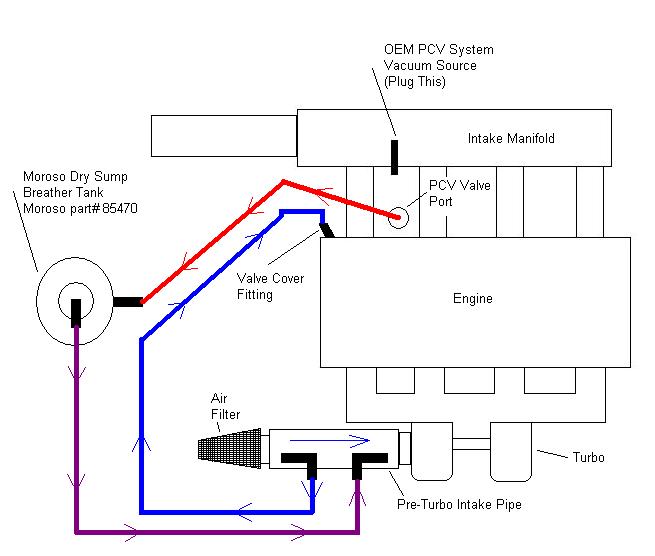
 </TD></TR></TABLE>
the first diagram is bullshit....
the valve cover releases pressure out of the nipple... dont believe me? put your finger on it and rev the motor.. you will feel air blow OUT of it... why would he make a line go from the valve cover nipple to the preturbo FACING the filter, like forcing air into it... thats a nooo nonono.. if anything you would want to face it toward the turbo so the turbo pulls the air out of the valve cover... this is similar to how i ran mine, but inbetween the line i put a catch can to catch any oil if it ever spewed out of the valve cover, which none has.
</TD></TR></TABLE>the first diagram is bullshit....
the valve cover releases pressure out of the nipple... dont believe me? put your finger on it and rev the motor.. you will feel air blow OUT of it... why would he make a line go from the valve cover nipple to the preturbo FACING the filter, like forcing air into it... thats a nooo nonono.. if anything you would want to face it toward the turbo so the turbo pulls the air out of the valve cover... this is similar to how i ran mine, but inbetween the line i put a catch can to catch any oil if it ever spewed out of the valve cover, which none has.

Joined: Dec 2004
Posts: 377
Likes: 0
Re: Catch Can options (jDMJeRk)
<TABLE WIDTH="90%" CELLSPACING=0 CELLPADDING=0 ALIGN=CENTER><TR><TD>Quote, originally posted by jDMJeRk »</TD></TR><TR><TD CLASS="quote">Pictures taken from HaberDashers Turbo Guide from g2ic.com; much respect given to him!
</TD></TR></TABLE>
Do not run this setup. It doesn't pull the vapours from the crankcase. I have tested it and blew out my cam seals. Get rid of the pcv and use the exhaust to vacuum the crankcase.
</TD></TR></TABLE>Do not run this setup. It doesn't pull the vapours from the crankcase. I have tested it and blew out my cam seals. Get rid of the pcv and use the exhaust to vacuum the crankcase.
Thread Starter
Honda-Tech Member
Joined: Jul 2001
Posts: 633
Likes: 1
From: USA
Re: Catch Can options (vtec.dc2)
<TABLE WIDTH="90%" CELLSPACING=0 CELLPADDING=0 ALIGN=CENTER><TR><TD>Quote, originally posted by vtec.dc2 »</TD></TR><TR><TD CLASS="quote">pic modified by me to show my setup.. been running for over 25k miles
 </TD></TR></TABLE>
Thats how I was going to run mine. But then some people say that it doesn't work. Is there any way for running a catch can correctly without using the back of the block and/or tapping into the valve cover?
</TD></TR></TABLE>Thats how I was going to run mine. But then some people say that it doesn't work. Is there any way for running a catch can correctly without using the back of the block and/or tapping into the valve cover?


 [/IMG]

Honda-Tech Member
Joined: Aug 2002
Posts: 6,112
Likes: 0
Re: Catch Can options (sneakypete)
<TABLE WIDTH="90%" CELLSPACING=0 CELLPADDING=0 ALIGN=CENTER><TR><TD>Quote, originally posted by sneakypete »</TD></TR><TR><TD CLASS="quote">
Thats how I was going to run mine. But then some people say that it doesn't work. Is there any way for running a catch can correctly without using the back of the block and/or tapping into the valve cover?</TD></TR></TABLE>
i don't know why they say it doesn't work, cause i've been running it like that for a while. and no breather filter
Thats how I was going to run mine. But then some people say that it doesn't work. Is there any way for running a catch can correctly without using the back of the block and/or tapping into the valve cover?</TD></TR></TABLE>
i don't know why they say it doesn't work, cause i've been running it like that for a while. and no breather filter

Honda-Tech Member
Joined: Aug 2003
Posts: 2,462
Likes: 0
From: 310, Ca

Honda-Tech Member
Joined: Jun 2003
Posts: 3,775
Likes: 0
From: Danbury, CT, 06804
Re: Catch Can options (DENCIO)
run your catch cans just like stock but remotely, and baffled. stock design is great. use the honda fitting on the oil galley for the drain, then run the smaller oil line up to the side of the catch can, and on top of the catch can put a pvc valve with an open element filter.

Junior Member
Joined: Sep 2003
Posts: 267
Likes: 0
From: Miami, FL, USA
Re: Catch Can options (jDMJeRk)
<TABLE WIDTH="90%" CELLSPACING=0 CELLPADDING=0 ALIGN=CENTER><TR><TD>Quote, originally posted by jDMJeRk »</TD></TR><TR><TD CLASS="quote">Pictures taken from HaberDashers Turbo Guide from g2ic.com; much respect given to him!
</TD></TR></TABLE>
In this diagram the fitting facing the turbo will always be in vaccum... Why wont this work? As for as the valve cover goes... Would teeing a line coming from the valve cover to the line going to the catch can from the pcv valve work? This makes sense to me... Something like this...

Modified by Boosted96EK at 9:55 AM 1/4/2005
</TD></TR></TABLE>
In this diagram the fitting facing the turbo will always be in vaccum... Why wont this work? As for as the valve cover goes... Would teeing a line coming from the valve cover to the line going to the catch can from the pcv valve work? This makes sense to me... Something like this...
Modified by Boosted96EK at 9:55 AM 1/4/2005

Member
Joined: Apr 2002
Posts: 1,842
Likes: 1
From: Somewhere in, FL, USA
Re: Catch Can options
Oil being introduced into your compressor housing, intercooler, and intake charge is never a good idea.
The baffled catch-can will not "catch" all the oil vapors especially when their is vacuum helping assist the oil vapors to leave the catch-can.
Has anyone actually used this setup for more than 15k miles? If so I think it would be interesting to see the inside of the compressor housing and intercooler.
The baffled catch-can will not "catch" all the oil vapors especially when their is vacuum helping assist the oil vapors to leave the catch-can.
Has anyone actually used this setup for more than 15k miles? If so I think it would be interesting to see the inside of the compressor housing and intercooler.

Joined: Oct 2000
Posts: 4,440
Likes: 2
From: Surrey, BC, Canada
Re: Catch Can options (btotherizzle)
<TABLE WIDTH="90%" CELLSPACING=0 CELLPADDING=0 ALIGN=CENTER><TR><TD>Quote, originally posted by btotherizzle »</TD></TR><TR><TD CLASS="quote">
Do not run this setup. It doesn't pull the vapours from the crankcase. I have tested it and blew out my cam seals. Get rid of the pcv and use the exhaust to vacuum the crankcase.</TD></TR></TABLE>
If you actually read what it says, it says use the PCV Valve *port*, not the PCV valve. In short, the pic's telling you remove the PCV.
Do not run this setup. It doesn't pull the vapours from the crankcase. I have tested it and blew out my cam seals. Get rid of the pcv and use the exhaust to vacuum the crankcase.</TD></TR></TABLE>
If you actually read what it says, it says use the PCV Valve *port*, not the PCV valve. In short, the pic's telling you remove the PCV.

Trial User
Joined: Jun 2004
Posts: 839
Likes: 0
From: Seattle, WA
Re: Catch Can options (dasher)
<TABLE WIDTH="90%" CELLSPACING=0 CELLPADDING=0 ALIGN=CENTER><TR><TD>Quote, originally posted by dasher »</TD></TR><TR><TD CLASS="quote">Oil being introduced into your compressor housing, intercooler, and intake charge is never a good idea.
The baffled catch-can will not "catch" all the oil vapors especially when their is vacuum helping assist the oil vapors to leave the catch-can.
Has anyone actually used this setup for more than 15k miles? If so I think it would be interesting to see the inside of the compressor housing and intercooler. </TD></TR></TABLE>
so true, when my ring lands said "no more" I pumped a ton of oil through my intake...it sucked
The baffled catch-can will not "catch" all the oil vapors especially when their is vacuum helping assist the oil vapors to leave the catch-can.
Has anyone actually used this setup for more than 15k miles? If so I think it would be interesting to see the inside of the compressor housing and intercooler. </TD></TR></TABLE>
so true, when my ring lands said "no more" I pumped a ton of oil through my intake...it sucked
Junior Member
Joined: Sep 2003
Posts: 267
Likes: 0
From: Miami, FL, USA
Re: Catch Can options (Benjithx)
<TABLE WIDTH="90%" CELLSPACING=0 CELLPADDING=0 ALIGN=CENTER><TR><TD>Quote, originally posted by Benjithx »</TD></TR><TR><TD CLASS="quote">
so true, when my ring lands said "no more" I pumped a ton of oil through my intake...it sucked </TD></TR></TABLE>
Aside from that... If one could find a way for the vaccum source not to suck up unwanted items would it work?
so true, when my ring lands said "no more" I pumped a ton of oil through my intake...it sucked
</TD></TR></TABLE>Aside from that... If one could find a way for the vaccum source not to suck up unwanted items would it work?
Member
Joined: Apr 2003
Posts: 1,210
Likes: 0
From: Now in SoCal, CA, USA
Re: Catch Can options (Boosted96EK)
holy christ!! why is everyone set on using a vacum source?? just get rid of the known shitbox OEM PCV system all together and you wont need a vacum at all for a street car...
all I know is my turbo that I spent so much on will NOT be seeing any oil vapors from the crank case... screw that ****...
plus I don't feel like driving around with race gas mix just to get back up to the 93 octane I would have before feeding those vapors back into the motor...
all I know is my turbo that I spent so much on will NOT be seeing any oil vapors from the crank case... screw that ****...
plus I don't feel like driving around with race gas mix just to get back up to the 93 octane I would have before feeding those vapors back into the motor...
Member
Joined: Apr 2002
Posts: 1,842
Likes: 1
From: Somewhere in, FL, USA
Re: Catch Can options (Boosted96EK)
<TABLE WIDTH="90%" CELLSPACING=0 CELLPADDING=0 ALIGN=CENTER><TR><TD>Quote, originally posted by Boosted96EK »</TD></TR><TR><TD CLASS="quote">
Aside from that... If one could find a way for the vaccum source not to suck up unwanted items would it work?</TD></TR></TABLE>
No it won't because the only method you will use to properly separate the oil vapors before being introduced into your intake (with the proposed setup above) is by using more baffles and filters which will place a huge restriction on the PCV system and thus negate the benefits of the vacuum source and cause excess pressure buildup in the crankcase.
Aside from that... If one could find a way for the vaccum source not to suck up unwanted items would it work?</TD></TR></TABLE>
No it won't because the only method you will use to properly separate the oil vapors before being introduced into your intake (with the proposed setup above) is by using more baffles and filters which will place a huge restriction on the PCV system and thus negate the benefits of the vacuum source and cause excess pressure buildup in the crankcase.