


h23/vtec or straight h22?


Thread Starter
Junior Member
Joined: Dec 2001
Posts: 883
Likes: 0
From: calgary, alberta, canada
 h23/vtec or straight h22?
Okay, so I'm looking for the opinions from other turbo'd ludes.
I'll be rebuilding my block soon, but my buddy has an h23 spare block that he said he'd sell to me. Now, I'm wondering what would be a better setup for moderate boost? I'll be running my old same setup of a t3/t04e 50 trim on my deltagate at 7psi. I ran this for a while but I'm pretty sure I'll need to rebuild.
my options, get the h23 and have that resleeved and throw on my h22 head and slap my kit on, or,
pull my block apart and have the h22a1 resleeved and throw my head back on that.
Either way, I'll be sticking with the exact turbo setup (with more boost and bigger injectors)
Let me know what you think would be a better setup and what I need to look out for
I'll be rebuilding my block soon, but my buddy has an h23 spare block that he said he'd sell to me. Now, I'm wondering what would be a better setup for moderate boost? I'll be running my old same setup of a t3/t04e 50 trim on my deltagate at 7psi. I ran this for a while but I'm pretty sure I'll need to rebuild.
my options, get the h23 and have that resleeved and throw on my h22 head and slap my kit on, or,
pull my block apart and have the h22a1 resleeved and throw my head back on that.
Either way, I'll be sticking with the exact turbo setup (with more boost and bigger injectors)
Let me know what you think would be a better setup and what I need to look out for

Honda-Tech Member

Joined: Sep 2004
Posts: 4,516
Likes: 0
From: so cal, USA
Re: h23/vtec or straight h22? (ludelvr)
i'd say displacement
i've read about people have problems with the h23 block and h22 heads...so i dont know for sure, but im sure someone will give you a definite ansewr
i've read about people have problems with the h23 block and h22 heads...so i dont know for sure, but im sure someone will give you a definite ansewr

Joined: Sep 2004
Posts: 12
Likes: 0
From: porterville, ca, 93257
Re: h23/vtec or straight h22? (ludelvr)
The only main difference between the h22 and h23 internals is the crank, the oil squirters and the piston rods. So if you really wanted the xtra displacement then just use the h23 crank and rods in your car.


Member
Joined: Mar 2002
Posts: 8,113
Likes: 3
From: East Village, NYC
Re: (uncle)
sleeve an h22a to 89mm = 2258cc nearly exact same displacement as H23 plus your block will be able to actually get some serious boost on it, and since it's an H22a crank you have a much wider power band to 8000rpms
you can sleeve your h23 block and just find an H22a crank and rods for it. just remove the oil control orifice from the top before you slap the H22a head on it. Other than crank/rods/pistons/orifice plug h22a and h23 blocks are largely the same internally.
you can sleeve your h23 block and just find an H22a crank and rods for it. just remove the oil control orifice from the top before you slap the H22a head on it. Other than crank/rods/pistons/orifice plug h22a and h23 blocks are largely the same internally.
Trending Topics
Thread Starter
Junior Member
Joined: Dec 2001
Posts: 883
Likes: 0
From: calgary, alberta, canada
Re: (satan_srv)
<TABLE WIDTH="90%" CELLSPACING=0 CELLPADDING=0 ALIGN=CENTER><TR><TD>Quote, originally posted by satan_srv »</TD></TR><TR><TD CLASS="quote">sleeve an h22a to 89mm = 2258cc nearly exact same displacement as H23 plus your block will be able to actually get some serious boost on it, and since it's an H22a crank you have a much wider power band to 8000rpms
you can sleeve your h23 block and just find an H22a crank and rods for it. just remove the oil control orifice from the top before you slap the H22a head on it. Other than crank/rods/pistons/orifice plug h22a and h23 blocks are largely the same internally.</TD></TR></TABLE>
From what I've read from searching, I wouldn't want to go any bigger than 89...or is it that I can't go any bigger than 89mm? In either case I was thinking of sticking with a stock bore, but again, that's up in the air. I'm getting some eagle rods from a good buddy of mine, but still need to find some pistons. Too many opinions both good and bad about virtually all brands.
On top of that, sleeving. I feel like I will be sticking with the h22a1 block simply because it's what I have and it will match up perfectly, but with regards to sleeves, I have a funny feeling that I'll be shipping the block to benson. Has any of the luders dealt with him? I know many of the b and d series guys have, just want to see how the H series comes out.
finally, when I do get this sucker resleeved and get my pistons and rods, I can reuse my old crank right? Should plug in fine or will I have to do some other work to get it in there? My head should be remaining stock so it should be all good.
you can sleeve your h23 block and just find an H22a crank and rods for it. just remove the oil control orifice from the top before you slap the H22a head on it. Other than crank/rods/pistons/orifice plug h22a and h23 blocks are largely the same internally.</TD></TR></TABLE>
From what I've read from searching, I wouldn't want to go any bigger than 89...or is it that I can't go any bigger than 89mm? In either case I was thinking of sticking with a stock bore, but again, that's up in the air. I'm getting some eagle rods from a good buddy of mine, but still need to find some pistons. Too many opinions both good and bad about virtually all brands.
On top of that, sleeving. I feel like I will be sticking with the h22a1 block simply because it's what I have and it will match up perfectly, but with regards to sleeves, I have a funny feeling that I'll be shipping the block to benson. Has any of the luders dealt with him? I know many of the b and d series guys have, just want to see how the H series comes out.
finally, when I do get this sucker resleeved and get my pistons and rods, I can reuse my old crank right? Should plug in fine or will I have to do some other work to get it in there? My head should be remaining stock so it should be all good.

Member
Joined: Oct 2002
Posts: 4,768
Likes: 1
From: Flowery Branch, Ga
Re: (satan_srv)
<TABLE WIDTH="90%" CELLSPACING=0 CELLPADDING=0 ALIGN=CENTER><TR><TD>Quote, originally posted by satan_srv »</TD></TR><TR><TD CLASS="quote"> and since it's an H22a crank you have a much wider power band to 8000rpms
</TD></TR></TABLE>
Did I just read that right?! An H22 crank giving a wider powerband than a H23 crank?!?! I don't think so....
How many pounds do you plan to push? For simplicity's sake, if you're using a moderately low amount of boost, I would stick to the straight H22.
But if you're gonna be replacing all of the internals anyways and have the H23 block handy, I would throw together the hybrid motor. The extra displacement will allow you to spool sooner, and to spool a bigger turbo if desired. It will also give you a wider, thicker powerband from idle to redline, although it's not as important on a boosted motor.
Plus you can get more displacement with the stock cylinder wall thickness than you can by boring out the H22 to the max for FI (89mm). Then if you choose to use the H23 crank and bore it to 89mm..............well, that's a lot more displacement.
</TD></TR></TABLE>
Did I just read that right?! An H22 crank giving a wider powerband than a H23 crank?!?! I don't think so....
How many pounds do you plan to push? For simplicity's sake, if you're using a moderately low amount of boost, I would stick to the straight H22.
But if you're gonna be replacing all of the internals anyways and have the H23 block handy, I would throw together the hybrid motor. The extra displacement will allow you to spool sooner, and to spool a bigger turbo if desired. It will also give you a wider, thicker powerband from idle to redline, although it's not as important on a boosted motor.
Plus you can get more displacement with the stock cylinder wall thickness than you can by boring out the H22 to the max for FI (89mm). Then if you choose to use the H23 crank and bore it to 89mm..............well, that's a lot more displacement.
Thread Starter
Junior Member
Joined: Dec 2001
Posts: 883
Likes: 0
From: calgary, alberta, canada
Re: (LudeyKrus)
<TABLE WIDTH="90%" CELLSPACING=0 CELLPADDING=0 ALIGN=CENTER><TR><TD>Quote, originally posted by LudeyKrus »</TD></TR><TR><TD CLASS="quote">
Did I just read that right?! An H22 crank giving a wider powerband than a H23 crank?!?! I don't think so....
How many pounds do you plan to push? For simplicity's sake, if you're using a moderately low amount of boost, I would stick to the straight H22.
But if you're gonna be replacing all of the internals anyways and have the H23 block handy, I would throw together the hybrid motor. The extra displacement will allow you to spool sooner, and to spool a bigger turbo if desired. It will also give you a wider, thicker powerband from idle to redline, although it's not as important on a boosted motor.
Plus you can get more displacement with the stock cylinder wall thickness than you can by boring out the H22 to the max for FI (89mm). Then if you choose to use the H23 crank and bore it to 89mm..............well, that's a lot more displacement.
</TD></TR></TABLE>
well, I'm now considering going with the h23/vtec...after reading on some archived threads. Seems like it would be pretty decent. Anyway, I'm just wondering of an exact list of what I'd need. Because from what I understand, it would be a direct bolt on, but I'm still wondering about the oil squirters...so has anyone successfully put these things onto the h23?
Also, am I understanding this right? I can use the eagle rods for the h22 as well as h22 pistons and the h22 crank in the h23 block?
To answer your question, I'll be running around 15 psi. I'm at 7.5 right now on my stock h22 block on uberdata with 450 cc injectors, but I'm pretty sure the rings are gone so a rebuild is in the works when I get back from Korea! haha, but I was under the impression that I would have a lower rev limit with this setup.
Did I just read that right?! An H22 crank giving a wider powerband than a H23 crank?!?! I don't think so....
How many pounds do you plan to push? For simplicity's sake, if you're using a moderately low amount of boost, I would stick to the straight H22.
But if you're gonna be replacing all of the internals anyways and have the H23 block handy, I would throw together the hybrid motor. The extra displacement will allow you to spool sooner, and to spool a bigger turbo if desired. It will also give you a wider, thicker powerband from idle to redline, although it's not as important on a boosted motor.
Plus you can get more displacement with the stock cylinder wall thickness than you can by boring out the H22 to the max for FI (89mm). Then if you choose to use the H23 crank and bore it to 89mm..............well, that's a lot more displacement.
</TD></TR></TABLE>
well, I'm now considering going with the h23/vtec...after reading on some archived threads. Seems like it would be pretty decent. Anyway, I'm just wondering of an exact list of what I'd need. Because from what I understand, it would be a direct bolt on, but I'm still wondering about the oil squirters...so has anyone successfully put these things onto the h23?
Also, am I understanding this right? I can use the eagle rods for the h22 as well as h22 pistons and the h22 crank in the h23 block?
To answer your question, I'll be running around 15 psi. I'm at 7.5 right now on my stock h22 block on uberdata with 450 cc injectors, but I'm pretty sure the rings are gone so a rebuild is in the works when I get back from Korea! haha, but I was under the impression that I would have a lower rev limit with this setup.
Member
Joined: Oct 2002
Posts: 4,768
Likes: 1
From: Flowery Branch, Ga
I think one or two people have made the oil squirters work by machining the block some, but they're honestly not worth using if you're replacing the pistons and rods w/ forged ones.
You will have to use H23 rods if you build the H23 VTEC. The only people I know of that makes aftermarket H23 rods are IB, Pauter, and Crower.
The hybrid motor will not necessarily yield a lower rev limit. If you properly build and balance the bottom end, it will be good up to the H22's stock rev limit.
You will have to use H23 rods if you build the H23 VTEC. The only people I know of that makes aftermarket H23 rods are IB, Pauter, and Crower.
The hybrid motor will not necessarily yield a lower rev limit. If you properly build and balance the bottom end, it will be good up to the H22's stock rev limit.

Joined: Nov 2004
Posts: 11
Likes: 0
From: All Over, CA
Re: (ludelvr)
<TABLE WIDTH="90%" CELLSPACING=0 CELLPADDING=0 ALIGN=CENTER><TR><TD>Quote, originally posted by ludelvr »</TD></TR><TR><TD CLASS="quote">I'm still wondering about the oil squirters...so has anyone successfully put these things onto the h23?</TD></TR></TABLE>
Squirters are pointless when using forged pistons. Havng squirters will actually add unnecessary wight to forged pistons because of the amount of oil thats doused on them on the upstroke. The squirters are in place on the OEM blocks for cooling reasons, not for lubrication as a lot of people think. Forged pistons generally run cooler than cast so to some it all up, squirters wont be needed for anything with forged pistons.
As for the differences between the H22 crank and the H23 on a boosted aplication goes. Your talking about breathing capablities here. With the piston speeds of the H23 block the motor is really going to gasp at higher rpm. This can be addressed through a decently reworked head, a good set of cams and a very well flowing IM. The comment above regarding a broader power band isnt comopletely true with a stock street motor. On a mild to built application that may be true to a point but stock to stock comparisons will show the H23/VTEC motor to have the more broad power band and be able to make slightly more power per pund of boost with most smaller street turbos. The key though will be tuning, it will be easier to tune and extract peak power with the H22 and boost. Especially with a large turbo, the extra high rpm breathing capability of the H22 will work wonders with boost. Generally with that type of application your not too worried about the first 3000-4000 rpm anyway.
It really all comes down to personal preferance though. If it were me Id stick with the H22 because the amount of torque your going to gain by going with the bigger block can easily be made through boost on the H22. your going to be making an absurd amount of TQ either way, 5-15 ft lbs isnt going to make that big of a difference. At least not enough to trade for high rpm stability. The H22 will aslo be less of a hassle on the cylinder head end of things. The H23 or other larger displacement motors tend to like a slightly larger port. WIth the H22 you can get away with a good V job by itself.
Squirters are pointless when using forged pistons. Havng squirters will actually add unnecessary wight to forged pistons because of the amount of oil thats doused on them on the upstroke. The squirters are in place on the OEM blocks for cooling reasons, not for lubrication as a lot of people think. Forged pistons generally run cooler than cast so to some it all up, squirters wont be needed for anything with forged pistons.
As for the differences between the H22 crank and the H23 on a boosted aplication goes. Your talking about breathing capablities here. With the piston speeds of the H23 block the motor is really going to gasp at higher rpm. This can be addressed through a decently reworked head, a good set of cams and a very well flowing IM. The comment above regarding a broader power band isnt comopletely true with a stock street motor. On a mild to built application that may be true to a point but stock to stock comparisons will show the H23/VTEC motor to have the more broad power band and be able to make slightly more power per pund of boost with most smaller street turbos. The key though will be tuning, it will be easier to tune and extract peak power with the H22 and boost. Especially with a large turbo, the extra high rpm breathing capability of the H22 will work wonders with boost. Generally with that type of application your not too worried about the first 3000-4000 rpm anyway.
It really all comes down to personal preferance though. If it were me Id stick with the H22 because the amount of torque your going to gain by going with the bigger block can easily be made through boost on the H22. your going to be making an absurd amount of TQ either way, 5-15 ft lbs isnt going to make that big of a difference. At least not enough to trade for high rpm stability. The H22 will aslo be less of a hassle on the cylinder head end of things. The H23 or other larger displacement motors tend to like a slightly larger port. WIth the H22 you can get away with a good V job by itself.

Member
Joined: Oct 2002
Posts: 4,768
Likes: 1
From: Flowery Branch, Ga
Re: (Sam1am26)
<TABLE WIDTH="90%" CELLSPACING=0 CELLPADDING=0 ALIGN=CENTER><TR><TD>Quote, originally posted by Sam1am26 »</TD></TR><TR><TD CLASS="quote">I would use an f23 crank and rods inside of a sleeved h22a4 with some 89mm forged pistons... That would give like 2.6 liters of displacement and should be able to handle an h22 redline with the 55mm crank mains...</TD></TR></TABLE>
I would recommend the same, but that becomes a much more in-depth project
And I don't fully agree with a bit of what the guy above you said. There is not really a point where the H23 VTEC would not outperform the H22 in any form....unless you start trying to rev much higher than the stock redline of the H22.
And weight of the oil on the pistons from the squirters is really a negligible point.
And the squirters were MOSTLY installed for cooling, but lubrication of the wristpins WAS a reason the Honda engineers had in mind.
And it will make more than a little more power per pound of boost, esp. when you start upping the boost.

I would recommend the same, but that becomes a much more in-depth project
And I don't fully agree with a bit of what the guy above you said. There is not really a point where the H23 VTEC would not outperform the H22 in any form....unless you start trying to rev much higher than the stock redline of the H22.
And weight of the oil on the pistons from the squirters is really a negligible point.
And the squirters were MOSTLY installed for cooling, but lubrication of the wristpins WAS a reason the Honda engineers had in mind.
And it will make more than a little more power per pound of boost, esp. when you start upping the boost.
Joined: Nov 2004
Posts: 11
Likes: 0
From: All Over, CA
Re: (Sam1am26)
<TABLE WIDTH="90%" CELLSPACING=0 CELLPADDING=0 ALIGN=CENTER><TR><TD>Quote, originally posted by Sam1am26 »</TD></TR><TR><TD CLASS="quote">I would use an f23 crank and rods inside of a sleeved h22a4 with some 89mm forged pistons... That would give like 2.6 liters of displacement and should be able to handle an h22 redline with the 55mm crank mains...</TD></TR></TABLE>
Thats a horrible idea. I would definitely strongly suggest otherwise on a boosted motor. Ive read these threads about the F23 crank or using the F23 block and I think its giving people a sense of false hope. It takes a lot to make a 98 stroke with a 5.50 rod breathe at anything over 6800 rpm. Your limiting yourself with that kind of set up. Limiting yourself to a smaller turbo, absolutely no off the shelf cams that were meant to work in that operating range, the rods are way too narrow and the BE bore is the same as a D seires motor. You start spinning that motor to 7500 and its only a matter of time before your scraping whats left of the rod bearings off of the crank (rod journal)
If you were really set on going with a 98mm stroke a smarter aproach would be to take the 95mm H23 crank and offset grind it to 98mm. This will allow you to run off the shelf B series rods due to the H and B series motors sharing the same exact rod width. B series rod options are plentiful, available in just about any length needed.
Thats a horrible idea. I would definitely strongly suggest otherwise on a boosted motor. Ive read these threads about the F23 crank or using the F23 block and I think its giving people a sense of false hope. It takes a lot to make a 98 stroke with a 5.50 rod breathe at anything over 6800 rpm. Your limiting yourself with that kind of set up. Limiting yourself to a smaller turbo, absolutely no off the shelf cams that were meant to work in that operating range, the rods are way too narrow and the BE bore is the same as a D seires motor. You start spinning that motor to 7500 and its only a matter of time before your scraping whats left of the rod bearings off of the crank (rod journal)
If you were really set on going with a 98mm stroke a smarter aproach would be to take the 95mm H23 crank and offset grind it to 98mm. This will allow you to run off the shelf B series rods due to the H and B series motors sharing the same exact rod width. B series rod options are plentiful, available in just about any length needed.
 Re: (Sam1am26)
<TABLE WIDTH="90%" CELLSPACING=0 CELLPADDING=0 ALIGN=CENTER><TR><TD>Quote, originally posted by Sam1am26 »</TD></TR><TR><TD CLASS="quote">.............and should be able to handle an h22 redline with the 55mm crank mains...</TD></TR></TABLE>
Personally, I wouldn't rev past 7K...but that's just me.
Personally, I wouldn't rev past 7K...but that's just me.
Member
Joined: Oct 2002
Posts: 4,768
Likes: 1
From: Flowery Branch, Ga
Re: (AndyD)
<TABLE WIDTH="90%" CELLSPACING=0 CELLPADDING=0 ALIGN=CENTER><TR><TD>Quote, originally posted by AndyD »</TD></TR><TR><TD CLASS="quote">
Personally, I wouldn't rev past 7K...but that's just me.</TD></TR></TABLE>
Well stock H22's redline is only 7200....
Personally, I wouldn't rev past 7K...but that's just me.</TD></TR></TABLE>
Well stock H22's redline is only 7200....

Joined: Oct 2004
Posts: 834
Likes: 0
From: Lawrence, KS
Re: (Sam1am26)
Not that I've don't any Honda internal work, but I would disagree about the squirters not being needed.
I think we can agree they arn't required, but forged pistons expand more then cast pistons. So being about to maintain a stable temperature is helpfull for long term reliability.
That said, I think the whole h23/Vtec would be the most pimp setup, easier, no, most pimp, yes.
I think we can agree they arn't required, but forged pistons expand more then cast pistons. So being about to maintain a stable temperature is helpfull for long term reliability.
That said, I think the whole h23/Vtec would be the most pimp setup, easier, no, most pimp, yes.
Re: (LudeyKrus)
<TABLE WIDTH="90%" CELLSPACING=0 CELLPADDING=0 ALIGN=CENTER><TR><TD>Quote, originally posted by LudeyKrus »</TD></TR><TR><TD CLASS="quote">
Well stock H22's redline is only 7200.... </TD></TR></TABLE>
Huh??? I thought it was 7400.
If I could build a hybrid motor, I would do what sam1 mentioned. However, I just can't justify the money to build one and the power expected.
It would be cool though.
Well stock H22's redline is only 7200....
</TD></TR></TABLE>Huh??? I thought it was 7400.
If I could build a hybrid motor, I would do what sam1 mentioned. However, I just can't justify the money to build one and the power expected.
It would be cool though.
Member
Joined: Oct 2002
Posts: 4,768
Likes: 1
From: Flowery Branch, Ga
Re: (SRP)
<TABLE WIDTH="90%" CELLSPACING=0 CELLPADDING=0 ALIGN=CENTER><TR><TD>Quote, originally posted by SRP »</TD></TR><TR><TD CLASS="quote">
Thats a horrible idea. I would definitely strongly suggest otherwise on a boosted motor. Ive read these threads about the F23 crank or using the F23 block and I think its giving people a sense of false hope. It takes a lot to make a 98 stroke with a 5.50 rod breathe at anything over 6800 rpm. Your limiting yourself with that kind of set up. Limiting yourself to a smaller turbo, absolutely no off the shelf cams that were meant to work in that operating range, the rods are way too narrow and the BE bore is the same as a D seires motor. You start spinning that motor to 7500 and its only a matter of time before your scraping whats left of the rod bearings off of the crank (rod journal)
If you were really set on going with a 98mm stroke a smarter aproach would be to take the 95mm H23 crank and offset grind it to 98mm. This will allow you to run off the shelf B series rods due to the H and B series motors sharing the same exact rod width. B series rod options are plentiful, available in just about any length needed. </TD></TR></TABLE>
Wow, I've never seen anyone like you on here before! You seem to have the concepts understood well, but applying them to individual motors is a bit lacking.
We are talking about using the F23 rods and crank in a H22 block and head. PLENTY of cams are available, right off the shelf. PLENTY of places work the heads for the H22. Breathing would not be a problem, even in a budget situation as seeing how well the H22 head flows from the factory.
IIRC, the stock F23's redline is 6500; you will be able to go a good bit higher than that safely.....and as with any stroker combination, you should balance the bottom end VERY WELL. If you do this, you will not have a problem revving the motor up, as long as you are reasonable.
How are you limiting yourself to a smaller turbo? Don't you know how displacement is directly related to turbo sizing? The bigger the motor, the bigger the turbo you will need. The more DISPLACEMENT you have, the more air you flow and the bigger the turbo, not the other way around.
Yes, the rods are too thin on the F23 stock. BUT when you are taking on a project like this, you typically won't leave the rods unaltered. A set of forged rods will take care of this problem.
Offset grinding is a horrible option. It is not strong, and is expensive. I STRONGLY recommend AGAINST doing this. Just use the F23 crank; it was designed with that stroke from the factory!
And you cannot use B-series rods in our motors. There's a LOT more different about them that will keep you from using them (journal sizes, pin sizes, lengths, etc) As said before, just get a set of aftermarket rods made.
Thats a horrible idea. I would definitely strongly suggest otherwise on a boosted motor. Ive read these threads about the F23 crank or using the F23 block and I think its giving people a sense of false hope. It takes a lot to make a 98 stroke with a 5.50 rod breathe at anything over 6800 rpm. Your limiting yourself with that kind of set up. Limiting yourself to a smaller turbo, absolutely no off the shelf cams that were meant to work in that operating range, the rods are way too narrow and the BE bore is the same as a D seires motor. You start spinning that motor to 7500 and its only a matter of time before your scraping whats left of the rod bearings off of the crank (rod journal)
If you were really set on going with a 98mm stroke a smarter aproach would be to take the 95mm H23 crank and offset grind it to 98mm. This will allow you to run off the shelf B series rods due to the H and B series motors sharing the same exact rod width. B series rod options are plentiful, available in just about any length needed. </TD></TR></TABLE>
Wow, I've never seen anyone like you on here before! You seem to have the concepts understood well, but applying them to individual motors is a bit lacking.
We are talking about using the F23 rods and crank in a H22 block and head. PLENTY of cams are available, right off the shelf. PLENTY of places work the heads for the H22. Breathing would not be a problem, even in a budget situation as seeing how well the H22 head flows from the factory.
IIRC, the stock F23's redline is 6500; you will be able to go a good bit higher than that safely.....and as with any stroker combination, you should balance the bottom end VERY WELL. If you do this, you will not have a problem revving the motor up, as long as you are reasonable.
How are you limiting yourself to a smaller turbo? Don't you know how displacement is directly related to turbo sizing? The bigger the motor, the bigger the turbo you will need. The more DISPLACEMENT you have, the more air you flow and the bigger the turbo, not the other way around.
Yes, the rods are too thin on the F23 stock. BUT when you are taking on a project like this, you typically won't leave the rods unaltered. A set of forged rods will take care of this problem.
Offset grinding is a horrible option. It is not strong, and is expensive. I STRONGLY recommend AGAINST doing this. Just use the F23 crank; it was designed with that stroke from the factory!
And you cannot use B-series rods in our motors. There's a LOT more different about them that will keep you from using them (journal sizes, pin sizes, lengths, etc) As said before, just get a set of aftermarket rods made.
Member
Joined: Oct 2002
Posts: 4,768
Likes: 1
From: Flowery Branch, Ga
Re: (M@)
<TABLE WIDTH="90%" CELLSPACING=0 CELLPADDING=0 ALIGN=CENTER><TR><TD>Quote, originally posted by M@ »</TD></TR><TR><TD CLASS="quote">Not that I've don't any Honda internal work, but I would disagree about the squirters not being needed.
I think we can agree they arn't required, but forged pistons expand more then cast pistons. So being about to maintain a stable temperature is helpfull for long term reliability.
</TD></TR></TABLE>
True, they do expand more; but you bore the block to accomodate that. The pistons won't expand more because of the heat, because they can dissipate it much more than cast pistons. It's just that they expand a bit more than cast pistons when they go from cool to operating temp.
<TABLE WIDTH="90%" CELLSPACING=0 CELLPADDING=0 ALIGN=CENTER><TR><TD>Quote, originally posted by AndyD »</TD></TR><TR><TD CLASS="quote">
Huh??? I thought it was 7400.
</TD></TR></TABLE>
I'm pretty sure redline is 7200 and fuel cut is 7600. Could be wrong though!
I think we can agree they arn't required, but forged pistons expand more then cast pistons. So being about to maintain a stable temperature is helpfull for long term reliability.
</TD></TR></TABLE>
True, they do expand more; but you bore the block to accomodate that. The pistons won't expand more because of the heat, because they can dissipate it much more than cast pistons. It's just that they expand a bit more than cast pistons when they go from cool to operating temp.
<TABLE WIDTH="90%" CELLSPACING=0 CELLPADDING=0 ALIGN=CENTER><TR><TD>Quote, originally posted by AndyD »</TD></TR><TR><TD CLASS="quote">
Huh??? I thought it was 7400.
</TD></TR></TABLE>
I'm pretty sure redline is 7200 and fuel cut is 7600. Could be wrong though!
Joined: Nov 2004
Posts: 11
Likes: 0
From: All Over, CA
Re: (LudeyKrus)
Originally Posted by LudeyKrus
Wow, I've never seen anyone like you on here before! You seem to have the concepts understood well, but applying them to individual motors is a bit lacking.
We are talking about using the F23 rods and crank in a H22 block and head. PLENTY of cams are available, right off the shelf. PLENTY of places work the heads for the H22. Breathing would not be a problem, even in a budget situation as seeing how well the H22 head flows from the factory.
IIRC, the stock F23's redline is 6500; you will be able to go a good bit higher than that safely.....and as with any stroker combination, you should balance the bottom end VERY WELL. If you do this, you will not have a problem revving the motor up, as long as you are reasonable.
How are you limiting yourself to a smaller turbo? Don't you know how displacement is directly related to turbo sizing? The bigger the motor, the bigger the turbo you will need. The more DISPLACEMENT you have, the more air you flow and the bigger the turbo, not the other way around.
Yes, the rods are too thin on the F23 stock. BUT when you are taking on a project like this, you typically won't leave the rods unaltered. A set of forged rods will take care of this problem.
Offset grinding is a horrible option. It is not strong, and is expensive. I STRONGLY recommend AGAINST doing this. Just use the F23 crank; it was designed with that stroke from the factory!
And you cannot use B-series rods in our motors. There's a LOT more different about them that will keep you from using them (journal sizes, pin sizes, lengths, etc) As said before, just get a set of aftermarket rods made.
When you offset grind a crank you remove material from the rod journal and can either increase or decrease stroke depending on the actual size you are going to. Heres a picture to give you an example
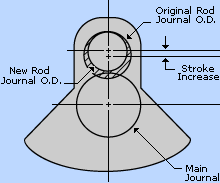
The width of the rod on the B series motors is identical to the rod width of the H series motors (except for the F23 and F20B) so when you offset grind the crank down to the B series diameter you are able to run B series rods. Offset grinding does not sacrifice the strength of the crank in any way whatso ever. The B series journal diameter has been more than adequite to feed over 900 HP with no problems and will more than handle the task of a built street H motor. Once the hournals are ground they are re heat trated and ultimately just as strong as they were from the factory. Keep in mind, Honda runs an even smaller journal on the F23 cranks along with a very narrow rod. IMO Id say the F23 crank would be less reliable under a high performance scenario.Also, the cost of offset grinding cranks isnt very expensive at all. Its generally about $250 which includes heat treating.
Last but not least, lets talk turbos. Lets use a SC61 for example. With the 98 stroke your right around 2330cc's using the stock 87mm bore. were talking a difference in 174cc's here. Spool is partially based on displacement so lets take that into consideration for a minute. Lets say that 174cc's gained you 800rpm in spool time. so fool boost went from 4500 on a H22 to 3700 with the bigger 98mm motor. redline of the bigger motor is 6500 in stock form so well use the stock numbers for now. You have a full poost range of 2800 rpm with the +174cc motor. Now look at the 4500-7400 range of the H22, were talking 2900 rpm.
thats just one point. Now lets talk cams with what i just listed frsh in mind. Lets use the H22 head for both blocks. You would need a custom cam to run with the larger stroke. The lowest Id say you can set the VTEC engagement with a stock cam Id say would be 4800 rom but even with that your creating a dip in the power band. That means your on the large lobe for a period of 1700 rpm. The large lobe is where power is going to be made. Now with the H22 you can keep the stock engagement point (5200) and run on the large lobe for 2200 rpm.
Either way you look at it the H22 is still at an advantage. You cant go higher with the 98 stroke because your creating breathing issues which will ultimately loose power. You cant run the large lobe too low without creating a huge dip in the power band.
You getting it now?
Member
Joined: Oct 2002
Posts: 4,768
Likes: 1
From: Flowery Branch, Ga
I can guarantee you that you will have to have custom "B-series style" rods made in order for them to work on this hybrid motor or you will have to start adding/subtracting material between the head and block, which is not going to be any easier. As I stated before, you should just have Pauter or someone make you some custom F23 rods. PirateMcFred has shown that the F23 rods w/ stock dimensions work easily in his motor.
It was either Pirate or Sam1 that was more educated on offset grinding than me, so I will let him step in to talk on that subject.
Now for turbo sizing: you are assuming that the stock F23 redline will be kept. As I said before we are talking about the F23 bottom end with the VTEC head. You will be revving the motor out to the stock H22's redline, 7200. Now, since more air is being pushed with the bigger bottom end, there will be more air flowed throught the head, into the combustion chamber, and out, and more power will be made. And since there will be more air being flowed throughout the entire powerband, a bigger turbo WILL be needed. Spool is mostly based on displacement, with Volumetric Efficiency also being mainly used. The VE will be very close between the two motors since the same head and cams will be used, so the displacement will be the determining factor in sizing.
Back to cams. You do not need a custom cam to run the bigger stroke; it will just make more power that way. Since more air is being flowed throughout the entire powerband, the F23 bottom end will reach the limits of each cam lobe much sooner than the H22 would. This means that the xover for VTEC will need to come down, and bigger lobes for VTEC will be needed to make use of the high redline. If you tune the cams CORRECTLY, there will be no dip in power at the xover point. With my H23 VTEC with only the 95mm bottom end, I needed to drop the VTEC xover point from 4900 to 4300 to even things out. With the F23 bottom end, I would imagine a xover point of 3700-4000 would be required on stock H22 cams. So assuming we're in the big cams from ~3800 up to ~7k or so, that gives us a usable powerband of 3400 RPM, as opposed to the H22's ~1700. I don't know about you, but I think that's a MUCH more usable powerband. Then, the cams are going to die off much quicker at the very top of the power band. Bigger cams will be needed to make use of the full potential of this hybrid motor.
I don't see these breathing issues you're talking about. Yes, piston speeds will increase with the bigger stroke, but it will not yet be a big enough problem to limit power. You have seen LS/VTEC's rev really high and make great power compared to their stock-configured VTEC breathren, haven't you? Obviously it works, although some people would like to say that it doesn't on paper. The rod/stroke ratio between the H23 and H22 is not that much different; the F23 is a bit more so, but it's not huge, IIRC.
You can say it doesn't work out on paper, but countless people have shown that these hybrid motors work through real-life application. I personally have built and run an H23 VTEC for my Prelude. On paper, your statements say that my motor should suck compared to a straight H22. Through racing, though, I have put many a VTEC Prelude to shame. And when you boost it, that gap is only going to get bigger, as the hybrid motor's characteristics will become even more evident when air is forced through it.
I wait for your rebuttal.
Modified by LudeyKrus at 5:02 PM 11/14/2004
It was either Pirate or Sam1 that was more educated on offset grinding than me, so I will let him step in to talk on that subject.
Now for turbo sizing: you are assuming that the stock F23 redline will be kept. As I said before we are talking about the F23 bottom end with the VTEC head. You will be revving the motor out to the stock H22's redline, 7200. Now, since more air is being pushed with the bigger bottom end, there will be more air flowed throught the head, into the combustion chamber, and out, and more power will be made. And since there will be more air being flowed throughout the entire powerband, a bigger turbo WILL be needed. Spool is mostly based on displacement, with Volumetric Efficiency also being mainly used. The VE will be very close between the two motors since the same head and cams will be used, so the displacement will be the determining factor in sizing.
Back to cams. You do not need a custom cam to run the bigger stroke; it will just make more power that way. Since more air is being flowed throughout the entire powerband, the F23 bottom end will reach the limits of each cam lobe much sooner than the H22 would. This means that the xover for VTEC will need to come down, and bigger lobes for VTEC will be needed to make use of the high redline. If you tune the cams CORRECTLY, there will be no dip in power at the xover point. With my H23 VTEC with only the 95mm bottom end, I needed to drop the VTEC xover point from 4900 to 4300 to even things out. With the F23 bottom end, I would imagine a xover point of 3700-4000 would be required on stock H22 cams. So assuming we're in the big cams from ~3800 up to ~7k or so, that gives us a usable powerband of 3400 RPM, as opposed to the H22's ~1700. I don't know about you, but I think that's a MUCH more usable powerband. Then, the cams are going to die off much quicker at the very top of the power band. Bigger cams will be needed to make use of the full potential of this hybrid motor.
I don't see these breathing issues you're talking about. Yes, piston speeds will increase with the bigger stroke, but it will not yet be a big enough problem to limit power. You have seen LS/VTEC's rev really high and make great power compared to their stock-configured VTEC breathren, haven't you? Obviously it works, although some people would like to say that it doesn't on paper. The rod/stroke ratio between the H23 and H22 is not that much different; the F23 is a bit more so, but it's not huge, IIRC.
You can say it doesn't work out on paper, but countless people have shown that these hybrid motors work through real-life application. I personally have built and run an H23 VTEC for my Prelude. On paper, your statements say that my motor should suck compared to a straight H22. Through racing, though, I have put many a VTEC Prelude to shame. And when you boost it, that gap is only going to get bigger, as the hybrid motor's characteristics will become even more evident when air is forced through it.
I wait for your rebuttal.
Modified by LudeyKrus at 5:02 PM 11/14/2004

Junior Member
Joined: Oct 2001
Posts: 398
Likes: 0
From: mpls, mn
Re: (LudeyKrus)
<TABLE WIDTH="90%" CELLSPACING=0 CELLPADDING=0 ALIGN=CENTER><TR><TD>Quote, originally posted by LudeyKrus »</TD></TR><TR><TD CLASS="quote">
Well stock H22's redline is only 7200.... </TD></TR></TABLE>
the redline is 7200 but the fuel cut is at about 7625 rpms.
Well stock H22's redline is only 7200....
</TD></TR></TABLE>the redline is 7200 but the fuel cut is at about 7625 rpms.
