


1994-1996 Integra Rs What Ecu and Obd?


Honda-Tech Member

Joined: Feb 2003
Posts: 5,643
Likes: 0
From: Searching...
 Re: 1994-1996 Integra Rs What Ecu and Obd? (CA6VTEC)
Originally Posted by CA6VTEC
<FONT COLOR="royalblue">94-95 OBD1 P73 Ecu
96+ OBD2 P73 Ecu
</FONT>
96+ OBD2 P73 Ecu
</FONT>
UM...Are you guys serious?
 How about there not being an obd1 P73 ecu...That would be like GOLD lol
  , or that fact that you guys may actually think that the R was produced PRE-August 1995 IN JAPAN!!!
  P73 ecus com as OBD2 and OBD2-b.
 HISTORY LESSON.
In Japan, in late 1995, the Integra R was introduced as a stablemate to the NSX-R. Given the price of the NSX-R, the Integra R was a inexpensive alternative to its potent super-car brethren. The Integra R was a Thoroughbred track car from is conception. During its first year, the Integra R received reviews like no other FF car had and its prowess on the track carried the R badge, well.
Given the similarities between the SI, Si vtec and the SIR-G in shape and design, the R was in a class all its own. The most noticeable feature is the updated fascia. Long, thin headlamps replace circle headlamps. And the front lip and rear spoiler are functional pieces, actually creating down force and reduced drag. Lightening of the car, in certain key areas of the chassis and needed chassis strengthening as well and when available, lighter products were used, such as an lighter Aluminum Radiator, smaller/lighter battery, and using thinner sound deadening "tar" in some places and not using any sound deadening in other places. Sunroofs, the rear-window wiper, and rear carpet were also cast aside and A/C and ABS became an option, not standard. Power windows were also ditched in favor of lighter-crank driven designs.
The interior gets the Faux Carbon Fiber treatment and Recaro bucket seats. The shifter is given a shorter throw and a heavier shift **** for a more direct "feel" when shifting. The dash is filled with orange lights, yellow needles and a 8500 rpm redline.
The suspension was also greatly improved upon. The spring rates were increased to 4.4 kg in the front and a linear spring was employed in the rear with rates from 2.5-4.4. Dampening was also increased, as well as sway diameter, 24mm in the front and up to 23 mm in the rear. Chassis braces were also equipped to the vehicle in weak points through out the car: a front strut bar, a rear-lower tie bar, a rear pan bar and a rear-strut bar. A unique four lug hub (4X114.3) was also utilized with a different lower control arm allowing the shock to bolt up inside the control arm. The rear pan of the R was also thicker in some places, compared to the SI, Si vtec and the SIR-G. Mainly the rear sub frame included the thickening.
The engine was the work of art in the beast. Generating an astonishing 197 Hp from 1.8 liters of displacement, and revving to an formula-like 8500 RPM, leaving most contenders at the starting line. From the Intake down, the entire motor shared very little with the Si vtec and the SIR-G except for the casting of the block. The intake tube diameter was increased as well as the throttle body size, TB size up to 62 mm. The intake manifold was changed to suite higher revs. Incorporating shorter/larger runners, it had the ability to flow the air required for the thirsty motor. The valves were modified to allow increased air flow, by reducing the size of the valve stem, near the bottom of the valve from 5.5 mm to 4.5, thus lightening the valve and having less mass in front of the air allowed for more efficient movement. The valve springs were upgraded by using the intake springs from the Si vtec and the SIR-G, and moving the valve springs to the exhaust side of the head. Stiffer springs were produced for the intake side as the lift of the cam was greater then that of the other B-series V-TEC cams. The retainers were also lighter. The head was then given a mild Port and Polish to increase airflow speed and density. The B18CR or C5 head casting only differ from the B16 casting in this one respect; that its PnP'd. From hear, the compression ratio sees a bump to 11:1, via larger domed pistons. The con-rods or (rods) are fully blueprinted with micro meters and the crank is counter-weighted, although heavier then the standard b18C, found in the Si vtec and the SIR-G, it allows the crank to achieve a better balance. The exhaust is said to be 2.5 inches but measures 2.38. From hear, the tranny also gets shorter gears and a LSD.
These specs apply to the 96 Spec R. The 98 spec received the five lug hubs, even shorter gearing and an increased power coming from a steal 4-1 header. Certain components in the rear suspension were also changed to give more control. The front lip and rear spoiler also receive attention, becoming even more functional. The axles are also enlarger to 36 mm and balanced. In 2000, the cam is also increased in size.
The US gets the R in 97 and in 98 with the only color available being Championship White. Sales end in 99 and begin again in 00 through 01 and Now offer Pheonix Yellow and Night Hawk Black Pearl (and as a dealer option other black colors). The USDM ITR more closely resembles the 98 spec R except for the Recaro Sport bucket seats ( USDM ITR seats are still made by Recaro) and the Front end. The usdm engine/tranny on the other hand is almost a mirror image of the 96 spec R with the cams being given the same enlarging in 00.
Oh yeah, the ecus also had more aggresive fuel/ignition maps. And those ecus are OBD2. ONLY

Modified by nathan atwell at 4:02 AM 10/9/2004


Trial User
Joined: Feb 2014
Posts: 2
Likes: 0
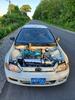
1996 integra seems to be missing an engine piece.. Please help!!!!
Hey so I have a 96 integra and I have been having some problems, I just realized that I migh be missing something in the engine. I seem other 96 integra engines and they don't match up. Please help
Honda-Tech Member
Joined: Sep 2012
Posts: 9,721
Likes: 13
From: Toronto,Ontario
Re: 1996 integra seems to be missing an engine piece.. Please help!!!!
you've literally bumped a 10 year old post pls create a new thread....

Thread
Thread Starter
Forum
Replies
Last Post
