


Struggling to understand bearing selection


Thread Starter
Honda-Tech Member
Joined: Jul 2016
Posts: 80
Likes: 0
 Struggling to understand bearing selection

I have a D16Y7 I'm rebuilding. I don't have a micrometer, but I'm just putting calipers on the crank journals to make sure nothing is totally hashed, and this is what I have.
The main bearing journals all seem to check to the 2.165in spec I found. The rod bearing journals measure 1.770 like they are supposed to.
The crank is stamped CBBC and 2,2,2,2,2 but I'm not sure what to take from that....
Last edited by t_can; Jun 16, 2017 at 05:34 PM.

Honda-Tech Member
Joined: Nov 2008
Posts: 867
Likes: 35
From: East Bay, CA
Re: Struggling to understand bearing selection
I feel your pain. I had the machine shop who honed block, polished crank order the bearings for me. I figured they know what they're doing. Gl

Hysterically Calm


Joined: Jan 2013
Posts: 10,439
Likes: 597
Re: Struggling to understand bearing selection
What you can do since this is going to be a back yard rebuild is pray and operate blindly that everything is within spec and use the same OEM bearings the markings dictate (by use of the FSM) and re-assemble.
You don't have the tools to accurately verify spec and you've ripped the motor apart so might as well continue with your blind rebuild.
What you need is a decent micrometer set and a .0001"/.001mm 1-6inch dial bore gauge (not some chinese knock off junk either) at the bare minimum.
Just that alone will run you about 500 bucks or more for decent entry level tools.
Best of luck to you.
Thread Starter
Honda-Tech Member
Joined: Jul 2016
Posts: 80
Likes: 0
Re: Struggling to understand bearing selection
You do realize bearing tolerance is in the 10,000ths range and even the best calipers accuracy is in the 1,000ths range +/- 1 or 2 with a best resolution of 5/10,000ths.
What you can do since this is going to be a back yard rebuild is pray and operate blindly that everything is within spec and use the same OEM bearings the markings dictate (by use of the FSM) and re-assemble.
You don't have the tools to accurately verify spec and you've ripped the motor apart so might as well continue with your blind rebuild.
What you need is a decent micrometer set and a .0001"/.001mm 1-6inch dial bore gauge (not some chinese knock off junk either) at the bare minimum.
Just that alone will run you about 500 bucks or more for decent entry level tools.
Best of luck to you.
What you can do since this is going to be a back yard rebuild is pray and operate blindly that everything is within spec and use the same OEM bearings the markings dictate (by use of the FSM) and re-assemble.
You don't have the tools to accurately verify spec and you've ripped the motor apart so might as well continue with your blind rebuild.
What you need is a decent micrometer set and a .0001"/.001mm 1-6inch dial bore gauge (not some chinese knock off junk either) at the bare minimum.
Just that alone will run you about 500 bucks or more for decent entry level tools.
Best of luck to you.
Do I just order standard size bearings, or is it more complicated than that?
Hysterically Calm
Joined: Jan 2013
Posts: 10,439
Likes: 597
Re: Struggling to understand bearing selection
My point was that bearing specs are ten thousandths, not 1 or 2 thousandths. Massive difference between .001" and .0001".
But to do it blind like you are doing, there is a table in the factory service manual that correlates to the markings of the crank and the rods, and then again for the crank and the block. With that table and those markings it tells you which color bearing to order. Honda I believe has 4 bearing sizes to order from for each motor.
This also assumes you've had zero wear on the journals, rods and mains.
If you had the right tools, you could measure precisely and if you needed to mix bearing colors, you could and get an exact spec oil clearance.
But since you can't....... You are actually assembling the motor blind no matter how many times you measured with a caliper.
But to do it blind like you are doing, there is a table in the factory service manual that correlates to the markings of the crank and the rods, and then again for the crank and the block. With that table and those markings it tells you which color bearing to order. Honda I believe has 4 bearing sizes to order from for each motor.
This also assumes you've had zero wear on the journals, rods and mains.
If you had the right tools, you could measure precisely and if you needed to mix bearing colors, you could and get an exact spec oil clearance.
But since you can't....... You are actually assembling the motor blind no matter how many times you measured with a caliper.
Thread Starter
Honda-Tech Member
Joined: Jul 2016
Posts: 80
Likes: 0
Re: Struggling to understand bearing selection
I don't intend to be a dick, but I'm not looking to be told how I'm doing it wrong. I'd like some information on how to properly identify the bearing size I need based on actual measurements of the crank and rods. All I've been able to find is a guide on how to figure out the original bearing colors, and I don't fully follow that either. But I do know it's only useful if there is no wear on the crank.
Whatever I get is going to be plastigauged, but I'd like something a little more precise than guess and check.
Whatever I get is going to be plastigauged, but I'd like something a little more precise than guess and check.
Hysterically Calm
Joined: Jan 2013
Posts: 10,439
Likes: 597
Re: Struggling to understand bearing selection
And I don't mean to be a dick, but I already told you twice before, the information you are requesting is in the factory service manual (FSM).
or T/L;D/R
Look for the FSM, what you need is in there.
And this is what I'm pointing out, your are not actually getting accurate measurements with your methods so you can't actually get bearing sizes based on your measurements.
But the FSM will show you all of that.
Once again, find the helmsinc.com manual (FSM) for your car and engine.
http://lmgtfy.com/?q=96-00+civic+fsm
It's getting harder to find, but a little persistence will pay off. And it will lay it out for you in a simple and easy to follow format.
or T/L;D/R
Look for the FSM, what you need is in there.
And this is what I'm pointing out, your are not actually getting accurate measurements with your methods so you can't actually get bearing sizes based on your measurements.
But the FSM will show you all of that.
Once again, find the helmsinc.com manual (FSM) for your car and engine.
http://lmgtfy.com/?q=96-00+civic+fsm
It's getting harder to find, but a little persistence will pay off. And it will lay it out for you in a simple and easy to follow format.
Trending Topics
Thread Starter
Honda-Tech Member
Joined: Jul 2016
Posts: 80
Likes: 0
Re: Struggling to understand bearing selection
I already have a helms manual, it doesn't tell you what the bearing thicknesses are. And I've called a bunch of Honda dealerships and even Honda corporate. Nobody has the information I need.
In this thread, on the 3rd post, someone posted the info I need for b series. I need the same stuff for D series.
http://www.d-series.org/forums/engine-building/84248-d-series-...
I ordered all he tools I need 3 days ago. So chill out telling me I can't do this. I just need the tools to get here and and the information I asked for, if anyone knows where it is.
In this thread, on the 3rd post, someone posted the info I need for b series. I need the same stuff for D series.
http://www.d-series.org/forums/engine-building/84248-d-series-...
I ordered all he tools I need 3 days ago. So chill out telling me I can't do this. I just need the tools to get here and and the information I asked for, if anyone knows where it is.
Thread Starter
Honda-Tech Member
Joined: Jul 2016
Posts: 80
Likes: 0
Re: Struggling to understand bearing selection
Worse, the color chart information in the manual doesn't correspond to the parts that are available at Honda. Yet my chart matches all the carts I've seen online.
Hysterically Calm
Joined: Jan 2013
Posts: 10,439
Likes: 597
Re: Struggling to understand bearing selection
I already have a helms manual, it doesn't tell you what the bearing thicknesses are. And I've called a bunch of Honda dealerships and even Honda corporate. Nobody has the information I need.
In this thread, on the 3rd post, someone posted the info I need for b series. I need the same stuff for D series.
http://www.d-series.org/forums/engine-building/84248-d-series-...
I ordered all he tools I need 3 days ago. So chill out telling me I can't do this. I just need the tools to get here and and the information I asked for, if anyone knows where it is.
In this thread, on the 3rd post, someone posted the info I need for b series. I need the same stuff for D series.
http://www.d-series.org/forums/engine-building/84248-d-series-...
I ordered all he tools I need 3 days ago. So chill out telling me I can't do this. I just need the tools to get here and and the information I asked for, if anyone knows where it is.
No where did I say you can't do this but if that's how you feel, that's on you.
I said the method you were describing won't work for what you were asking. If you've ordered the proper tools to get accurate measurements then I don't think you will have too much problem.
As for the chart not matching your dealership, are you not in the USA? That could be a little bit of challenge. Canadian Honda a bit different than USA Honda and the helms manual found on line is based on USA as most of the software used up here in Canada.
As for the D series bearing thickness being recorded, I don't think too many people fiddle with the D's so am not sure if anyone shared or even bothered ordering all the colors to measure.
USA Honda parts:
| 18 | 19 | 20 | |||
| 13211-P2F-A01 | 13321-PK1-752 | 13321-PK1-752 | |||
| Bearing A, Connecting Rod (Blue) (Glacier Vandervell) | Bearing A, Main (Blue) (Taiho) | Bearing A, Main (Blue) (Taiho) | |||
| Require Quantity: | 8 | Require Quantity: | 5 | Require Quantity: | 5 |
| Package Quantity: | 1 | Package Quantity: | 1 | Package Quantity: | 1 |
| Replaced by: | 13211-PG6-003 | -- | -- | ||
| $15.72 | -- | -- | |||
| $11.03 | |||||
| 18 | 19 | 20 | |||
| 13211-PG6-003 | 13322-P2F-A01 | 13322-P2F-A01 | |||
| Bearing A, Connecting Rod (Blue) (Daido) | Bearing B, Main (Black) (Glacier Vandervell) | Bearing B, Main (Black) (Glacier Vandervell) | |||
| Require Quantity: | 8 | Require Quantity: | 5 | Require Quantity: | 5 |
| Package Quantity: | 1 | Package Quantity: | 1 | Package Quantity: | 1 |
| $15.72 | $16.23 | $16.23 | |||
| $11.03 | $11.40 | $11.40 | |||
| 18 | 19 | 20 | |||
| 13212-PG6-003 | 13322-PK1-752 | 13322-PK1-752 | |||
| Bearing B, Connecting Rod (Black) (Daido) | Bearing B, Main (Black) (Daido) | Bearing B, Main (Black) (Daido) | |||
| Require Quantity: | 8 | Require Quantity: | 5 | Require Quantity: | 5 |
| Package Quantity: | 1 | Package Quantity: | 1 | Package Quantity: | 1 |
| $15.72 | $16.23 | $16.23 | |||
| $11.03 | $11.40 | $11.40 | |||
| 18 | 19 | 20 | |||
| 13213-P2F-A01 | 13323-P2F-A01 | 13323-P2F-A01 | |||
| Bearing C, Connecting Rod (Brown) (Glacier Vandervell) | Bearing C, Main (Brown) (Glacier Vandervell) | Bearing C, Main (Brown) (Glacier Vandervell) | |||
| Require Quantity: | 8 | Require Quantity: | 5 | Require Quantity: | 5 |
| Package Quantity: | 1 | Package Quantity: | 1 | Package Quantity: | 1 |
| $15.72 | $16.23 | $16.23 | |||
| $11.03 | $11.40 | $11.40 | |||
| 18 | 19 | 20 | |||
| 13213-PG6-003 | 13323-PK1-752 | 13323-PK1-752 | |||
| Bearing C, Connecting Rod (Brown) (Daido) | Bearing C, Main (Brown) (Daido) | Bearing C, Main (Brown) (Daido) | |||
| Require Quantity: | 8 | Require Quantity: | 5 | Require Quantity: | 5 |
| Package Quantity: | 1 | Package Quantity: | 1 | Package Quantity: | 1 |
| $15.72 | $16.23 | $16.23 | |||
| $11.03 | $11.40 | $11.40 | |||
| 18 | 19 | 20 | |||
| 13214-PG6-003 | 13324-PK1-752 | 13324-PK1-752 | |||
| Bearing D, Connecting Rod (Green) (Daido) | Bearing D, Main (Green) (Daido) | Bearing D, Main (Green) (Daido) | |||
| Require Quantity: | 8 | Require Quantity: | 5 | Require Quantity: | 5 |
| Package Quantity: | 1 | Package Quantity: | 1 | Package Quantity: | 1 |
| $15.72 | $16.28 | $16.28 | |||
| $11.03 | $11.43 | $11.43 | |||
| 18 | 19 | 20 | |||
| 13215-PG6-003 | 13325-PK1-752 | 13325-PK1-752 | |||
| Bearing E, Connecting Rod (Yellow) (Daido) | Bearing E, Main | Bearing E, Main | |||
| Require Quantity: | 8 | Require Quantity: | 5 | Require Quantity: | 5 |
| Package Quantity: | 1 | Package Quantity: | 1 | Package Quantity: | 1 |
| $15.72 | $14.67 | $14.67 | |||
| $11.03 | $10.30 | $10.30 | |||
| 18 | 19 | 20 | |||
| 13216-PG6-003 | 13326-P2F-A01 | 13326-P2F-A01 | |||
| Bearing F, Connecting Rod (Pink) (Daido) | Bearing F, Main (Pink) (Glacier Vandervell) | Bearing F, Main (Pink) (Glacier Vandervell) | |||
| Require Quantity: | 8 | Require Quantity: | 5 | Require Quantity: | 5 |
| Package Quantity: | 1 | Package Quantity: | 1 | Package Quantity: | 1 |
| $15.72 | $15.62 | $15.62 | |||
| $11.03 | $10.96 | $10.96 | |||
| Limited Availability | Limited Availability | ||||
| 18 | 19 | 20 | |||
| 13217-PG6-003 | 13326-PK1-752 | 13326-PK1-752 | |||
| Bearing G, Connecting Rod (Red) (Daido) | Bearing F, Main (Pink) (Daido) | Bearing F, Main (Pink) (Daido) | |||
| Require Quantity: | 8 | Require Quantity: | 5 | Require Quantity: | 5 |
| Package Quantity: | 1 | Package Quantity: | 1 | Package Quantity: | 1 |
| $15.72 | $15.62 | $15.62 | |||
| $11.03 | $10.96 | $10.96 | |||
| Limited Availability | Limited Availability | ||||
| 19 | 20 | ||||
| 13327-P2F-A01 | 13327-P2F-A01 | ||||
| Bearing G, Main (Red) (Glacier Vandervell) | Bearing G, Main (Red) (Glacier Vandervell) | ||||
| Require Quantity: | 5 | Require Quantity: | 5 | ||
| Package Quantity: | 1 | Package Quantity: | 1 | ||
| Replaced by: | 13327-PK1-752 | Replaced by: | 13327-PK1-752 | ||
| $14.67 | $14.67 | ||||
| $10.30 | $10.30 | ||||
| 19 | 20 | ||||
| 13327-PK1-752 | 13327-PK1-752 | ||||
| Bearing G, Main | Bearing G, Main | ||||
| Require Quantity: | 5 | Require Quantity: | 5 | ||
| Package Quantity: | 1 | Package Quantity: | 1 | ||
| $14.67 | $14.67 | ||||
| $10.30 | $10.30 |
I'm not sure what your challenge is beyond waiting for tools and ordering the bearing colors that match up to your crank/rod/main markings.
You might want to read post #6 of this thread on D series.org that provides you the piece I think you may be looking for, same thread you linked but a touch further in.
http://www.d-series.org/forums/engin...-searched.html
Thread Starter
Honda-Tech Member
Joined: Jul 2016
Posts: 80
Likes: 0
Re: Struggling to understand bearing selection
USA
I have a 2C and 2B stamped crank/rods for the rods.
I have 2C and 2B stamped crank/block for the mains.
You'll see in the chart, this gives C/B green and yellow rod bearings. Same for the mains.
As you can see from the parts list you posted, no such part exists. There isn't even such a thing as a yellow main bearing. The colors that are there, don't match the letters!
How does one even approach that!?
I have a 2C and 2B stamped crank/rods for the rods.
I have 2C and 2B stamped crank/block for the mains.
You'll see in the chart, this gives C/B green and yellow rod bearings. Same for the mains.
As you can see from the parts list you posted, no such part exists. There isn't even such a thing as a yellow main bearing. The colors that are there, don't match the letters!
How does one even approach that!?
Hysterically Calm
Joined: Jan 2013
Posts: 10,439
Likes: 597
Re: Struggling to understand bearing selection
I suspect the Bearing E is yellow just not indicated in the list. As well there is also a bearing G for the mains and that goes beyond the base colors and does not indicate a color but I suspect has a color on the side.
If you order your bearings from the Dealer, you can see the color on them and if it's not the correct color, you can return them.
I think the challenge lies in the fact these cars are 20 plus years old so the database loses tidbits of info as they replace part numbers with new mfg parts.
If you order your bearings from the Dealer, you can see the color on them and if it's not the correct color, you can return them.
I think the challenge lies in the fact these cars are 20 plus years old so the database loses tidbits of info as they replace part numbers with new mfg parts.
Hysterically Calm
Joined: Jan 2013
Posts: 10,439
Likes: 597
Re: Struggling to understand bearing selection
I see now the other piece you are getting confused on. The bearing letters in the bearing list do not have anything to do with the letters in the table.
The table letters have to do with a specific measurement. While the letters of the bearings in the bearing list has to do with colors and sequential order. They are not directly related.
Also a thought occurred to me, Bearing G on the mains might be the new Blue that is discontinued at the top of the list.
So simply put, Bearing E which I believe is yellow only correlates to your 2B markings by color, the bearing letter of E has nothing to do with the table. It's to do with an internal Honda Database to indicate a specific thickness bearing. And for our purposes, the thickness is most likely yellow.
I hope this helps you.
The table letters have to do with a specific measurement. While the letters of the bearings in the bearing list has to do with colors and sequential order. They are not directly related.
Also a thought occurred to me, Bearing G on the mains might be the new Blue that is discontinued at the top of the list.
So simply put, Bearing E which I believe is yellow only correlates to your 2B markings by color, the bearing letter of E has nothing to do with the table. It's to do with an internal Honda Database to indicate a specific thickness bearing. And for our purposes, the thickness is most likely yellow.
I hope this helps you.

Honda-Tech Member
Joined: Feb 2014
Posts: 415
Likes: 0
From: Atlanta, GA
Re: Struggling to understand bearing selection
Hysterically Calm
Joined: Jan 2013
Posts: 10,439
Likes: 597
Re: Struggling to understand bearing selection
And probably should add the anvil set too:
7PC Micrometer Anvil Set
Always wondered if Shars was a quality beginner set.
And the bore gauge, they are out of stock but it's not badly priced:
http://www.shars.com/products/measur...re-gage-0001-1
7PC Micrometer Anvil Set
Always wondered if Shars was a quality beginner set.
And the bore gauge, they are out of stock but it's not badly priced:
http://www.shars.com/products/measur...re-gage-0001-1

Honda-Tech Member

Joined: Mar 2004
Posts: 4,826
Likes: 37
From: Looking for SloMofo....
Re: Struggling to understand bearing selection
Plasti-gauge is accurate enough. Its been used for decades and is still is used today.
Mitutoyo and Fowler and considered some of the best mic sets in the automotive industry(dont buy from ebay,lot of knock offs)
Letters have been stamped on the end of the block as a code for the size of each of the 5 main journal bores. They are in order. Use your helms to identify which is the flywheel side and which is the pulley side.
Use them, and the numbers stamped on the crankshaft (codes for main journal size), to choose the correct bearings.
Finally, your initial measurements indicate you are good to go. I wouldn't look to hard into this. While there is some precision work involved,this is an assembly line engine,and variances are to be expected.
Mitutoyo and Fowler and considered some of the best mic sets in the automotive industry(dont buy from ebay,lot of knock offs)
Letters have been stamped on the end of the block as a code for the size of each of the 5 main journal bores. They are in order. Use your helms to identify which is the flywheel side and which is the pulley side.
Use them, and the numbers stamped on the crankshaft (codes for main journal size), to choose the correct bearings.
Finally, your initial measurements indicate you are good to go. I wouldn't look to hard into this. While there is some precision work involved,this is an assembly line engine,and variances are to be expected.

Honda-Tech Member

Joined: Jan 2013
Posts: 10,027
Likes: 1,234
From: The South - Roll Tide !!!
Re: Struggling to understand bearing selection
t can,
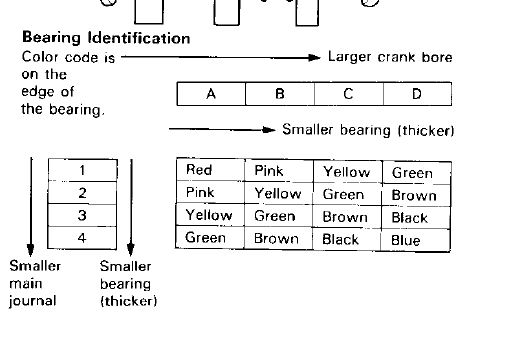
I am not sure you are creating the proper combination of letters and numbers to help identify the proper color for main and rod bearings. Each color is selected by a two digit code... a letter followed by a number, which then corresponds with a color code in the chart you see above. To get the codes for the main bores in the block, you need to first find the stamping on the engine block (the location is in the Helm's Manual) with the five letters (sometimes numbers - 1 for A, 2 for B, etc) and the order in which they are stamped. The main cap closest to the oil pump is the #1 cap... closest to the flywheel is #5. Then find the five numbers located on the crankshaft (again, the location is noted in the manual) for the main journal diameter. Starting at the first main journal location, combine the block letter and crankshaft number together to arrive at the color code which corresponds to what you see in the chart above.
To get the rod bearings assessed, simply use the four letters found on the crankshaft for the rod journal diameters with the number stamped at the split of any one of the connecting rods that you intend to use at that location... again, giving you a two digit letter+number code to correspond to a bearing color in the chart. Aftermarket rods are typically intended to be like a "2" stamping... but measuring will give you a better idea since the Helm's manual has a rod journal range listed in the spec section at the front of the book. This gives you a starting point. Now, you can argue whether plasti-gauge or using a micrometer or precise measuring equipment is best... fine... so use the method that makes you happy. One you know the oil clearance with the bearings chosen... if the clearance falls within spec for what your intended use is... use it. IF you need to alter the oil clearance +/-... it is generally accepted that the change from one color to the next in the chart is .0002" (two ten thousandths). You will not find a posted thickness of each bearing color because there are multiple manufacturers and the production variances can be as high as +/- .0003"... meaning you will simply have to DO instead of calculate and then buy once and assemble (which seems like what you are trying to do). I know this isn't what you wanted to hear... but it IS the real answer.
In short... you have seven colors... the thickest is BLUE... the thinnest is RED... and you have five more in between. The order is Blue, Black, Brown, Green, Yellow, Pink and Red. So, from the Green in the middle, moving toward Blue tightens your oil clearance and moving toward Red loosens your oil clearance.
Good luck.
I am not sure you are creating the proper combination of letters and numbers to help identify the proper color for main and rod bearings. Each color is selected by a two digit code... a letter followed by a number, which then corresponds with a color code in the chart you see above. To get the codes for the main bores in the block, you need to first find the stamping on the engine block (the location is in the Helm's Manual) with the five letters (sometimes numbers - 1 for A, 2 for B, etc) and the order in which they are stamped. The main cap closest to the oil pump is the #1 cap... closest to the flywheel is #5. Then find the five numbers located on the crankshaft (again, the location is noted in the manual) for the main journal diameter. Starting at the first main journal location, combine the block letter and crankshaft number together to arrive at the color code which corresponds to what you see in the chart above.
To get the rod bearings assessed, simply use the four letters found on the crankshaft for the rod journal diameters with the number stamped at the split of any one of the connecting rods that you intend to use at that location... again, giving you a two digit letter+number code to correspond to a bearing color in the chart. Aftermarket rods are typically intended to be like a "2" stamping... but measuring will give you a better idea since the Helm's manual has a rod journal range listed in the spec section at the front of the book. This gives you a starting point. Now, you can argue whether plasti-gauge or using a micrometer or precise measuring equipment is best... fine... so use the method that makes you happy. One you know the oil clearance with the bearings chosen... if the clearance falls within spec for what your intended use is... use it. IF you need to alter the oil clearance +/-... it is generally accepted that the change from one color to the next in the chart is .0002" (two ten thousandths). You will not find a posted thickness of each bearing color because there are multiple manufacturers and the production variances can be as high as +/- .0003"... meaning you will simply have to DO instead of calculate and then buy once and assemble (which seems like what you are trying to do). I know this isn't what you wanted to hear... but it IS the real answer.
In short... you have seven colors... the thickest is BLUE... the thinnest is RED... and you have five more in between. The order is Blue, Black, Brown, Green, Yellow, Pink and Red. So, from the Green in the middle, moving toward Blue tightens your oil clearance and moving toward Red loosens your oil clearance.
Good luck.
Honda-Tech Member
Joined: Feb 2014
Posts: 415
Likes: 0
From: Atlanta, GA
Re: Struggling to understand bearing selection
And probably should add the anvil set too:
7PC Micrometer Anvil Set
Always wondered if Shars was a quality beginner set.
And the bore gauge, they are out of stock but it's not badly priced:
1.4-6" Dial Bore Gage .0001"
7PC Micrometer Anvil Set
Always wondered if Shars was a quality beginner set.
And the bore gauge, they are out of stock but it's not badly priced:
1.4-6" Dial Bore Gage .0001"
I would however buy a mitutoyo digital caliper over the cheap import ones, feels substantially more firm.
I don't buy a ton of stuff from Shars since it basically is chinese stuff with better QC but if it doesn't spin, I usually don't have a problem with it. I've bought plenty of lathe aloris style toolholders, couple of indicator bases, parallel sets, 1-2-3 blocks, v-blocks, etc.
Thread Starter
Honda-Tech Member
Joined: Jul 2016
Posts: 80
Likes: 0
Re: Struggling to understand bearing selection
t can,
I am not sure you are creating the proper combination of letters and numbers to help identify the proper color for main and rod bearings. Each color is selected by a two digit code... a letter followed by a number, which then corresponds with a color code in the chart you see above. To get the codes for the main bores in the block, you need to first find the stamping on the engine block (the location is in the Helm's Manual) with the five letters (sometimes numbers - 1 for A, 2 for B, etc) and the order in which they are stamped. The main cap closest to the oil pump is the #1 cap... closest to the flywheel is #5. Then find the five numbers located on the crankshaft (again, the location is noted in the manual) for the main journal diameter. Starting at the first main journal location, combine the block letter and crankshaft number together to arrive at the color code which corresponds to what you see in the chart above.
To get the rod bearings assessed, simply use the four letters found on the crankshaft for the rod journal diameters with the number stamped at the split of any one of the connecting rods that you intend to use at that location... again, giving you a two digit letter+number code to correspond to a bearing color in the chart. Aftermarket rods are typically intended to be like a "2" stamping... but measuring will give you a better idea since the Helm's manual has a rod journal range listed in the spec section at the front of the book. This gives you a starting point. Now, you can argue whether plasti-gauge or using a micrometer or precise measuring equipment is best... fine... so use the method that makes you happy. One you know the oil clearance with the bearings chosen... if the clearance falls within spec for what your intended use is... use it. IF you need to alter the oil clearance +/-... it is generally accepted that the change from one color to the next in the chart is .0002" (two ten thousandths). You will not find a posted thickness of each bearing color because there are multiple manufacturers and the production variances can be as high as +/- .0003"... meaning you will simply have to DO instead of calculate and then buy once and assemble (which seems like what you are trying to do). I know this isn't what you wanted to hear... but it IS the real answer.
In short... you have seven colors... the thickest is BLUE... the thinnest is RED... and you have five more in between. The order is Blue, Black, Brown, Green, Yellow, Pink and Red. So, from the Green in the middle, moving toward Blue tightens your oil clearance and moving toward Red loosens your oil clearance.
Good luck.
I am not sure you are creating the proper combination of letters and numbers to help identify the proper color for main and rod bearings. Each color is selected by a two digit code... a letter followed by a number, which then corresponds with a color code in the chart you see above. To get the codes for the main bores in the block, you need to first find the stamping on the engine block (the location is in the Helm's Manual) with the five letters (sometimes numbers - 1 for A, 2 for B, etc) and the order in which they are stamped. The main cap closest to the oil pump is the #1 cap... closest to the flywheel is #5. Then find the five numbers located on the crankshaft (again, the location is noted in the manual) for the main journal diameter. Starting at the first main journal location, combine the block letter and crankshaft number together to arrive at the color code which corresponds to what you see in the chart above.
To get the rod bearings assessed, simply use the four letters found on the crankshaft for the rod journal diameters with the number stamped at the split of any one of the connecting rods that you intend to use at that location... again, giving you a two digit letter+number code to correspond to a bearing color in the chart. Aftermarket rods are typically intended to be like a "2" stamping... but measuring will give you a better idea since the Helm's manual has a rod journal range listed in the spec section at the front of the book. This gives you a starting point. Now, you can argue whether plasti-gauge or using a micrometer or precise measuring equipment is best... fine... so use the method that makes you happy. One you know the oil clearance with the bearings chosen... if the clearance falls within spec for what your intended use is... use it. IF you need to alter the oil clearance +/-... it is generally accepted that the change from one color to the next in the chart is .0002" (two ten thousandths). You will not find a posted thickness of each bearing color because there are multiple manufacturers and the production variances can be as high as +/- .0003"... meaning you will simply have to DO instead of calculate and then buy once and assemble (which seems like what you are trying to do). I know this isn't what you wanted to hear... but it IS the real answer.
In short... you have seven colors... the thickest is BLUE... the thinnest is RED... and you have five more in between. The order is Blue, Black, Brown, Green, Yellow, Pink and Red. So, from the Green in the middle, moving toward Blue tightens your oil clearance and moving toward Red loosens your oil clearance.
Good luck.

Hysterically Calm
Joined: Jan 2013
Posts: 10,439
Likes: 597
Re: Struggling to understand bearing selection
Simply, it's to be sure you didn't make an error in your measurements with precision measuring tools (bore gauge and micrometer).
Honda-Tech Member
Joined: Jan 2013
Posts: 10,027
Likes: 1,234
From: The South - Roll Tide !!!
Re: Struggling to understand bearing selection
Every engine builder I have ever spoken to has always indicated plastigauge is used as a second opinion tool not primary as it's not precise enough to rely on solely.
Simply, it's to be sure you didn't make an error in your measurements with precision measuring tools (bore gauge and micrometer).
Simply, it's to be sure you didn't make an error in your measurements with precision measuring tools (bore gauge and micrometer).
Hysterically Calm
Joined: Jan 2013
Posts: 10,439
Likes: 597
Re: Struggling to understand bearing selection
This is true for the seasoned engine builder TomCat39, but there are WAY too many factors that need to be considered as well as factored in for proper measurements. Ambient temperature variance is huge... also, did you consider the fact that simply holding a bearing half in your hand for five minutes while you are nervously taking measurements will alter the dimensions of the bearing three or four tenths ??? Simply put: POOR precise measuring is no better than plasti-gauge.
As such, the next attempt I do of measuring my block(s) I plan on wearing work gloves to prevent heat transfer.
Honda-Tech Member
Joined: Mar 2004
Posts: 4,826
Likes: 37
From: Looking for SloMofo....
Re: Struggling to understand bearing selection
Every engine builder I have ever spoken to has always indicated plastigauge is used as a second opinion tool not primary as it's not precise enough to rely on solely.
Simply, it's to be sure you didn't make an error in your measurements with precision measuring tools (bore gauge and micrometer).
Simply, it's to be sure you didn't make an error in your measurements with precision measuring tools (bore gauge and micrometer).
However it was done for years and years in the bay. and almost ever manufacturer indicated that plastigauge was precise enough for measurements and that was how it was done. Millions of engines have been rebuilt using plastigauge, with out any issues. There is a tolerance allowed.
For what its worth, I know quite a few engineers, master technicians and transmission rebuilders that Ive met over the past 20 years.
Ironically I dont know 1 professional engine rebuilder., I mention that because you indicate that youve spoken to more than one and Ive got to wonder what type of engines they are building that plastigauge isnt good enough......
Last edited by DCFIVER; Jun 26, 2017 at 07:41 AM.